On this page
First, a prediction. You want root 2 correct to six decimals (1.414214), starting from the lazy guess 1 and repeating one rule. How many rounds will it take: 3, 6, 10 or 20? Write your number down.
What is the Babylonian method for square roots?
The rule is: divide the number by your guess, then average the guess and the result. In symbols, the next guess is (x + S/x) / 2, which is how the overview of square root algorithms on Wikipedia writes Heron's method. The same page notes that it is Newton's method applied to x² − S = 0.
Why it works: if your guess x is too big, S/x is too small, and the true root sits between them. Averaging lands you closer.
A clear early written description comes from Heron of Alexandria, who lived around AD 10 to 75, in his *Metrica*. The MacTutor biography of Heron quotes his example for the square root of 720: divide 720 by 27 (the root of 729) to get 26⅔, add 27, halve, and get 26⅚. Its square is 720 1/36, and Heron notes you can repeat the step to get closer.
Did the Babylonians really use it?
The name comes from a clay tablet. YBC 7289, held in the Yale Babylonian Collection and dated to about 1800 to 1600 BC, gives root 2 as 1;24,51,10 in base 60, which is about 1.41421296 (YBC 7289). That value is off by less than one part in two million. David Fowler and Eleanor Robson studied the tablet in detail in a 1998 paper in Historia Mathematica.
How the scribes got that number is unknown. MacTutor's article on Babylonian mathematics says several authors conjecture a method equivalent to Heron's, and suggests a simpler alternative: average one guess that is too high with one that is too low. As the article on the square root of 2 notes, there is no direct evidence, so "Babylonian method" is a modern label.
How many rounds does it take to find root 2 to six decimals?
Start at 1 and keep the fractions exact. The square root of 2 page lists the same sequence:
Round 1: (1 + 2/1) / 2 = 3/2 = 1.5. The error is about 0.086.
Round 2: (3/2 + 4/3) / 2 = 17/12 ≈ 1.416667. The error is about 0.0025.
Round 3: (17/12 + 24/17) / 2 = 577/408 ≈ 1.4142157. The error is about 0.0000021.
Round 4: (577/408 + 816/577) / 2 = 665857/470832 ≈ 1.41421356237. The error is about 0.0000000000016.
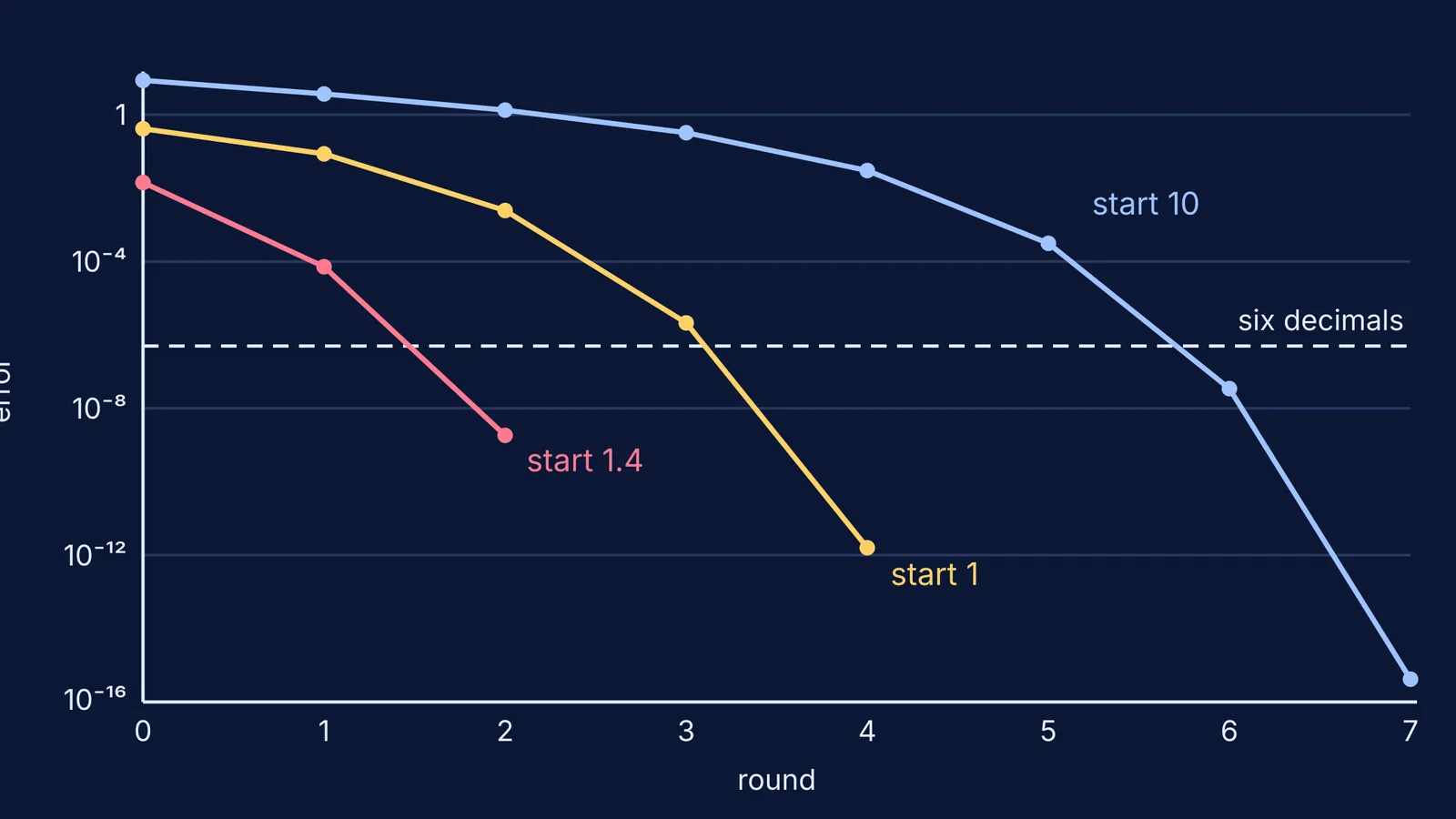
That page gives root 2 as 1.414213562. The answer is four rounds. Round 3 is tempting, but 1.4142157 rounds to 1.414216, so the sixth decimal is wrong. Round 4 is right to eleven decimals.
Count the correct decimals after each round: 0, 2, 5, 11. That is the signature of quadratic convergence: the number of correct digits roughly doubles with each round, as the square root algorithms overview puts it.
You can see why with one line of algebra. Write your guess as x = r + e, where r is the true root and e is the error. Then (x + r²/x) / 2 − r = (x − r)² / (2x) = e² / (2x). The new error is the old error squared, then divided by roughly 2.8. An error of 0.0025 squared is about 0.000006, and dividing by 2.8 gives the 0.0000021 you saw in round 3.
What if your first guess is bad?
Apply the same rule from the square root algorithms overview to other starts. From 10, the guesses run 5.1, 2.746, 1.737, 1.444, 1.41453, 1.4142136: six rounds. While the guess is far too big, S/x is tiny, so each round only roughly halves it. Digit-doubling starts once you are close.
Start from 1.4 (since 1.4² = 1.96) and round 1 gives 1.4142857; round 2 brings the error to about 0.000000002. Two rounds. A good first estimate saves work, and estimating square roots without a calculator shows quick ways to get one.
How can you try it yourself in ten minutes?
Write down your predictions for root 2 starting from 1, from 10 and from 1.4.
On a scientific calculator, enter the starting guess, then type (Ans + 2/Ans) / 2 and press = again and again.
Record each value and its error against 1.41421356.
Count the correct decimals each round and check whether they roughly double.
Repeat Heron's example: root 720 from 27.
To see where root 2 sits first, read how to locate root 2 on a number line; for another predict-then-check approximation, try how many Taylor terms match sine.
The Fermi Simulation Lab has interactive simulations for ideas that are easier to see than to read. If the error-squaring step trips you up, the Fermi Problem Library has worked problems with a step-by-step solver that explains the reasoning rather than printing an answer.
Now compare your prediction with what you found.