

On this page
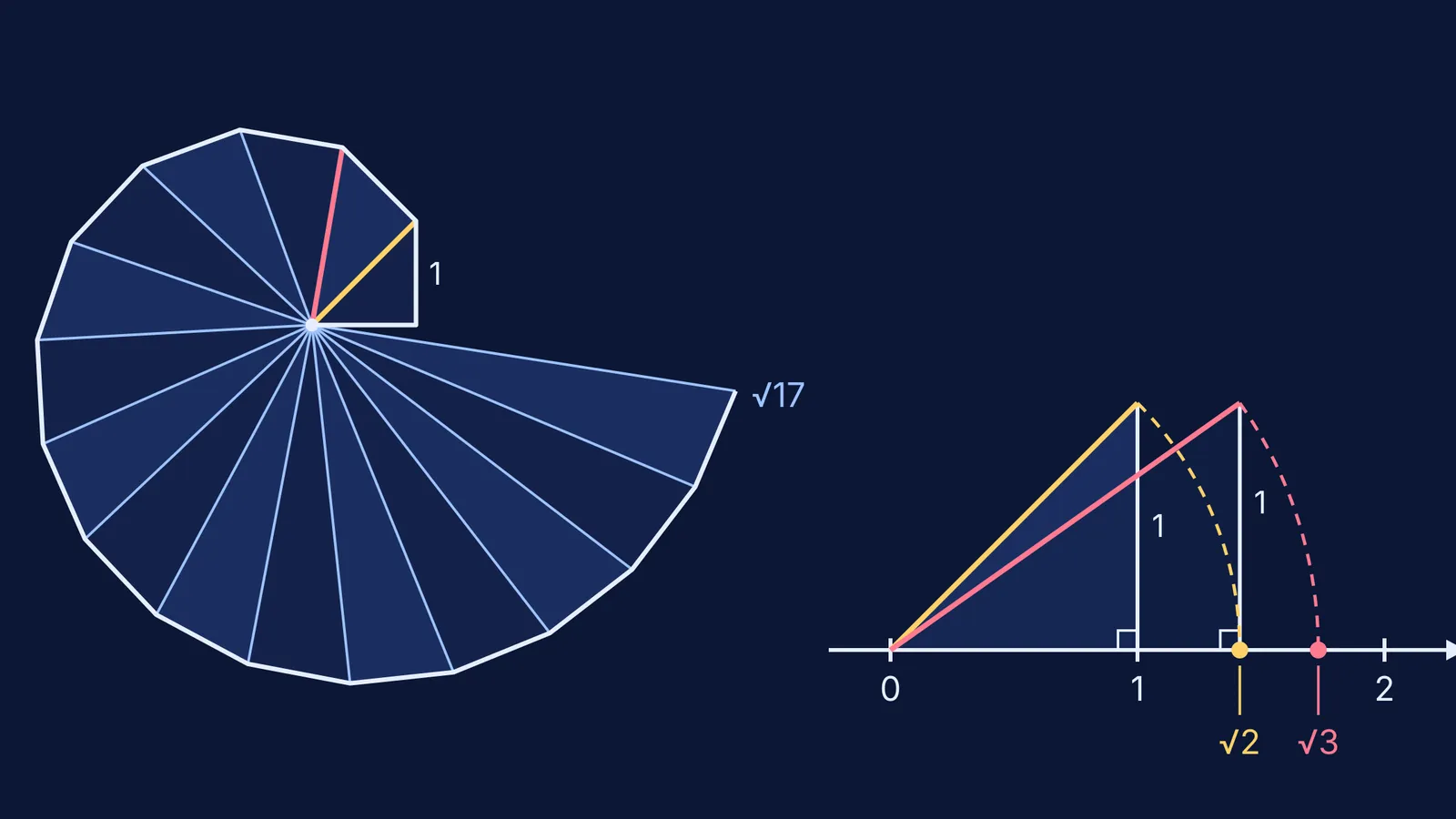
√2 is about 1.414, but its decimal never ends, so how can one dot on a number line be exactly √2? Stop measuring and start constructing: build an exact √2 with a right triangle, then carry it onto the line with a compass. Repeat the trick and it grows into the square root spiral.
How do you locate root 2 on the number line?
The new NCERT Grade 9 textbook, Ganita Manjari, sets out this construction in section 3.5.2 of Chapter 3, The World of Numbers. Here it is with a ruler, set square and compass:
Draw a number line. Mark 0 (call it O) and 1 (call it A). Pick a big unit, such as 5 cm.
At A, draw a line perpendicular to the number line.
On it, mark B so that AB = 1 unit. Join OB.
By the Baudhāyana–Pythagoras theorem (the textbook's name for it in Chapter 1), OB² = 1² + 1² = 2, so OB = √2.
Put the compass point on O, open it to B, and swing an arc down to the number line. Call the crossing point P. OP = √2.
The compass does the real work: it copies a slanted length onto the line with no ruler reading, so the mark is as exact as your drawing. If you want to see why the theorem holds before you rely on it, try our visual proof of the Pythagoras theorem.
How do you locate root 3 on the number line?
The NCERT chapter leaves √3 as a Think and Reflect question. The answer reuses your √2 mark:
At P, your √2 point, draw a perpendicular to the number line.
Mark Q on it with PQ = 1 unit. Join OQ.
OQ² = (√2)² + 1² = 3, so OQ = √3.
Compass point on O, open it to Q, and arc down to the line. That point is √3.
What is the square root spiral, and how long is each hypotenuse?
Now stand each new triangle on the previous hypotenuse instead of on the number line. Draw OP₁ = 1. Draw P₁P₂ = 1 at right angles to OP₁ and join OP₂. Draw P₂P₃ = 1 at right angles to OP₂, join OP₃, and keep going. Exercise 16 at the end of the NCERT chapter asks you to find every hypotenuse in its square root spiral figure.
You can predict them before you draw. Triangle n has legs √n and 1, so its hypotenuse is √(n + 1), as the entry on the spiral of Theodorus sets out. Use it as a prediction drill:
Triangle 1: legs 1 and 1, hypotenuse √2
Triangle 2: legs √2 and 1, hypotenuse √3
Triangle 3: legs √3 and 1, hypotenuse √4 = 2, a whole number hiding in the spiral
Triangle 4: legs 2 and 1, hypotenuse √5
Triangle 8: legs √8 and 1, hypotenuse √9 = 3
The spiral is named after Theodorus of Cyrene. His own work is lost, but Plato's dialogue Theaetetus tells of his ideas (spiral of Theodorus). He is believed to have stopped at √17, usually explained as the last hypotenuse before the triangles start to overlap the first one. Each triangle is thinner than the last, because its angle at O has tan φ = 1/√n: the first is 45 degrees and the rest keep shrinking. Keep going past √17 and the gap between neighbouring turns gets closer and closer to π.
How do you check your drawing is accurate?
A ruler cannot prove a length is irrational, but it can catch a bad right angle. The NCERT chapter gives √2 = 1.41421356... in section 3.6.3. With a 5 cm unit, your targets are:
√2 ≈ 1.414, so OP should be about 7.07 cm
√3 ≈ 1.732, so about 8.66 cm
√5 ≈ 2.236, so about 11.18 cm
If you are 2 mm out, check the set square, then the compass, which can slip mid-swing. Our guide to estimating square roots without a calculator shows how to work out targets like these by hand.
A shortcut for √5: you do not need the spiral. Draw a 1-unit perpendicular at 2 on the number line, and the hypotenuse from O is √(4 + 1) = √5. When n is a sum of two perfect squares, one triangle is enough.
Why does the construction matter?
It is a picture of a strange fact: some points on the number line have no fraction that names them. The NCERT textbook proves √2 is irrational by contradiction, and our step-by-step guide to proving root 2 is irrational walks through it. Put the proof beside your compass arc and you have both halves: the point exists, and no fraction reaches it.
For ideas like this that are easier to see than to read, the Fermi Simulation Lab has interactive simulations you can explore next.


