On this page
You have worked out the direction cosines of a line, and the answer key has the opposite sign. Or a chatbot has handed you three neat fractions. Before you move on, run two quick checks, and make the AI run them with you instead of for you.
What are direction cosines and direction ratios?
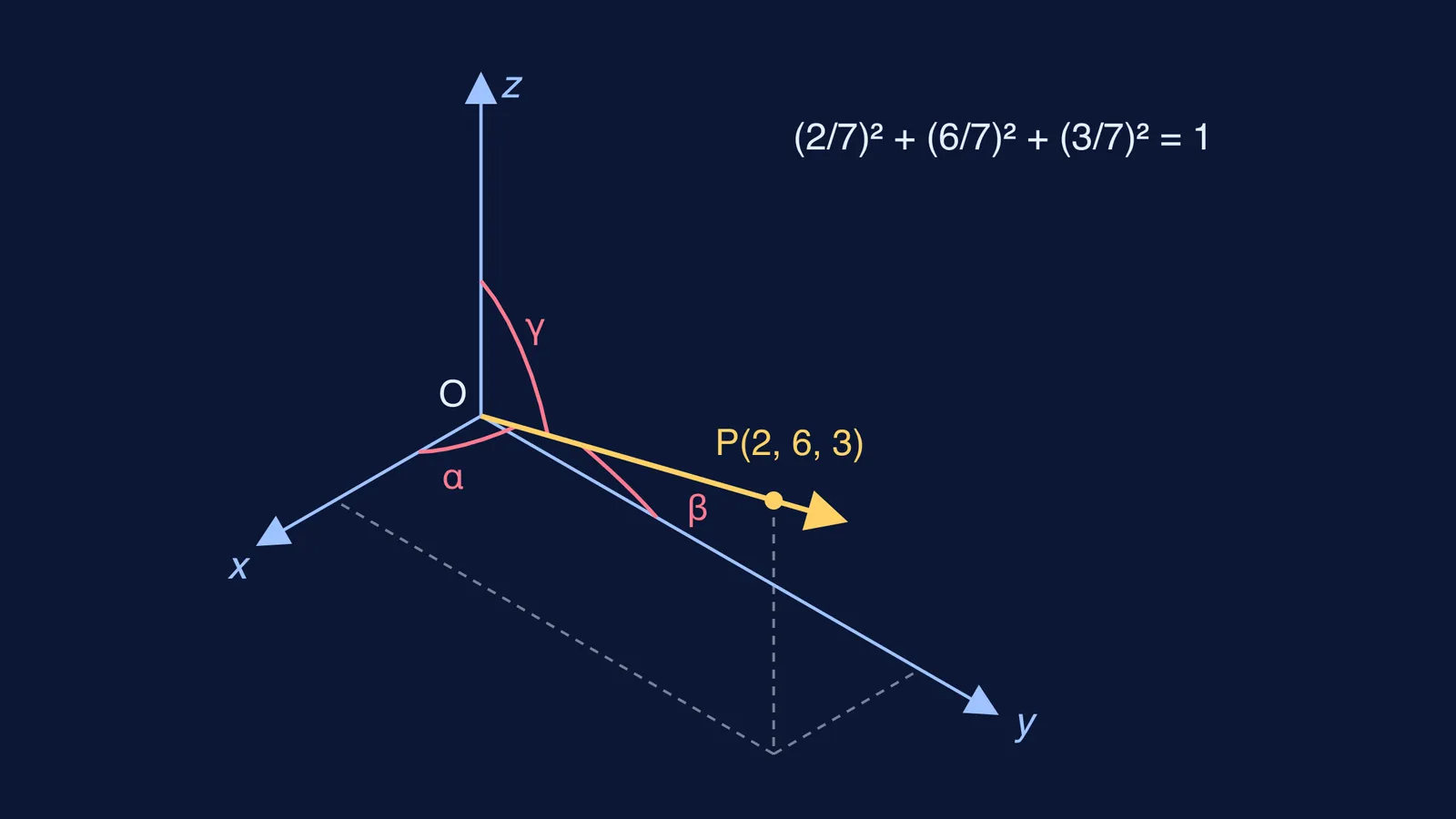
If a directed line makes angles α, β and γ with the x, y and z axes, then cos α, cos β and cos γ are its direction cosines, written l, m and n (NCERT Class 12 Mathematics, Chapter 11).
Any three numbers proportional to l, m and n are direction ratios of the line, so a line has infinitely many sets of direction ratios, according to the same NCERT chapter.
The chapter also uses the identity every answer must pass: l² + m² + n² = 1. From direction ratios a, b, c it gets l = ±a/√(a² + b² + c²), and m and n the same way with b and c.
This is core JEE material: the official JEE Main 2027 syllabus from NTA lists direction ratios and direction cosines under Unit 11, Three Dimensional Geometry.
Why is l² + m² + n² = 1 not enough to check your answer?
The square-sum test catches arithmetic slips, such as forgetting to divide by the length. It cannot see signs, because squaring erases them. (2/7, 6/7, −3/7) passes the test just as well as (2/7, 6/7, 3/7), yet the two point in different directions.
NCERT's chapter notes that reversing a line's direction replaces each angle by its supplement, so all three signs flip together. That gives you the second check: your l, m, n must be a positive multiple of the direction ratios for the direction the question asks about. If only one or two signs differ, something has gone wrong.
Worked JEE-style example: what are the direction cosines of AB?
Question: find the direction cosines of the line from A(1, −2, 3) to B(3, 4, 6). Then decide whether any line can make angles of 30°, 45° and 60° with the axes.
Direction ratios of AB: (3 − 1, 4 − (−2), 6 − 3) = (2, 6, 3).
Length of AB: √(4 + 36 + 9) = √49 = 7.
Direction cosines from A to B: l = 2/7, m = 6/7, n = 3/7.
Check 1: 4/49 + 36/49 + 9/49 = 49/49 = 1. Pass.
Check 2: 2/7 : 6/7 : 3/7 = 2 : 6 : 3, every sign matching (2, 6, 3). Pass. For the line from B to A, all three flip: −2/7, −6/7, −3/7.
Sense check: cos α = 2/7 gives α ≈ 73.4°, cos β = 6/7 gives β ≈ 31.0°, and cos γ = 3/7 gives γ ≈ 64.6°. The smallest angle goes with the biggest ratio, as it should.
For the second part, cos²30° + cos²45° + cos²60° = 3/4 + 1/2 + 1/4 = 3/2. That is not 1, so no line makes those three angles.
The same identity gives a shortcut examiners like. Since cos 2θ = 2cos²θ − 1, for every line cos 2α + cos 2β + cos 2γ = 2(1) − 3 = −1.
How do you get AI to check direction cosines and ratios?
Paste your own working, not just the question. Then ask for a check, not a solution:
"Here are my direction cosines for the line from A to B. Don't solve it. Tell me whether the squares sum to 1 and whether l : m : n matches the direction ratios, sign for sign."
"Which direction did I use, A to B or B to A? Does the question ask for a particular one?"
"Give me one wrong answer that still passes the square-sum test, and explain why it is wrong."
"Now give me a similar question with different points, and wait for my answer before you show yours."
If the AI gives you numbers without both checks, ask it to show them. If its squares do not add up to 1, you have caught an error yourself.
The Fermi Problem Library has worked problems with a step-by-step solver that explains the reasoning rather than printing an answer, so you can see where a sign is decided. Fermi's AI tutor notices where you are stuck and decides whether to explain, ask or show, and it can draw the figure when a line in space is hard to picture.
Where does this lead next in 3D geometry?
Direction cosines are a unit vector in disguise. The same idea drives how you find the component of one vector along another, and it returns when you work out the distance of a point from a plane. For the same check-don't-copy habit in a different chapter, read how to prove a function is one-one and onto, then let AI attack your proof.
Next time you write l, m and n, run both checks before you turn to the answer key.