

On this page
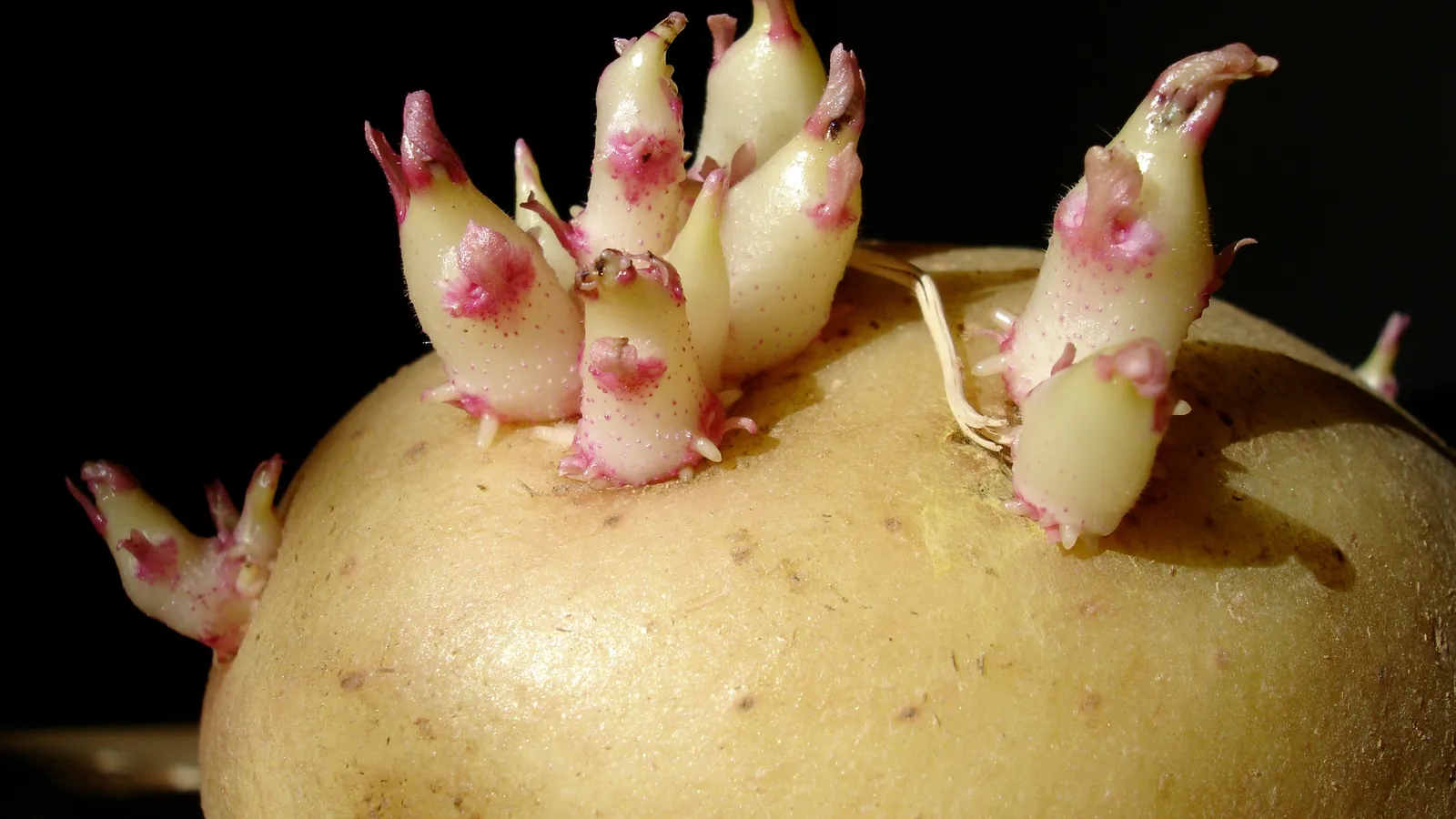
Leave aloo in a dark corner for a few weeks and pale, pinkish shoots push out of the dents in its skin. The potato is starting a new plant from stored food, and that makes it one of the cleanest examples for the Class 10 reproduction chapter.
Is a potato a root or a stem?
A potato is a stem, not a root. Botanists call it a stem tuber: the swollen tip of an underground stem called a stolon. The open textbook Botany in Hawaii on LibreTexts/03:_Stems/3.03:_Modified_stems) puts its job simply: "The main function of tubers is the storage of carbohydrates."
The giveaway is the eyes. The same textbook explains that a potato's eyes "are the nodes and axillary buds", and that planting them grows new plants. Nodes and axillary buds belong to stems, so every eye is a tiny, sleeping shoot.
Why do potatoes sprout when stored for long?
Because the buds' rest period runs out. After a tuber forms, it goes through "a period of dormancy during which visible bud growth is inhibited", as Sophia and Uwe Sonnewald write in their review in Planta (2014). How long that lasts is under environmental, physiological and hormonal control.
The review describes a hormone tug-of-war:
Abscisic acid (ABA) is thought to hold sprouting back; ethylene may too, but its role is unclear.
Cytokinins are needed for the bud to break open.
Gibberellins are needed for the sprout to keep growing.
Once a bud is ready, hormone levels control when it sprouts. In a 2022 study in Frontiers in Plant Science, genetically modified potato lines with a lower ABA to gibberellin ratio sprouted earlier.
The buds do not all wake at once: a review of the physiology of potato sprouting notes that the apical eye generally sprouts first, marking the start of a stage called apical dominance. Compare our post on why cutting the shoot tip makes plants bushy.
What feeds a potato sprout?
The stored starch. The Sonnewald review states that sucrose availability is a prerequisite for bud break: without sucrose, no bud break occurs.
A 2023 study in Scientific Reports tracked this in tubers given sprout-forcing treatments. From the first to the third week of storage, starch fell while sucrose, glucose and fructose rose, and the authors suggest the sugars formed as sprouting began might be used by the growing sprouts. Treating tubers with the cytokinin BAP plus gibberellin also shortened dormancy by 9.6 days compared with untreated tubers.
How does this link to vegetative propagation in Class 10?
The CBSE Class X science curriculum for 2025-26 lists reproduction in animals and plants, asexual and sexual, under the World of Living unit. Vegetative propagation is the asexual route: a new plant grows from a stem, root or leaf rather than a seed. Potato is the stem example, because a tuber or a piece carrying an eye grows into a whole plant.
No gametes fuse, so the new plant is a genetic copy of its parent. That keeps a variety's taste and yield steady, but adds no variation, the trade-off laid out in our side-by-side table of sexual vs asexual reproduction. For a leaf example to set beside the potato, read vegetative propagation in Bryophyllum and beyond.
How do you write a 3-mark answer on potato sprouting?
Question: Why do stored potatoes sprout, and what reproduction does this show?
A potato is a stem tuber; its eyes are nodes bearing axillary buds. (1 mark)
After harvest the buds stay dormant; with time the hormone balance shifts and the buds grow, using sugars made from the stored starch. (1 mark)
Each eye can grow into a new plant identical to the parent, so this is vegetative propagation, a type of asexual reproduction. (1 mark)
Are sprouted potatoes safe to eat?
Treat sprouts with care. The European Food Safety Authority's 2020 risk assessment of glycoalkaloids reports 2,000 to 7,300 mg/kg of these natural toxins in sprouts, against 10 to 150 mg/kg in whole tubers, and notes that rises in solanine in the peel are closely associated with greening. It also found that peeling cut glycoalkaloid content by 25 to 75%. At home, cut away sprouts, eyes and green patches, and throw out potatoes that are badly sprouted, green or shrivelled.
Why not just refrigerate them? Cold storage below 10 °C is used to cut storage losses, but a 2024 study in Plants notes that as temperatures drop, starch is converted to sugars.
You should find that only pieces with an eye sprout: the bud, not the starch alone, makes the new plant. If watching a process unfold helps you, the Fermi Simulation Lab has interactive simulations for ideas that are easier to see than to read, and the Fermi Concept Library gives each biology concept its own lesson.
Next time you peel aloo, count the eyes: each one is a plant waiting for its turn.


