On this page
Ratio word problems usually go wrong before any arithmetic: "3:5" read as three-fifths, grams mixed with kilograms, the wrong total. The fix is to have the AI turn the story into a table first, then check that table before anyone solves anything.
Why set up a ratio problem as a table first?
The table shows the structure of the problem: which quantities are being compared, which number is the whole, and what one part is worth. In a 2009 study in Contemporary Educational Psychology, Asha Jitendra, Jon Star and colleagues taught 148 seventh graders a 10-day unit on ratio and proportion word problems. Classrooms were randomly assigned either to their usual teaching or to schema-based instruction, which focuses on a problem's structure and gives students a step-by-step routine for solving and checking their own work.
According to the study abstract, students taught this way did better on problem-solving tests right after the unit and again four months later. Their scores on the state's standardised maths test were about the same as the other classes, so treat this as help with word problems, not a general maths boost. The study did not test AI or ratio tables as such; the table is simply one way to make the structure visible.
The table also helps the AI. Researchers at Google DeepMind found that language models' accuracy on grade-school maths drops sharply when a problem includes one irrelevant sentence, and that telling the model to ignore irrelevant information helps. If the AI has to put every number into a labelled cell first, you can see straight away if it has used a detail that doesn't belong.
What should you type to the AI?
Paste the problem, then use a prompt like this:
"Don't solve this yet. Turn the story into a ratio table."
"One column for each quantity being compared, plus a Total column."
"Row 1: the ratio in parts. Row 2: the real amounts, with units. Put a ? in any cell we don't know yet."
"List any numbers in the story that the table doesn't need."
"Stop and wait for me to check the table."
The last line matters most. It turns the AI's answer into something you can check, instead of something you just copy.
Worked example: what does a good ratio table look like?
The story: Riya and Kabir share Rs 1,200 in the ratio 3:5. Riya also has a 2-hour bus ride home. How much does each get?
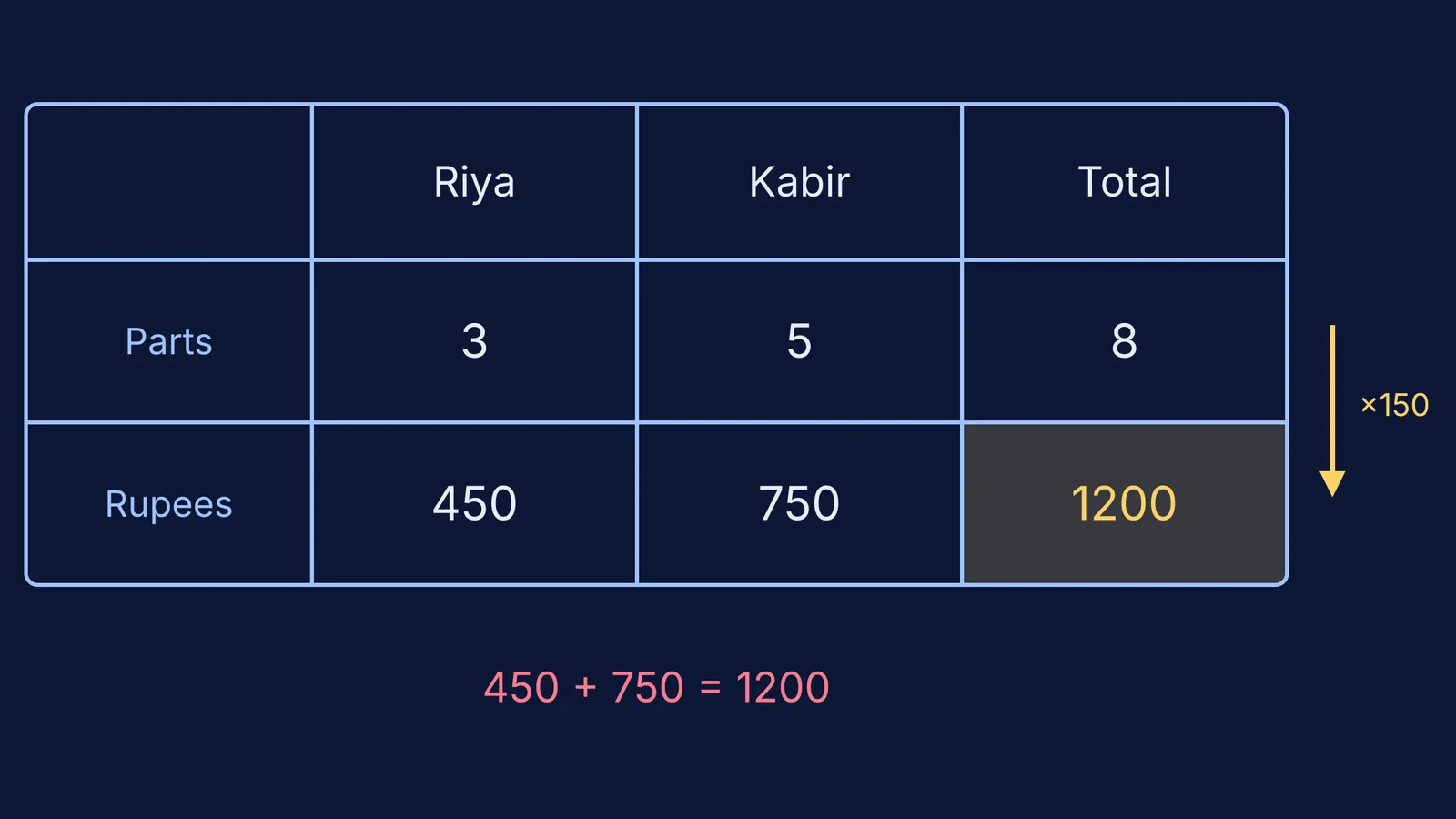
A good table looks like this:
Columns: Riya, Kabir, Total
Parts: 3, 5, 8
Rupees: ?, ?, 1,200
Not needed: the 2-hour bus ride
Now the solution is just reading across the table. Eight parts make Rs 1,200, so one part is Rs 150. Riya gets 3 × 150 = Rs 450 and Kabir gets 5 × 150 = Rs 750.
Watch for a classic slip. If the AI writes "Riya gets 3/5 of 1,200 = 720", it has used a part-to-part ratio as a part-to-whole fraction. Riya's share is 3/8, not 3/5, and the Total column makes that easy to see.
Units are the other trap. Say a recipe uses flour and sugar in the ratio 5:2 by mass, and you have 1.5 kg of flour. Ask for the table in grams, so the flour cell reads 1,500 g. Five parts make 1,500 g, so one part is 300 g and the sugar is 600 g. If the AI leaves one cell in kg and another in g, the units row will show it.
How do you check that the units and parts add up?
Run these three checks on the AI's table, and then on its answer:
Parts sum: the separate parts add up to the Total column (3 + 5 = 8).
Amounts sum: the final amounts add up to the whole in the story (450 + 750 = 1,200).
Same ratio: divide each amount by its parts. Every column should give the same value for one part (450 ÷ 3 = 750 ÷ 5 = 150).
If a check fails, don't just ask the AI to "try again". Point to the exact cell: "Your Total column says 5, but 3 + 5 is 8. Fix row 1, then redo row 2." The basic steps are in how to divide an amount in a given ratio, and longer chains are covered in combining ratios such as a:b and b:c.
Where does Fermi fit in?
If you keep using the wrong method, it helps to see the reasoning laid out one step at a time. The Fermi Problem Library has worked problems with a step-by-step solver that explains the reasoning rather than printing an answer. Fermi's AI tutor notices where a student is stuck and decides whether to explain, ask or show, so you can practise building the table yourself.
One more habit is worth keeping: make a rough guess of the answer before you trust any number the AI gives you. Our post on estimating before trusting an AI's number shows how.