

On this page
Proportional reasoning is the foundation of much of high school mathematics and science, from balancing chemical equations to calculating physics rates. Yet, it remains a common stumbling block; OECD PISA 2022 data shows that 31% of 15-year-olds across OECD countries struggle with the baseline mathematics level.
When a problem gives you two separate ratios that share a common term — such as a to b and b to c — you cannot simply push them together. Because the value for the shared term is different in each ratio, the "parts" are different sizes.
Here is how to align them and solve the problem.
How to combine ratios a to b and b to c?
The secret to combining two ratios is to make the shared term equal in both. You do this by finding the lowest common multiple (LCM).
Imagine a business where profits are split between three partners. You are given two separate facts:
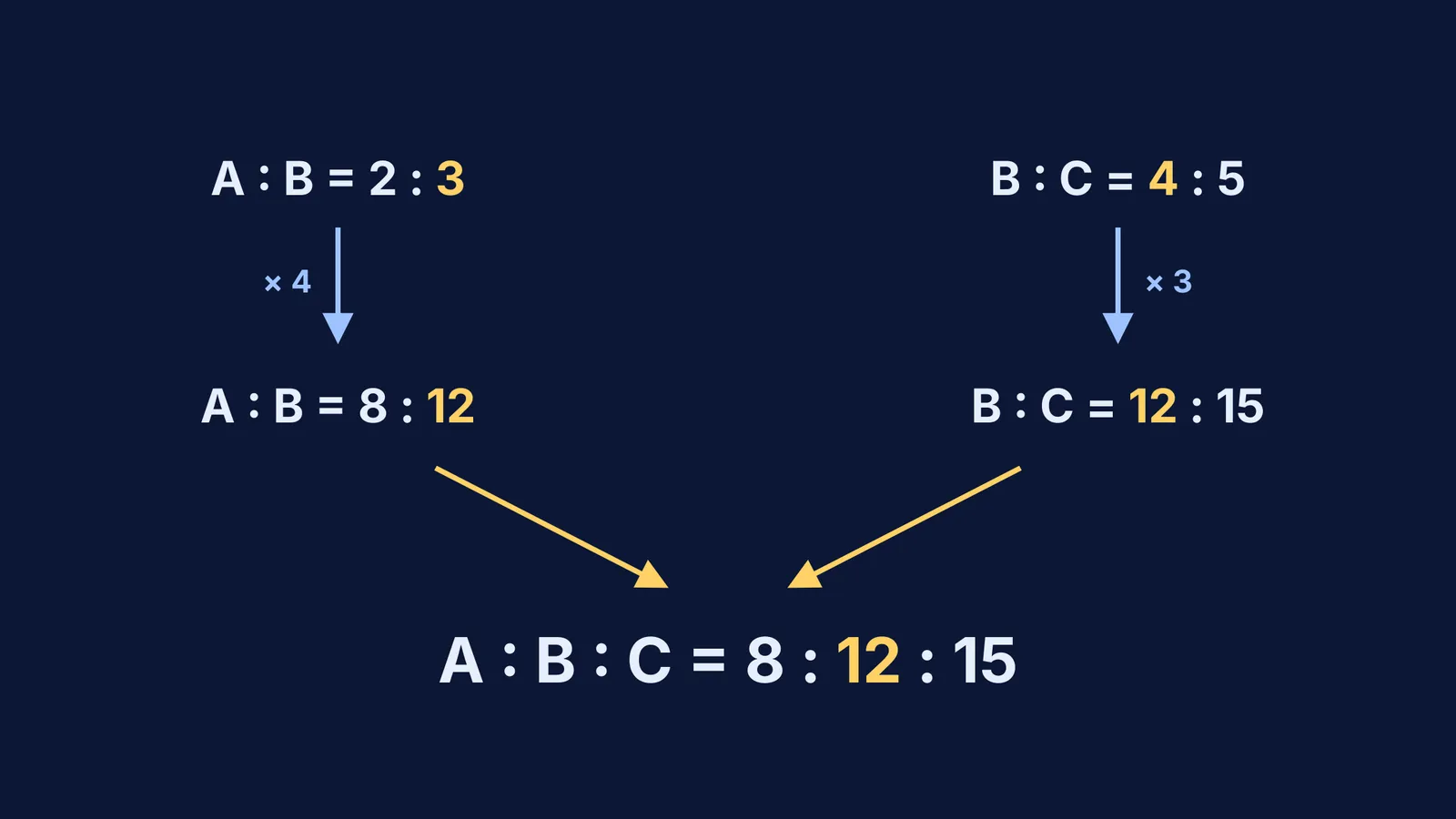
Alice to Bob (A : B) is 2 : 3
Bob to Charlie (B : C) is 4 : 5
Bob is the shared term, but he has 3 parts in the first ratio and 4 parts in the second. To combine them, we need Bob's parts to be the same number.
Find the shared term: Here, it is Bob (B). The numbers are 3 and 4.
Find the LCM: The lowest common multiple of 3 and 4 is 12.
Scale the first ratio: To turn Bob's 3 into 12, multiply the whole A : B ratio by 4.
(2 × 4) : (3 × 4) = 8 : 12.
Scale the second ratio: To turn Bob's 4 into 12, multiply the whole B : C ratio by 3.
(4 × 3) : (5 × 3) = 12 : 15.
Combine them: Now that B is 12 in both, you can read straight across.
A : B : C = 8 : 12 : 15.
If you are stuck on proportion questions, the Fermi Problem Library has worked problems with a step-by-step solver that explains the reasoning rather than printing an answer.
How do you share an amount in a combined ratio?
Once you have a combined ratio, exam questions usually ask you to share a total amount between the parts. This requires working out the value of a single unit.
Let's say Alice, Bob and Charlie need to share Rs 1,400 in the combined ratio 8 : 12 : 15.
Add the parts: First, find the total number of parts in the ratio.
8 + 12 + 15 = 35 total parts.
Find the value of one part: Divide the total amount by the total number of parts.
Rs 1,400 ÷ 35 = Rs 40 per part.
Multiply out: Multiply each person's ratio share by the value of one part.
Alice (8 parts): 8 × 40 = Rs 320
Bob (12 parts): 12 × 40 = Rs 480
Charlie (15 parts): 15 × 40 = Rs 600
To check your work, add the final amounts together. They should equal the original total (320 + 480 + 600 = 1,400).
What if the ratios contain fractions?
Sometimes you will encounter ratios that are not whole numbers, such as A : B = 1.5 : 2 or a recipe calling for ½ cup of sugar to ¾ cup of flour. Before you can combine these with another ratio, you must simplify them into whole integers.
If A : B = 1.5 : 2, multiply both sides by 2 to remove the decimal. This leaves a clean 3 : 4 ratio. If dealing with fractions like A : B = ½ : ¾, multiply both sides by the lowest common denominator (which is 4 in this case) to get 2 : 3. Once you have whole-number ratios, you can apply the LCM method to combine them with B : C exactly as shown above.
Why does proportional reasoning catch students out?
A common mistake in exams is trying to use addition instead of multiplication. For example, a student might see A : B = 2 : 3 and B : C = 4 : 5, notice that B increases by 1 (from 3 to 4), and incorrectly add 1 to A to get a combined ratio.
Ratios are always multiplicative. When you scale a ratio up or down, you are multiplying or dividing. A report by the Nuffield Foundation shows that students often grasp proportions as part-to-part ratios (like 1 white marble to 2 black marbles) before they understand part-to-whole fractions (like 1/3 of the marbles are white).
This same multiplicative machinery applies across subjects. When you are inserting arithmetic and geometric means in a sequence, or finding the average molar mass of a gas mixture based on its proportions, you are using the exact same underlying logic. By taking the time to find the LCM and align the shared terms, you ensure that every part of the ratio measures the exact same underlying unit.
The combined ratio checklist
When you face a multi-part ratio problem, use this structured plan:
Identify the bridge: Which variable appears in both ratios? Write the ratios out so this shared variable is in the middle (e.g., A : B and B : C).
Find the LCM: Look at the two different numbers for the shared variable and calculate their lowest common multiple.
Scale both ratios: Multiply the left ratio to reach the LCM, and do the same for the right ratio.
Write the combined line: Combine them into A : B : C.
Calculate the single part: If sharing a total, add the parts together (A + B + C) and divide the total amount by this sum.
Distribute the total: Multiply the single part value by A, B, and C to get the final amounts.


