On this page
An AI chatbot can set up a kinetics problem fluently and still pick the wrong reaction order. To catch that, you don't need to solve it again. Look at the units of the rate constant k, because the order fixes them.
How do the units of k depend on reaction order?
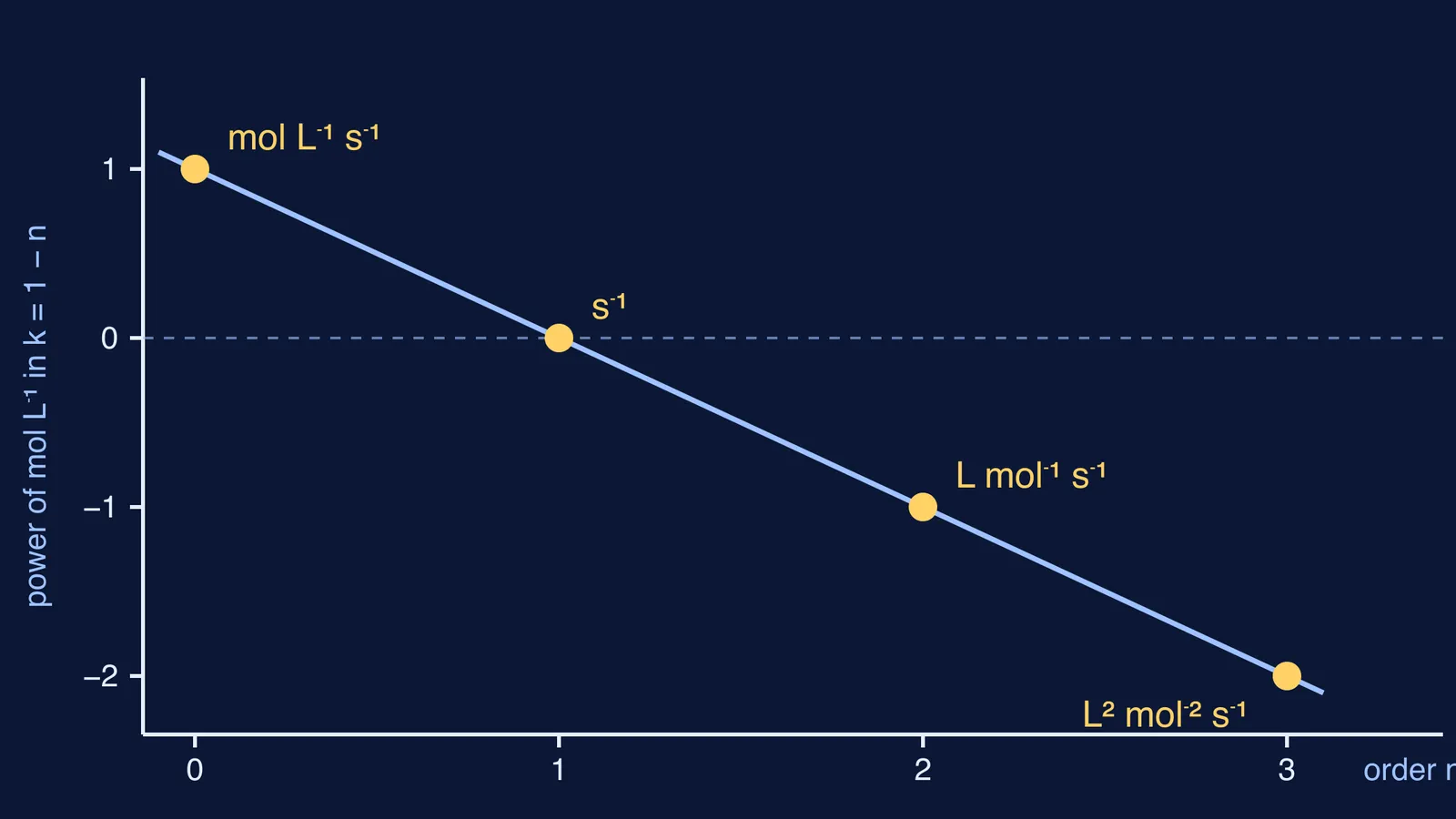
Start from a rate law of the form rate = k[A]ⁿ, where n is the overall order. Rate has units of mol L⁻¹ s⁻¹ and concentration has units of mol L⁻¹. Rearranging gives k = rate / [A]ⁿ, so the units of k are (mol L⁻¹ s⁻¹) / (mol L⁻¹)ⁿ = (mol L⁻¹)^(1−n) s⁻¹.
The units of the rate constant are mol L⁻¹ s⁻¹ for a zero-order reaction, s⁻¹ for first order, L mol⁻¹ s⁻¹ for second order and L² mol⁻² s⁻¹ for third order (OpenStax Chemistry 2e, Rate Laws; the same table is in Chemistry LibreTexts/12:_Kinetics/12.04:_Rate_Laws)).
The same OpenStax section says rate laws "are determined by experiment only and are not reliably predicted by reaction stoichiometry". An AI that reads the order off the coefficients in the balanced equation falls into exactly this trap.
Read the formula backwards and you have a test: the power of mol L⁻¹ in k equals 1 − n. If k's units say first order and the AI used a second-order formula, the answer is wrong. For more detail on each order, see our explainer on reading reaction order from the units of the rate constant.
How do you check an AI's reaction order from the units of k?
Find k in the question and write down its units.
Read off the power of mol L⁻¹ and solve 1 − n = that power for n.
Compare n with the formula the AI used. Then check that the final answer comes out in the right unit: seconds for a time, mol L⁻¹ for a concentration.
What does the units check look like on an AI's answer?
These three cases are made up for practice.
Case 1: k = 3.0 × 10⁻⁴ s⁻¹, and the AI says second order. The question asks for the half-life. The AI writes: "This is second order, so t½ = 1/(k[A]₀)."
The units of k are s⁻¹. That means the power of mol L⁻¹ is 0, so 1 − n = 0 and n = 1. The reaction is first order. A second warning sign: 1/(k[A]₀) has units of 1/(s⁻¹ × mol L⁻¹) = L s mol⁻¹, which is not a time. The correct working is t½ = 0.693/k = 2310 s. Verdict: wrong order.
Case 2: k = 2.0 × 10⁻² L mol⁻¹ s⁻¹, and the AI says second order. The question gives [A]₀ = 0.50 mol L⁻¹ and asks for [A] after 100 s. The AI uses 1/[A] = 1/[A]₀ + kt.
L mol⁻¹ is (mol L⁻¹)⁻¹, so 1 − n = −1 and n = 2. That matches. Now check the units: kt = 2.0 × 10⁻² × 100 = 2.0 L mol⁻¹, the same unit as 1/[A]₀ = 2.0 L mol⁻¹, so you can add them. That gives 1/[A] = 4.0 L mol⁻¹ and [A] = 0.25 mol L⁻¹. Verdict: correct setup. The units check cannot catch an arithmetic slip, so check the numbers too.
Case 3: k = 4.0 × 10⁻³ mol L⁻¹ s⁻¹, and the AI uses t½ = 0.693/k. The question gives [A]₀ = 0.80 mol L⁻¹ and asks for the half-life. The AI answers 0.693/k = 173 s.
Here mol L⁻¹ appears to the power 1, so 1 − n = 1 and n = 0. The reaction is zero order. The AI's 0.693/k has units of L s mol⁻¹, not seconds. For zero order, t½ = [A]₀/(2k) = 0.80/(2 × 4.0 × 10⁻³) = 100 s, and (mol L⁻¹)/(mol L⁻¹ s⁻¹) does come out in seconds. Verdict: wrong order, and the unit gave it away.
To see why zero-order and first-order half-lives behave so differently, read zero vs first order: concentration-time graphs and half-life. For any other order, see half-life and initial concentration for any reaction order.
What should you do when the units and the AI disagree?
Go with the units given in the question, not the AI's description of the reaction.
Ask it directly: "k is in s⁻¹. What order does that imply, and which half-life formula goes with that order?"
Watch for fractional orders. For rate = k[A][B]^½, n = 1.5, so k has units of (mol L⁻¹)^(−½) s⁻¹, or mol^(−½) L^½ s⁻¹. If the AI writes s⁻¹ here, it has treated the reaction as first order.
To practise choosing the right order, the Fermi Problem Library has worked problems with a step-by-step solver that explains the reasoning rather than printing an answer, so you see why each formula was picked. If the link between order and rate law still feels shaky, the Fermi Concept Library gives each chemistry concept its own lesson and its place in the map.
Next time an AI hands you a kinetics answer, look at the units of k before you look at the number.