On this page
If you lose marks on derivations you know well, the problem is often layout, not physics. AI feedback helps when you ask it to check each marked part of a derivation one by one, instead of asking "is this right?"
How are derivations marked in board exams?
The CBSE Class XII Physics sample marking scheme for 2025-26 puts marks beside parts of each answer, not only beside the final line. Three examples from it:
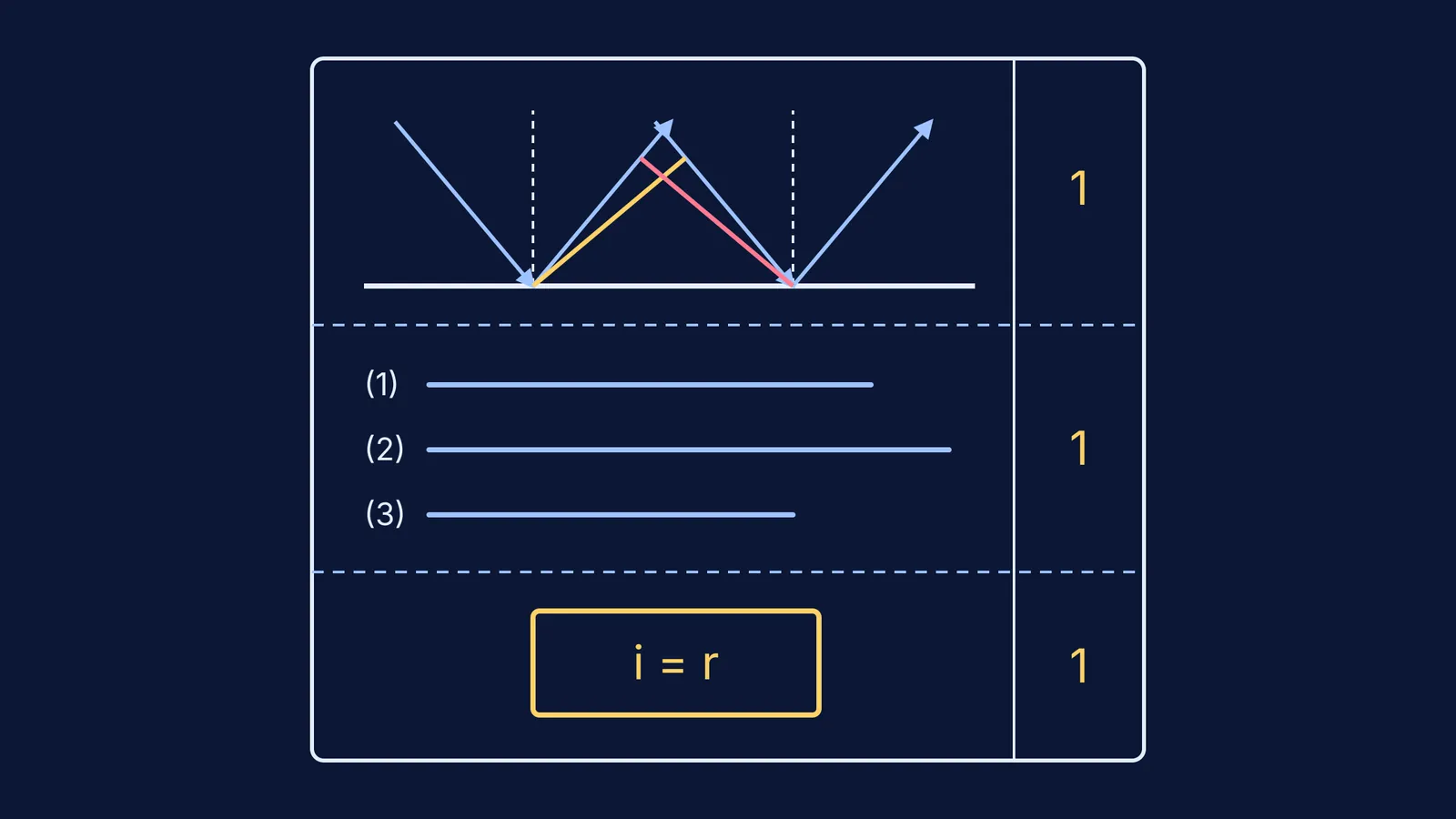
Huygens' proof of the laws of reflection (Q26, 3 marks): 1 mark for the wavefront diagram, 1 for the working, 1 for the result i = r.
The lens maker's formula (Q32): 1 mark for refraction at the first surface, 1 for refraction at the second surface, 1 for the final formula with the object at infinity.
The prism relation i + e = A + δ (Q32, the OR option): 1 mark for the ray diagram, 1 for the angle relations from the triangles, 1 for the final relation.
In the reflection and prism questions the diagram carries its own mark, and in all three the final result does. A missing figure can cost you a mark even when the physics is right.
What can AI feedback check in a derivation?
Feedback is one of the most powerful influences on learning, but its impact can be positive or negative, according to a review by John Hattie and Helen Timperley in Review of Educational Research; the type of feedback and the way it is given make a difference. "Looks good" teaches you nothing. Feedback tied to a clear standard, here the marks split, tells you what to change.
Ask an AI to check these six things, built around the parts the scheme gives marks for:
Figure: drawn and labelled, with every symbol you use later (angles, wavefronts, radii) marked on it.
Givens and assumptions: stated at the top, such as "thin lens" or "object at infinity".
Numbered steps: key equations tagged (1), (2), (3), so later lines can say "from (1) and (2)".
A reason for each step: a few words naming the law used, such as "refraction at the first surface".
Signs and conventions: stated once, then followed.
Final result: on its own line, boxed and named, for example "This is the lens maker's formula".
How do I ask AI for feedback on my derivation layout?
Write the derivation by hand, timed, from memory. Photograph the full page in good light; see how to photograph handwritten rough work for AI.
Paste the marks split for that question from the official CBSE marking scheme. Here is how to ask AI to mark your answer using the CBSE marking scheme.
Send a prompt that asks for marking, not rewriting (see below).
Fix the page, then rewrite it from memory the next day.
The script you can copy:
"This is my derivation of the lens maker's formula for a board exam. Do not rewrite it. Mark it like an examiner using this split: 1 mark for the first surface, 1 mark for the second surface, 1 mark for the final formula. For each mark, say awarded, at risk or lost, and point to the line. Then list layout fixes only: figure labels, step numbers, missing reasons and the final box."
Worked example: what does useful feedback look like?
Say you derive i + e = A + δ for a prism. Your page has a quick triangle with no labels, the equations run together in one paragraph, and the answer sits in the middle of a line.
Useful feedback sounds like this:
"Your figure does not mark r₁, r₂ or the point O, so the step using triangle OPQ has nothing to point to. The diagram mark is at risk."
"You wrote A = r₁ + r₂ without saying where it comes from. Number the quadrilateral and triangle equations and write 'from (1) and (2)'."
"Your result i + e = A + δ is not separated. Put it on its own line and box it."
The corrected page keeps the same physics: a labelled figure, three numbered equations with one-line reasons, and a boxed result. If the AI says your method itself is wrong, check that step in your NCERT textbook before changing anything. For method mistakes, the Fermi Problem Library has worked problems with a step-by-step solver that explains the reasoning rather than printing an answer.
When should you not trust AI feedback on a derivation?
AI can misread handwriting, accept a wrong sign, or praise a layout your teacher would mark down. Treat its comments as a checklist to verify, not a verdict. Your teacher knows how answers are read in your board, so show them a corrected page now and then.
If the trouble is understanding the derivation rather than writing it out, Fermi's AI tutor works through it with you, writing on a board, drawing the figure and checking understanding as it goes.
Start tonight: pick one short derivation, write it, and ask for feedback mark by mark.