

On this page
When you ask an AI to grade your practice answers, the results can be frustrating. A general-purpose AI might give you 5 out of 5 for simply stating the correct final answer, completely ignoring the method. In a real exam, that same answer might only score 1 mark because the working is missing.
If you are preparing for a board exam, you do not just need to know if you are right. You need to know exactly where you gained or lost marks. You can fix this by supplying the official marking scheme so the AI grades against real criteria instead of its own idea of a good answer.
Why does an AI tutor need a marking scheme?
Large language models (LLMs) are trained on vast amounts of text, not on specific exam board policies. Without a rubric, they tend to evaluate answers subjectively or act like a simple checklist. They might inflate your score because your grammar is excellent, even if your scientific reasoning is incomplete.
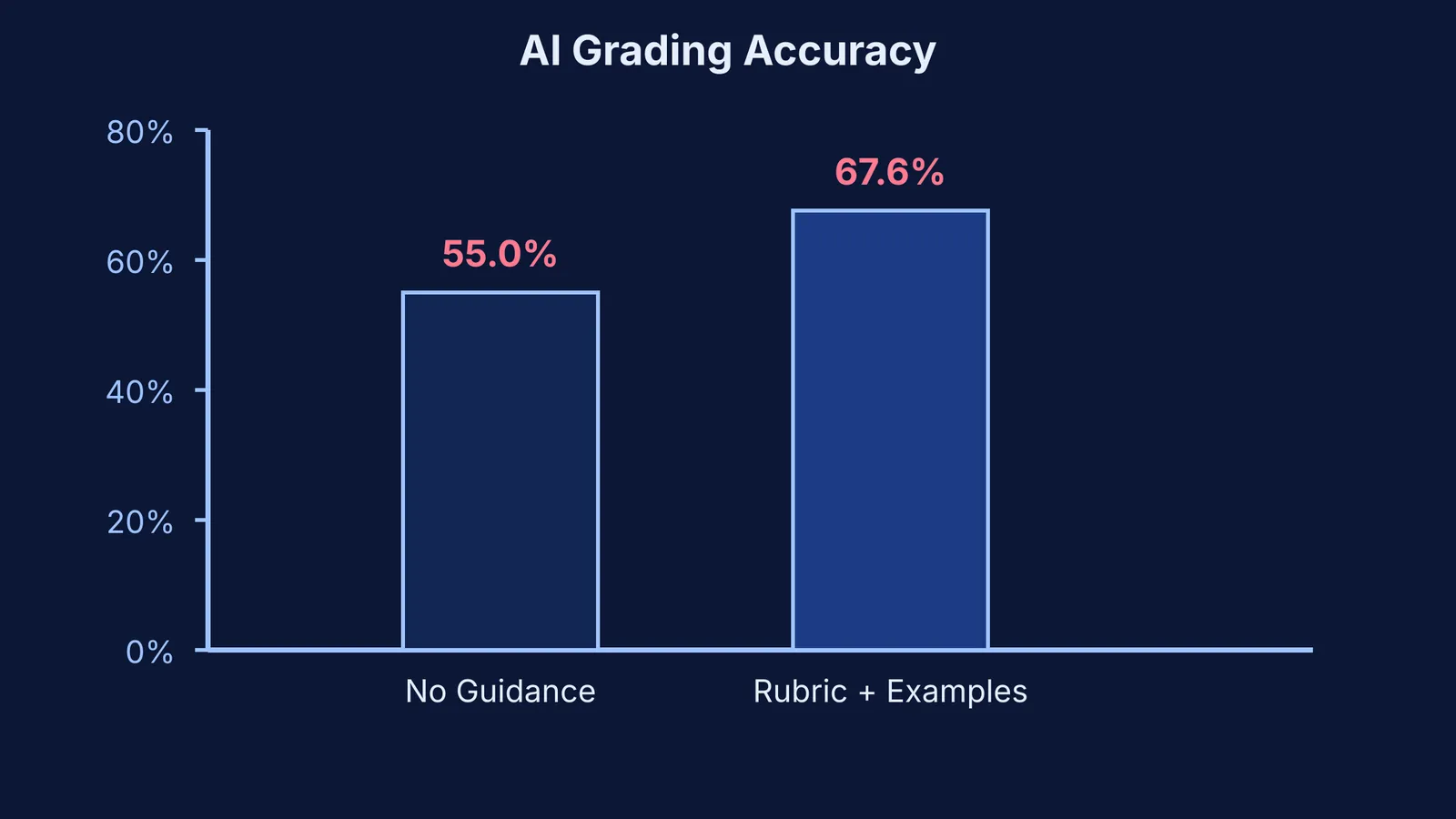
Giving the AI the explicit rules changes its behaviour. A 2024 study published in *Computers and Education: Artificial Intelligence* tested how accurately LLMs grade open-ended science responses. The researchers found that providing the model with a scoring rubric and a few graded examples improved its grading accuracy by 12.6% compared to asking it to grade without guidance (Lee et al., 2024). When the AI knows exactly what to look for, its assessment aligns much more closely with a human expert.
How does CBSE step marking work?
The Central Board of Secondary Education (CBSE) uses a rigorous step-wise evaluation system. This means examiners look for specific "value points" and award marks for the logical progression of an answer, not just the final result.
If you make a calculation error early in a mathematics or physics problem, but use that wrong value correctly in subsequent steps, the CBSE's "no double penalty" rule means you only lose the mark for the initial mistake. This is known as an error carried forward. Without the official marking scheme, an AI might simply mark the entire answer wrong because the final number is incorrect, robbing you of the partial credit you would earn in the actual exam.
A typical 3-mark physics numerical is broken down into specific stages:
Formula: Stating the correct principle or equation (½ to 1 mark).
Substitution: Placing the correct given values into the formula (½ to 1 mark).
Calculation: The logical steps leading to the result (½ mark).
Final answer: The correct numerical value with the proper SI unit (½ to 1 mark).
The same logic applies to theoretical questions in chemistry and biology. Examiners look for key scientific terms rather than long, meandering paragraphs. For example, a question about how traits are inherited might require the specific term "independent assortment" to award full marks. The CBSE publishes these exact breakdowns every year. You can download the current official marking schemes alongside the sample question papers for Class 10 and Class 12 directly from the CBSE Academic Website.
How do you ask AI to mark your answer using the CBSE marking scheme?
To make the AI grade like a board examiner, you need to combine your answer with the official instructions. Here is a framework you can use for your daily practice.
Find the official scheme: Open the marking scheme document for the subject and year you are practicing.
Copy the value points: Find the exact question you answered and copy the entire text of the marking scheme for that question.
Use this prompt script: Paste your answer and the copied scheme into the AI with the following instruction:
> "I am practicing for my CBSE board exams. Here is the question I attempted: [Paste question]. > > Here is the official CBSE marking scheme for this question: [Paste marking scheme]. > > Here is my answer: [Paste your answer or upload a clear photo of your handwriting]. > > Grade my answer strictly according to this marking scheme. Break down the marks step by step, explicitly telling me how many marks I earned for the formula, substitution, calculation, and final unit. Tell me exactly where I lost marks."
By forcing the AI to evaluate each stage, you prevent it from jumping to conclusions and ensure your feedback mirrors what a real examiner would write on your paper. This method works for any subject, from complex mathematics proofs to descriptive answers in biology.
How can you move beyond a simple grade?
Knowing your score is only the first step. If you consistently lose marks on the substitution step, you might need to practice converting units. If you lose marks on the formula step, you have a conceptual gap that requires reviewing your textbook.
Instead of just telling you if the final answer is right, Fermi's AI tutor holds a line of reasoning across a session. It notices where you are stuck, decides whether to explain, ask or show, and works out what you know to build a plan for the session, much like a human tutor reading your workings.
When you practice with the right rubrics, you stop treating exams as a test of getting the final number right, and start focusing on clearly communicating your scientific reasoning. This shift in mindset builds confidence and reduces exam anxiety. For more ways to practice efficiently, try getting AI feedback on handwritten solutions or making an AI chatbot quiz you properly.


