On this page
Photographing your handwritten solution and asking an AI to check it can save hours. It can also go wrong in a quiet way: the AI misreads a minus sign or a subscript, then gives confident feedback on working you never wrote. Most of the fix is in how you take the photo and what you ask first.
Why does the photo matter so much?
The companies that build these models say so in their own documentation. Anthropic's guide for Claude says images should be clear and not too blurry, with important text legible and not too small, and warns that the model "might hallucinate or make mistakes when interpreting low-quality, rotated, or very small images". It also notes that large images may be resized, which can make text less legible, and that heavy compression can make text hard to read.
OpenAI's guide lists similar limits: the model may misinterpret rotated or upside-down text and images, may struggle with graphs where colours or line styles vary, and struggles with tasks needing precise spatial localisation. It suggests enlarging small text to improve readability. For physics, that matters: a diagram where direction or position is the whole question is exactly where a misreading can creep in.
A checklist for the photo
Light: daylight or a bright lamp, no shadow from your phone or hand.
Angle: page flat, phone held parallel to it, photo upright.
One problem per photo. Crop the margins but keep the question, your diagram and all your working in frame. Anthropic advises against cropping out key context just to enlarge text.
Ink: dark pen on plain or lightly ruled paper. Faint pencil is harder to read.
Layout: number your lines, write units, and leave space between steps. Our guide to neat working shows why this also cuts your own errors.
Check it yourself: zoom in on the photo before sending. If you can't read a symbol, the AI may not either.
Step zero: make it read your work back
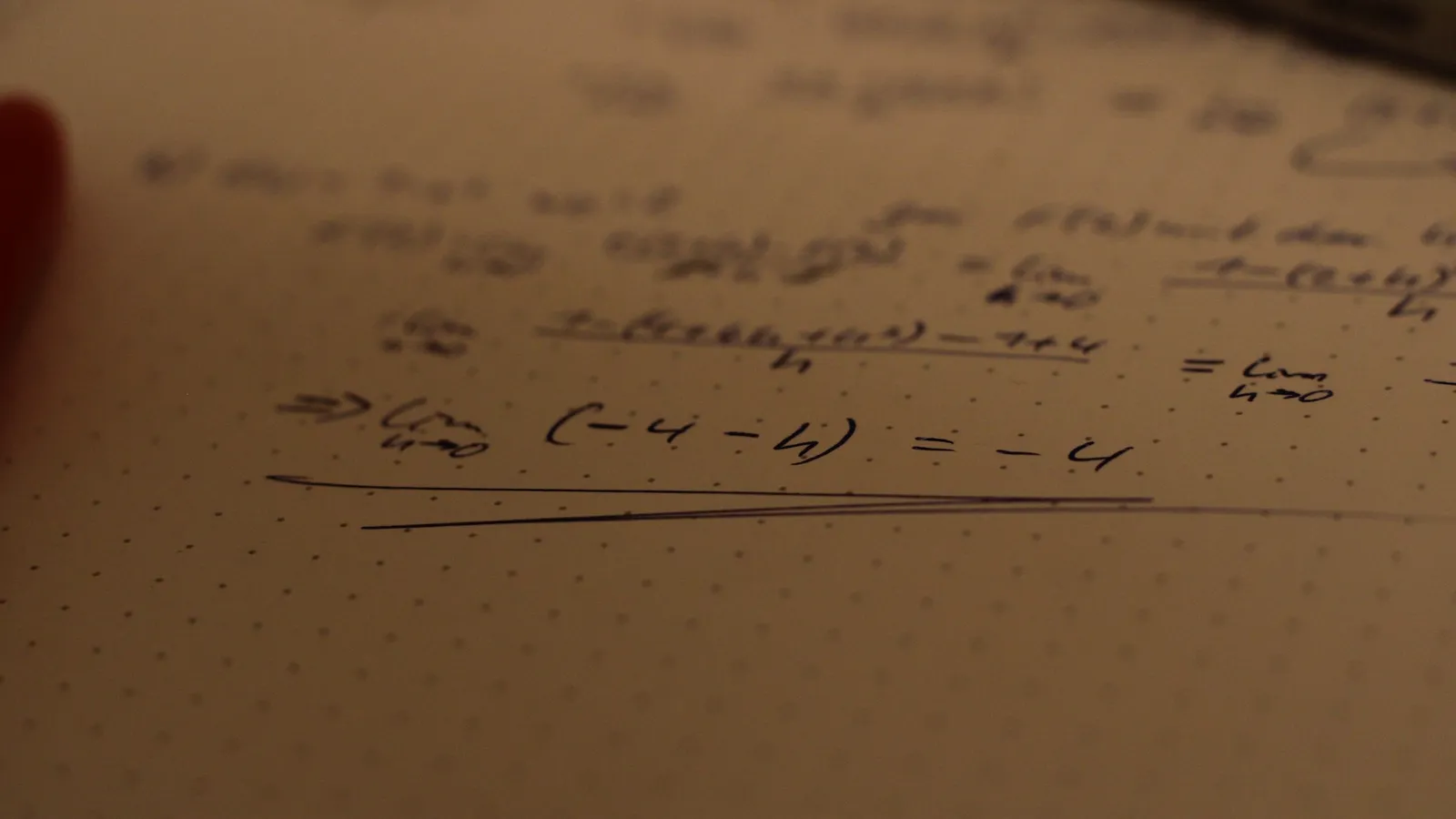
Before asking for feedback, ask: "Transcribe my working line by line, exactly as written. Don't correct anything." Then compare the transcript with your page. Look closely at the usual troublemakers: minus signs, powers, subscripts, 1 and 7, 2 and z, and arrows on vectors. Correct any misreading in your next message. Only then ask for feedback. This takes a minute and prevents the most confusing kind of wrong advice.
Which questions give useful feedback?
In their review of feedback research, Hattie and Timperley found that feedback is among the major influences on learning but that its impact can be positive or negative, and the type of feedback and how it is given matter. Feedback that shows you exactly where you went wrong, while leaving the fixing to you, keeps you doing the learning. Try these:
"Find the first line where my reasoning or algebra goes wrong. Tell me the line number and the type of mistake. Don't correct it."
"Check the units in every line and flag any that don't match."
"Is my free-body diagram complete? List any force I missed without solving the problem."
"My answer is X and the key says Y. Without solving it, which step should I recheck?"
A short example
Say a student's projectile solution has line 3 reading "y = ut sin θ + ½gt²" with upward taken as positive. A useful reply is: "Line 3: sign error. You took upward as positive, so the gravity term should be negative." The student fixes it and reworks lines 4 to 6 themselves. A less useful reply rewrites the whole solution, and the student copies it.
Then redo it without help
Close the chat, take a fresh sheet and solve the problem again from the start. A day later, try a similar problem with different numbers. If you get it right alone, the feedback worked. For more, see our guides to getting useful AI feedback on step-by-step solutions and asking AI about a photographed problem.
Where Fermi fits
You can bring a scanned assignment to Fermi's AI tutor, which works out what you already know and teaches through it, checking understanding as it goes. To practise the redo step, the Fermi Problem Library has worked problems with a step-by-step solver that explains the reasoning.