On this page
When Class 7 homework says "draw the circuit diagram", an AI tutor helps most if the student, not the AI, does the drawing. Ask it to describe a circuit in words, draw it on paper, then check every part against the textbook's symbol table.
What do the Class 7 circuit symbols mean?
The NCERT Class 7 science textbook, Curiosity, covers this in Chapter 3, "Electricity: Circuits and their Components" (NCERT chapter PDF). Its Table 3.2 gives symbols for seven components: electric cell, battery, electric lamp, LED, switch ON, switch OFF, and wire.
Cell: two parallel lines. The long line is the positive terminal and the short line is the negative terminal.
Battery: two or more cells, with the positive terminal of one joined to the negative terminal of the next.
Lamp: a circle with a cross inside.
LED: a triangle against a bar; the triangle points the way current can flow.
Switch: ON is a line joining two small circles; OFF shows a gap, so the circuit is open.
Wire: a plain straight line.
A circuit diagram, NCERT says, is a representation of an electrical circuit using symbols. For a refresher, see our post on circuit symbols for a cell, battery, switch and bulb.
How do you use an AI tutor to practise circuit diagrams?
Use the AI as the one who sets the puzzle, not the one who solves it.
Ask for words, not a picture. Type: "Describe a simple Class 7 circuit in words only. List the parts in order around the loop and say whether each switch is ON or OFF."
Draw it yourself on paper, using only the symbols in Table 3.2.
Check it part by part with the checklist below.
Ask the AI to check you. Describe your drawing back in words and ask: "Does this match yours? Point out the first difference, but don't fix it for me."
AI tools can make mistakes, so your textbook table is the final word. If you get stuck, our guide on how long to try a problem before asking AI helps you decide when to ask.
Worked example: how do you draw a torch circuit with a switch?
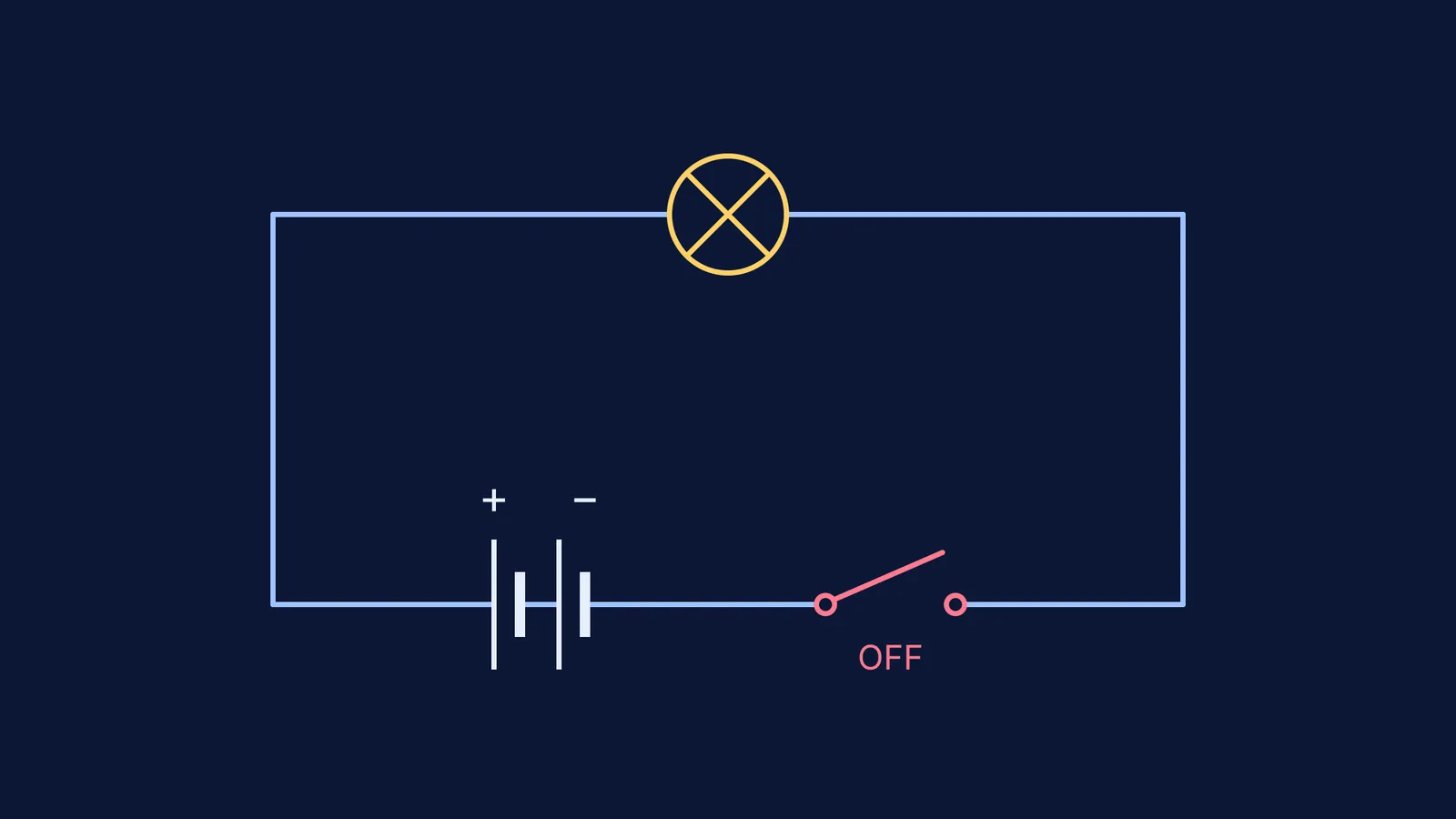
Practise with this description, written in an AI tutor's style: "A torch has a battery of two cells, a switch and a lamp, joined in one loop. The switch is OFF." Now check your drawing:
Cells: two long-and-short pairs side by side, the short line of the first facing the long line of the second, so plus meets minus.
Battery ends: the free long line is the positive end; the free short line is the negative end.
Switch: drawn OFF, with a gap. NCERT says the circuit is then open and the lamp does not glow.
Loop: trace the wire with your finger from the positive end, past the lamp and switch, to the negative end. The only break should be at the switch.
A slip to look for, in your drawing or any AI picture: both long lines facing each other. That would mean plus touching plus.
Then change one thing and redraw: "Now turn the switch ON and add a second lamp." The chapter's own end questions ask students to draw a torch circuit and to predict which lamps glow when switches S1 and S2 are ON or OFF (NCERT chapter PDF).
Why draw it yourself instead of asking AI for the picture?
Because drawing first, then comparing, is the step one study found helps. In a 2021 study, Qian Zhang and Logan Fiorella had college students learn about the human circulatory system from a text (Zhang and Fiorella, 2021). In their second experiment, with 85 students, those who drew their own diagrams and then saw a provided diagram as feedback took longer but scored significantly better on comprehension than those who only studied the provided diagram. In their first experiment, with 107 students, drawing without that feedback step did no better than studying a provided diagram.
The topic was biology and the students were older, so treat it as a hint, not proof, for Class 7 circuits.
Fermi's AI tutor is built to teach rather than hand over answers: it decides whether to explain, ask or show, writes on a board, draws the figure, and checks understanding as it goes.
What should parents watch for?
Sit nearby for the first few sessions. Check that the AI is describing, not drawing, and that the notebook diagram is your child's own. Our guide on how Class 6 to 8 students should use an AI tutor safely covers the set-up.
A good sign is when your child can say why the lamp stays dark when the switch is OFF. If seeing it helps, the Fermi Simulation Lab has interactive simulations for ideas that are easier to see than to read.