On this page
Most students meet fractions as pizza slices and get stuck when the pizza stops helping. Is 2/3 bigger than 3/4? Two pizzas cut differently are hard to compare by eye. An AI chatbot can describe the same fraction as a pizza, a strip and a number line. Your job is to draw them, solve the problem, and check the AI as hard as it checks you.
Why use a strip and a number line instead of a pizza?
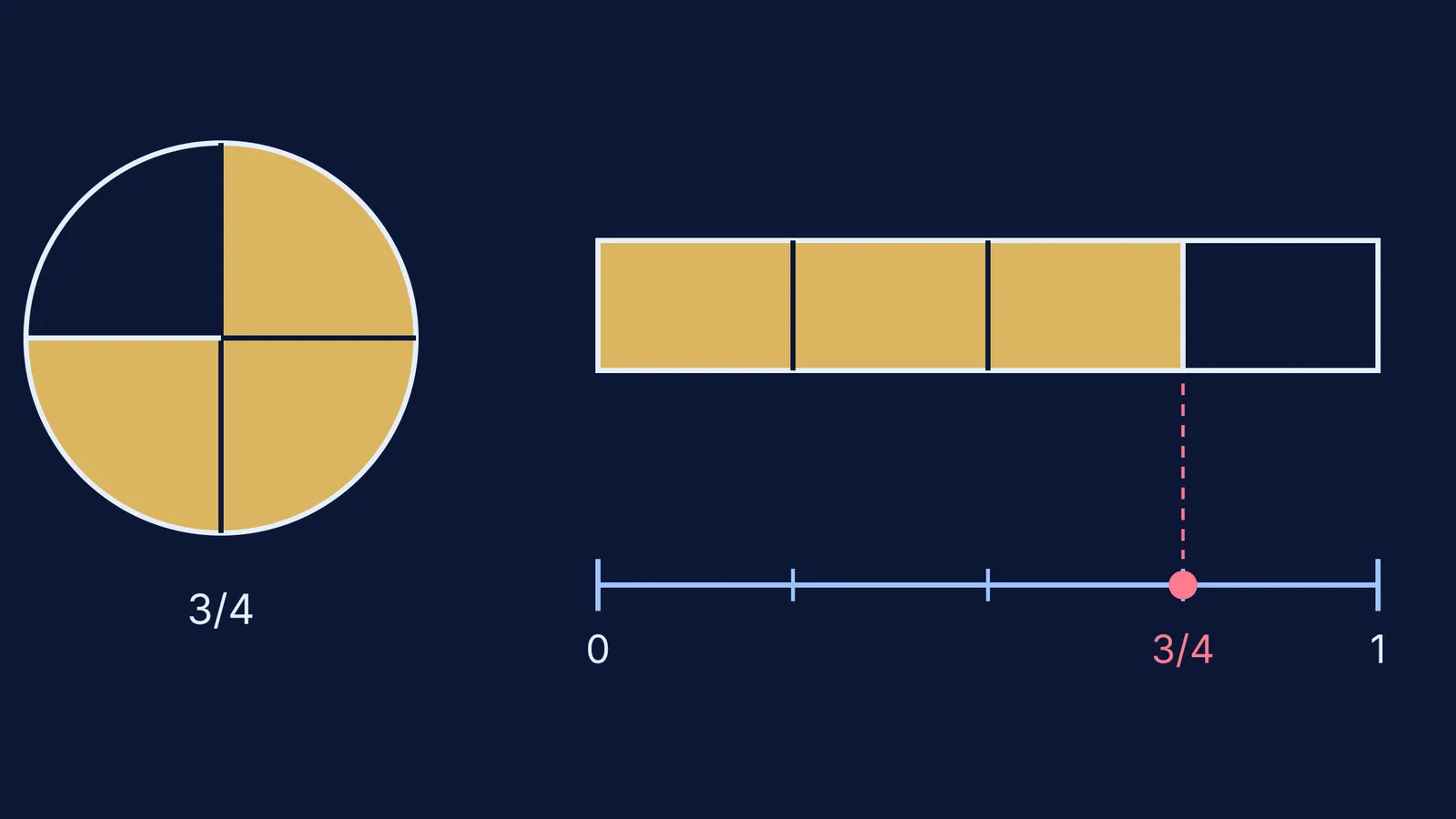
A pizza (an area model) shows a fraction as part of one whole. A strip puts that part in a straight line, so two equal strips can be lined up. A number line shows a fraction as a number with its own place between 0 and 1.
The US Institute of Education Sciences practice guide on fractions recommends using number lines "as a central representational tool in teaching this and other fraction concepts from the early grades onward", and rates the evidence for helping students see fractions as numbers as moderate.
An experiment backs this up. In a 2017 study in Developmental Psychology, Noora Hamdan and Elizabeth Gunderson trained second and third graders with number lines, area models or a non-numerical control activity. Each training group got better at its own kind of picture, but only the number-line group improved at comparing fractions, a task none of them had been trained on. So start with the pizza and finish on the number line.
How do you ask AI to describe a fraction problem as a strip and number line?
Ask for a description, not an answer, so you still do the thinking. Paste this:
"Here is a fraction problem: [paste the problem]. Do not solve it."
"Describe in words how to draw it three ways: a pizza cut into equal slices, a strip (one rectangle cut into equal parts), and a number line from 0 to 1."
"For each picture, tell me how many equal parts to make, which parts to shade or mark, and how long to make the strip and the line so every part is a whole number of centimetres."
"Stop there and wait for me to tell you what I drew and what answer I got."
When you have drawn and solved it, send a second message: "My answer is ___. Here is how I got it from the number line: ___. Check my reasoning, not just the final number."
Worked example: is 2/3 bigger than 3/4?
Pizza. One pizza cut into 3 equal slices with 2 shaded, another cut into 4 with 3 shaded. Both look "mostly full". Hard to call.
Strip. Draw two 12 cm strips, one above the other. Cut the first into thirds (4 cm each) and shade 8 cm. Cut the second into quarters (3 cm each) and shade 9 cm. The quarter strip reaches further, because its unshaded gap (1/4) is smaller than 1/3.
Number line. Draw a 12 cm line from 0 to 1. Mark 2/3 at 8 cm and 3/4 at 9 cm. 3/4 sits to the right, so it is bigger, by 1 cm out of 12, which is 1/12.
Now push one step further: what is 2/3 + 1/4? On the same 12 cm line, start at 8 cm and move 3 cm. You land on 11 cm, so the answer is 11/12. The ruler found the common denominator for you.
If fractions with different denominators still feel slippery, our guide to adding fractions with different denominators using the LCM covers the common-denominator step, and solving fraction of a quantity word problems uses a bar model, the same strip idea, on rupees and kilograms.
How do you check the AI's answer?
Chatbots can still slip on the numbers or give the right answer for the wrong reason. Check every reply:
Equal parts. Every slice, strip part and number-line gap must be the same size.
Same whole. When comparing two fractions, both pictures must start from the same size whole.
0 and 1 marked. A number line without both ends is not a number line.
All three agree. If the strip says 3/4 is bigger but the AI's sentence says otherwise, something is wrong. Find which.
Reason, not size of digits. "3/4 is bigger because 3 and 4 are bigger numbers" is a wrong reason, even when the answer happens to be right. Try 2/3 against 3/5 and see it fail.
If you would rather have a tutor that draws alongside you, Fermi's AI tutor writes on a board, draws the figure and checks understanding as it goes, so the picture and the reasoning arrive together. For extra practice, the Fermi Problem Library has worked problems with a step-by-step solver that explains the reasoning rather than printing an answer.
For younger children, see helping when your Class 6 child is confused by fractions. Tonight, take one homework fraction, run the two prompts, and draw all three pictures before you read the AI's check.