

On this page
When a child reaches Class 6, mathematics undergoes a quiet shift. The solid, countable world of whole numbers gives way to fractions—a system where the rules seem to change. Suddenly, dividing can make a number larger, and multiplying can make it smaller. A child who was confident in maths a year ago might start confusing the steps for adding unlike fractions with the steps for multiplying them.
If you find yourself repeatedly explaining that 1/2 + 1/3 is not 2/5, the problem is rarely that they are not paying attention. The issue is usually that they are trying to apply a memorised procedure to numbers they do not fully understand.
Why are fractions so confusing in Class 6?
Fractions break the intuition built over years of counting. A child learns early on that 4 is larger than 2, so it takes a mental leap to understand why 1/4 is smaller than 1/2.
The US Department of Education's What Works Clearinghouse guide (2010) on effective fractions instruction emphasises using number lines as a "central representational tool" to help students visualise fractions as numbers with specific magnitudes, rather than just isolated "parts of a pizza".
While pizzas and cakes are good for introducing the idea of sharing, they can be awkward when it comes to adding. You cannot easily stack two different pizza slices to see how they combine. This is where linear models—like paper strips—work better, as they map naturally to a number line and prepare the child for measuring distance and everyday activities like cooking.
How do you explain equivalent fractions?
The NCERT Class 6 Mathematics textbook introduces equivalent fractions as different fractions representing the same part of a whole. Before a child can add 1/2 and 1/4, they must deeply understand that 1/2 is exactly the same quantity as 2/4.
A seminal 2003 study published in *Learning Disabilities Research & Practice* found that teaching fractions using a Concrete-Representational-Abstract (CRA) sequence—starting with physical manipulatives before moving to drawings and symbols—produced a better understanding of equivalent fractions compared to starting with drawings.
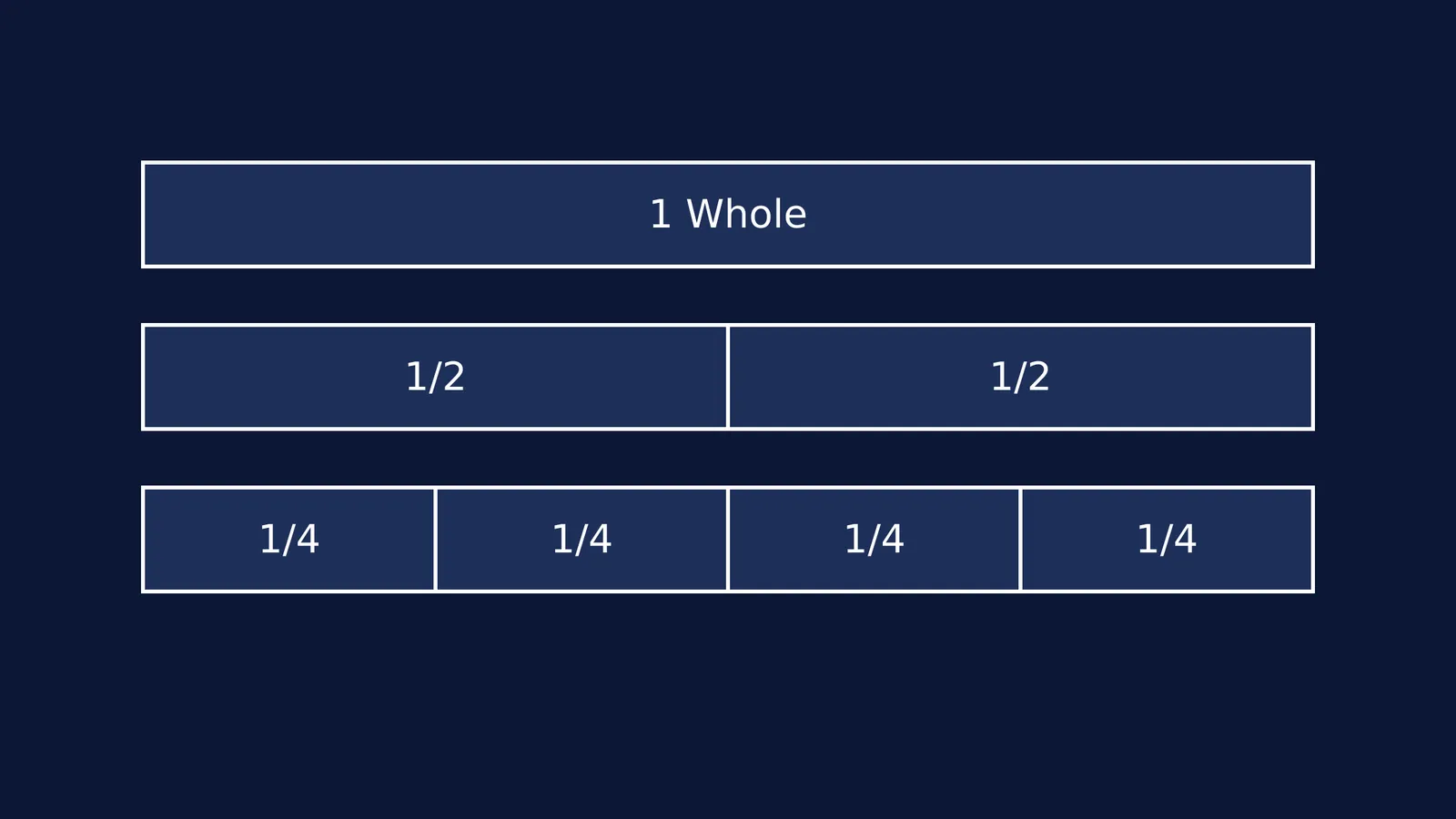
To build this understanding concretely, try this short activity at home:
Cut four identical strips of paper.
Leave the first strip blank and label it "1 Whole".
Fold the second strip in half, trace the fold with a pen, and label each section "1/2".
Fold the third strip into thirds (you may need to help them measure this) and label the sections "1/3".
Fold the fourth strip in half, and then in half again. Trace the folds and label the sections "1/4".
Now, ask your child to align the "1/2" strip just under the "1/4" strip. They will visually see that two 1/4 sections line up perfectly with one 1/2 section.
How do you add and subtract fractions?
Once the child understands equivalence, addition stops being an abstract rule about finding a Lowest Common Multiple (LCM) and becomes a logical necessity.
If you ask a child to add one apple and two oranges, they know they have three pieces of fruit, but they cannot call them "three apples" or "three oranges". They need a common name. Fractions are the same. You cannot easily add 1/2 and 1/4 because they are different sizes. You need to convert them into pieces of the same size—in this case, quarters.
Here is a practical framework to guide them when they get stuck on a worksheet:
Step 1: Check the denominators (the sizes). Are we adding pieces of the same size? If yes, just add the numerators. If no, go to Step 2.
Step 2: Find a common size. Use the paper strips or draw a quick sketch. Can we turn the halves into quarters?
Step 3: Rename the fraction. Show that 1/2 is renamed as 2/4.
Step 4: Add. Now add 2/4 and 1/4 to get 3/4.
If your child is still struggling to picture these operations or needs step-by-step guidance through their homework, Fermi's AI tutor works out what they already know, builds a plan for the session, and teaches through it—drawing the figure and checking understanding as it goes.
Learning fractions is a marathon, not a sprint. By slowing down, getting the paper out, and showing how maths is used in real life, you can help your child build a foundation that will carry them through algebra and beyond.


