

On this page
When a Class 7 mathematics paper asks, "In a school of 250 students, 3/5 are girls; how many are girls?", many students freeze. They know how to multiply and divide whole numbers, but seeing a fraction next to a large quantity breaks their usual rules.
A 2022 study found that elementary students face challenges interpreting context-based problems and the usage of the word "of" (Journal on Mathematics Education, 2022). Testing 5th graders, researchers discovered that children's procedural knowledge is more dominant than conceptual knowledge, which falls apart when the word problem changes slightly.
Once a student can translate "of" into a physical picture—and then into multiplication—the rest is just arithmetic.
Why does "of" mean multiplication in maths?
In everyday language, "of" usually means a portion of a group. If you have "two of the 50-rupee notes", you have 2 × 50 = 100 rupees. If you eat "half of a pizza", you eat 1/2 × 1 pizza.
Similarly, "3/5 of 250" simply means 3/5 × 250.
But as the 2022 study noted, just telling a child to memorise the rule "replace 'of' with a multiply sign" is a brittle strategy. They need to see *why* it works. (You can read more about how rules handle these operations in our guide to simplifying fractions with brackets and 'of'.)
How do you draw a bar model for fractions?
To build conceptual knowledge, we have to make the abstract numbers physical. The easiest way is drawing a bar model.
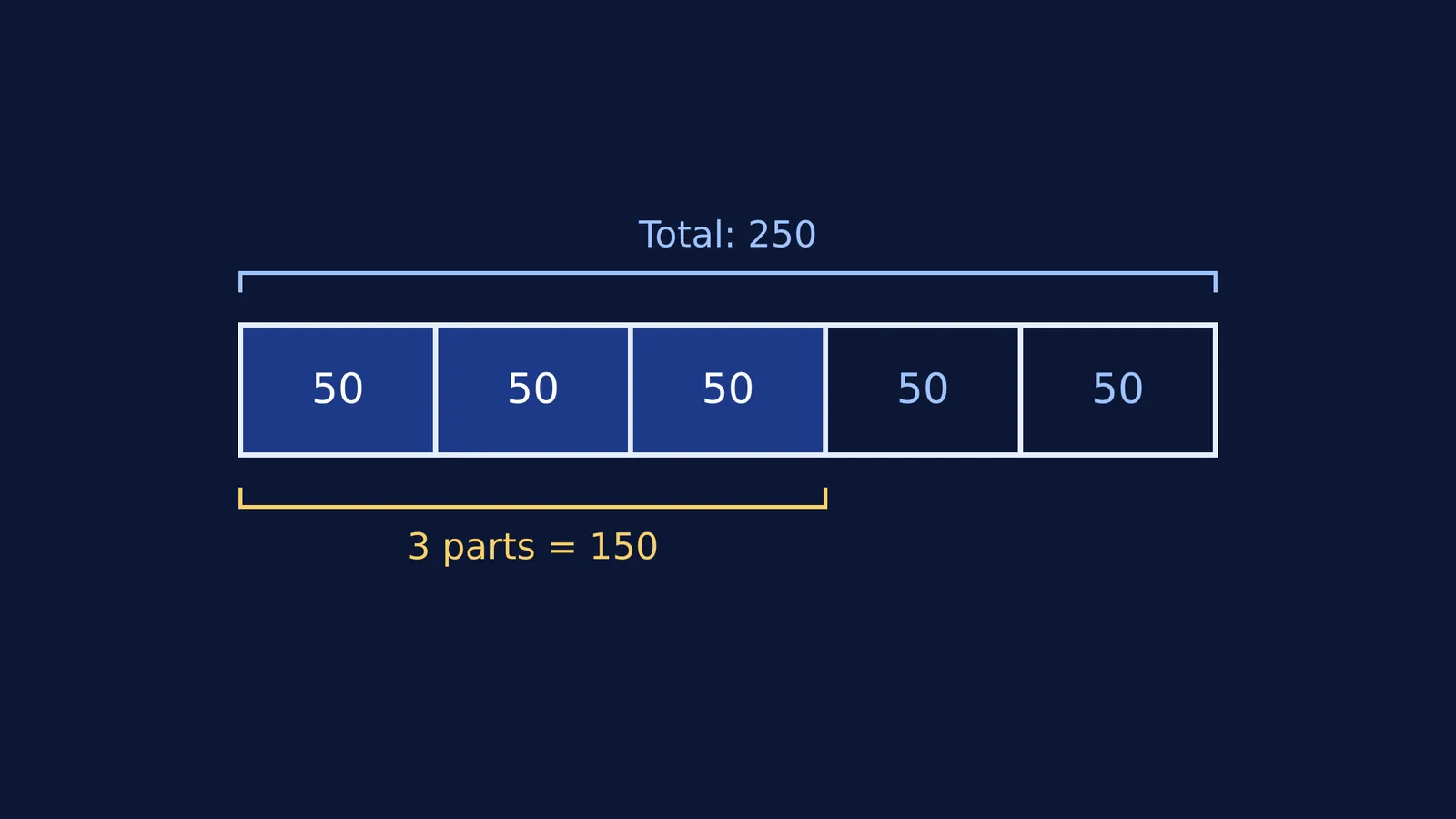
Let us use the 3/5 of 250 example:
The total: Draw one long rectangle and label the whole thing 250.
The denominator (bottom number): The fraction is 3/5, so the denominator is 5. It tells us how many equal slices to cut the total into. Divide the 250 rectangle into 5 equal boxes. 250 ÷ 5 = 50. Write "50" in each box.
The numerator (top number): The fraction is 3/5, so we only want 3 of those slices. We highlight 3 boxes. 50 + 50 + 50 = 150. (Or 3 × 50 = 150).
The answer is 150 girls. This visual approach proves to the student why they are dividing by the bottom and multiplying by the top. (For another visual approach, see why the area model makes fraction multiplication make sense.)
How do you solve fraction of a remainder word problems?
Word problems get harder when they add extra steps, especially when they ask for a fraction of a *remainder*. This is a classic trap in middle school exams.
Look at this question: "Rahul reads 1/3 of a book on Saturday. On Sunday, he reads 3/4 of the remaining pages. The book is 300 pages long. How many pages are left for Monday?"
If a student rushes and calculates 3/4 of 300 for Sunday, the whole answer derails. Here is the step-by-step breakdown:
Saturday: Rahul reads 1/3 of 300. (300 ÷ 3 = 100 pages).
The remainder: 300 total − 100 read = 200 pages remaining.
Sunday: Rahul reads 3/4 *of the remaining pages*. He reads 3/4 of 200. (200 ÷ 4 = 50. 50 × 3 = 150 pages).
Monday: The pages left are 200 − 150 = 50 pages.
This is exactly where a one-to-one tutor helps untangle the logic. If your child consistently mixes up the original total and the remainder, the Fermi Problem Library has worked problems with a step-by-step solver that explains the reasoning rather than printing an answer.
What is the hidden trap in fraction word problems?
When your teenager is staring blankly at a fraction word problem, the trap is that they are guessing an operation instead of visualizing the quantities. Do not say, "Just multiply them." Instead, use these prompts to help them draw the bar model:
"Let's draw a bar for the total. How big is the whole group?"
"Look at the fraction. How many equal slices does the bottom number want us to make?"
"If the whole bar is 250, how much is one slice?"
"Now look at the top number. How many of those slices are we keeping?"
By sketching it out, the intimidating "3/5 of 250" turns back into the basic division and multiplication they already know.