

On this page
Maths expressions with multiple fractions can look messy. When you see addition, division, brackets and the word "of" all in the same line, it is hard to know where to begin. According to an error analysis study, 46% of student mistakes in fraction arithmetic are caused by a lack of conceptual understanding rather than simple calculation errors Jurnal Teknologi Pendidikan.
The fix is to lean on a rigid framework. You might have mastered the basics of Working with fractions in Class 7: multiplying and dividing, but putting them together needs a set sequence. That sequence is the BODMAS rule.
What is the BODMAS rule for fractions?
In the UK and Commonwealth countries, the mathematical order of precedence is taught using the acronym BODMAS Wikipedia. This tells you the exact order in which to solve parts of a long expression:
Brackets: Clear these first.
Of: This simply means fraction multiplication.
Division and Multiplication: Do these from left to right.
Addition and Subtraction: Do these last, from left to right.
If you are just getting comfortable with the basics, we cover foundational concepts in Fractions in Class 6: equivalent fractions and how to compare them.
How do you simplify fractions with brackets and 'of'?
When you simplify fractions with brackets and 'of', the most common trap is ignoring the special status of 'of'.
In everyday language, finding "half of something" is an intuitive step. In mathematical notation, 'of' translates directly into a multiplication sign (×). However, BODMAS deliberately places 'of' higher in the queue than ordinary division or multiplication.
Why does this matter? If you have an expression like 1/3 ÷ 1/2 of 6, resolving the 'of' first gives you 1/3 ÷ 3, which equals 1/9. If you were to mistakenly divide first, treating 'of' as just another multiplication, you would get (1/3 ÷ 1/2) × 6, which equals 2/3 × 6 = 4. Getting the sequence wrong completely changes the outcome. You must resolve 'of' before you divide.
If you keep getting stuck because you try to run multiple operations at once, the Fermi Problem Library has worked problems with a step-by-step solver that explains the reasoning rather than printing an answer.
How do you handle different types of brackets?
When you face complex fraction problems, you will often see more than one type of bracket. The standard order for clearing them is:
Round brackets or parentheses ( )
Curly brackets or braces { }
Square brackets [ ]
You always work from the inside out. For example, if you see [ 1/2 + { 1/4 of ( 1/3 + 1/6 ) } ], you must ignore the square and curly brackets at first. Go straight to the innermost round brackets: 1/3 + 1/6. By the time you reach the outer square brackets, the inside will have collapsed into a single, manageable number.
A worked example: step-by-step simplification
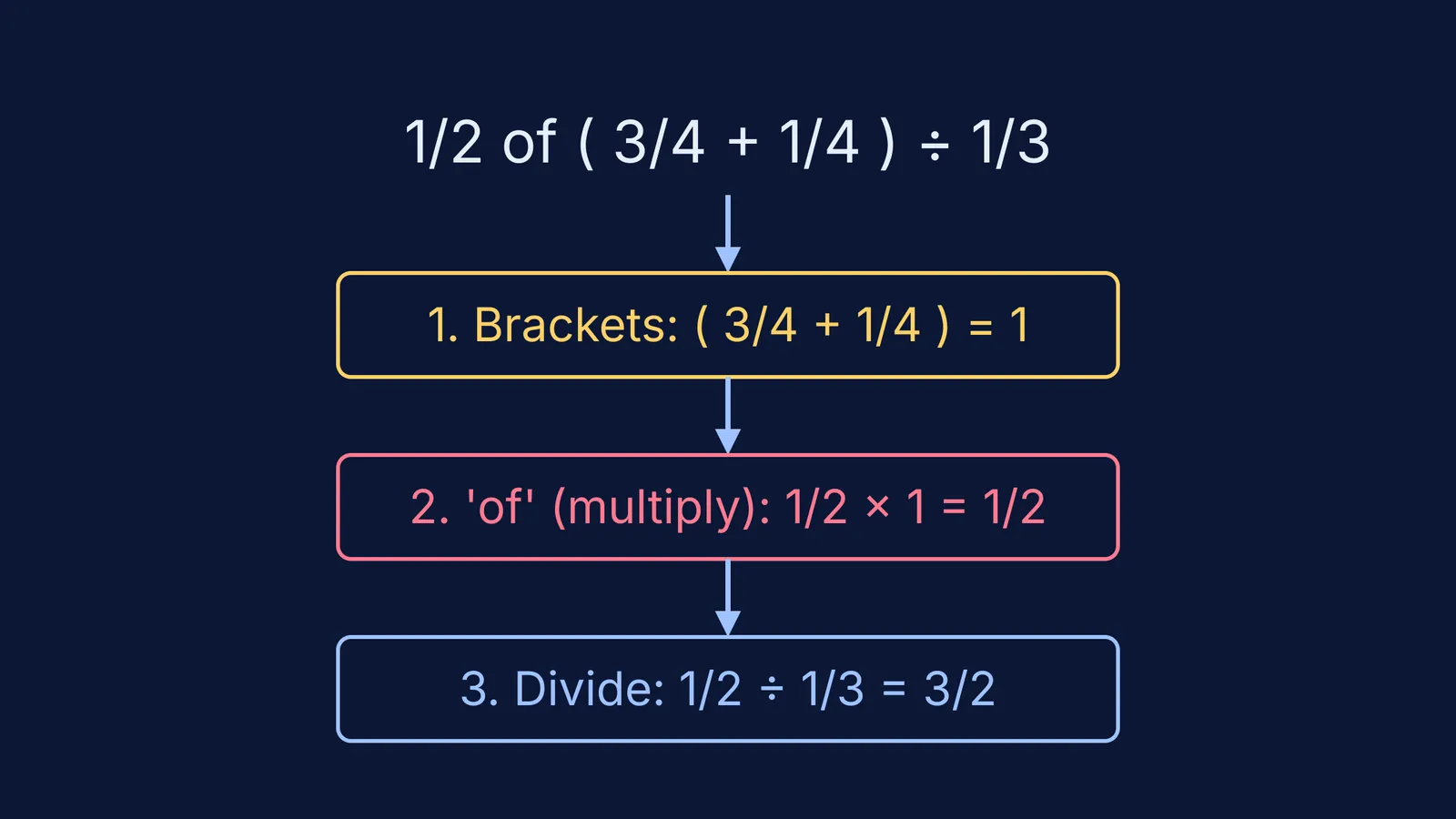
Let us tackle the exact problem shown in our diagram above:
1/2 of ( 3/4 + 1/4 ) ÷ 1/3
Here is how you apply BODMAS to simplify it without making a conceptual error.
Step 1: Brackets (B) Look for the innermost brackets and solve what is inside. 3/4 + 1/4 = 4/4 Since 4/4 is exactly 1, our expression shrinks to: 1/2 of 1 ÷ 1/3
Step 2: Of (O) Next, we handle the 'of' operator. Treat this as multiplying the two numbers immediately attached to it. 1/2 × 1 = 1/2 Now substitute that back into the line. The expression is much shorter: 1/2 ÷ 1/3
Step 3: Division (D) To divide fractions, you take the first fraction and multiply it by the reciprocal (the flipped version) of the second fraction. The reciprocal of 1/3 is 3/1, or just 3. 1/2 × 3 = 3/2
The final, simplified answer is 3/2, which you can also write as the mixed number 1 1/2.
What if the problem has mixed numbers?
If your expression includes mixed numbers like 2 1/4, you should add a step before checking your BODMAS checklist: convert every mixed number into an improper fraction.
For example, 2 1/4 becomes 9/4. Why? Because carrying a whole number and a fraction through the rigid rules of BODMAS often leads to arithmetic slips, particularly when division or 'of' gets involved. Converting everything to improper fractions gives you a uniform format. When every number has a clear numerator and denominator, applying rules like "multiply by the reciprocal" becomes automatic, eliminating the guesswork of what to do with the whole numbers during a division step.
Working systematically prevents panic. Fermi's AI tutor can work out what you already know and build a plan for the session, so you sit down to a clear next step. Once you trust the BODMAS sequence, even the most sprawling algebraic fraction falls apart neatly.


