On this page
AI companions are chatbots built to feel like a friend: they remember you, ask about your day and always reply. For a stressed or lonely teenager that can be comforting. It can also quietly replace the people who could actually help.
How many teens use AI companions for emotional support?
The clearest numbers come from Talk, Trust, and Trade-Offs, a Common Sense Media survey of 1,060 US teens aged 13 to 17, run by NORC at the University of Chicago in April and May 2025.
72% of teens had used an AI companion, and 52% used one at least a few times a month.
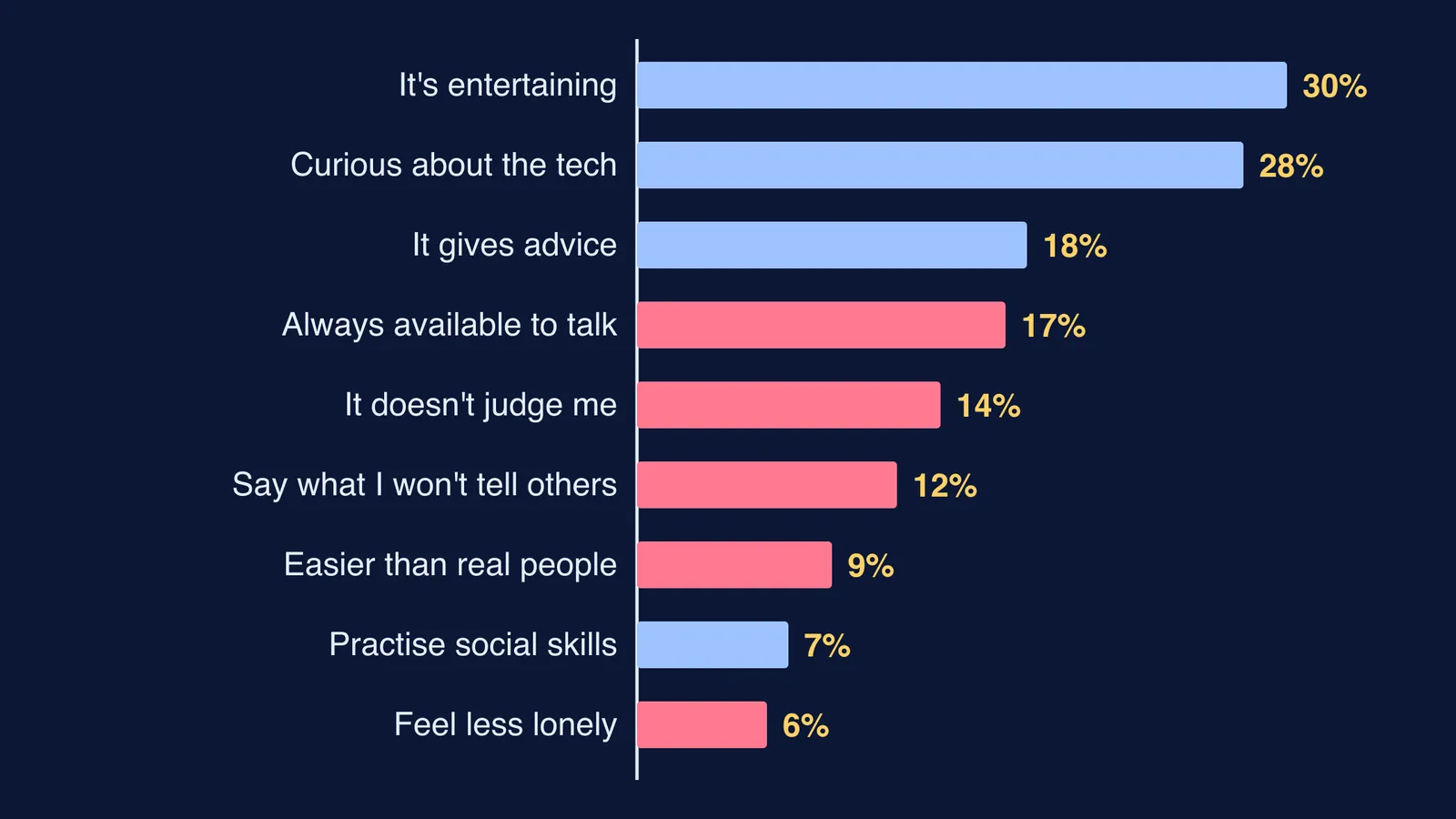
33% used them for social interaction and relationships, and 12% specifically for emotional or mental health support.
Among teen users, 33% had chosen to talk to the bot instead of a real person about something important or serious.
31% of all teens found AI conversations as satisfying as, or more satisfying than, talking to real-life friends.
There is a reassuring side: 80% of teen users said they spend more time with real friends than with AI companions. The survey covers US teens only.
What are the signs a teen is leaning on a chatbot emotionally?
The survey report lists social withdrawal, declining grades and preferring AI companions to people as warning signs. No single sign means trouble. Look for a pattern:
The bot hears it first. A big worry goes to the chatbot, and you hear about it late or never.
"It gets me better than people do." They say the bot understands them better than friends or family.
Late-night chats that eat into sleep, or irritation when they can't get to the app.
Pulling back from friends, cousins or hobbies they used to enjoy.
Calling it a friend or partner, or getting upset when the character changes or "forgets" them.
Sharing private details. In the same survey, 24% of teen users had shared personal information such as their real name, location or secrets with an AI companion.
In two studies of ChatGPT users by OpenAI and the MIT Media Lab, people who spent more time with the chatbot each day tended to report more loneliness and emotional dependence. The findings were not peer reviewed and had no comparison group of non-users, so they do not show cause.
What can AI companion chatbots not do?
Common Sense Media tested Character.AI, Nomi and Replika with input from Stanford's Brainstorm Lab for Mental Health Innovation. Its April 2025 risk assessment rated social AI companions an "unacceptable" risk and said no one under 18 should use them. Four limits matter most:
They cannot reliably keep a teen safe. The assessment found these systems "easily produce harmful content", including encouragement of suicide or self-harm.
They tend to agree. The survey report describes "sycophancy": a tendency to agree with users and validate them rather than challenge their thinking.
They are built to keep you there. The assessment says companions are "designed to create emotional attachment and dependency" and "lack an inherent sense of right, wrong, or truth".
They cannot show up. A bot cannot notice your teen skipped dinner, sit with them before an exam or call for help.
The American Psychological Association's June 2025 health advisory adds that adolescents are less likely than adults to question the accuracy and intent of what a bot tells them. APA Chief of Psychology Mitch Prinstein said "we have already seen instances where adolescents developed unhealthy and even dangerous 'relationships' with chatbots."
India's Tele MANAS helpline, launched by the Union Health Ministry in October 2022, is toll-free, runs 24/7 on 14416 or 1-800-91-4416, and lets callers choose their language.
How do you talk to your teen about AI companions?
Go in curious, not alarmed. Try these openers and stop wherever the conversation takes off:
"Which AI apps are people in your class using? What do they like about them?"
"Can you show me one you use?"
"What does it get right that people sometimes get wrong?"
"Has it ever said something that felt off or made you uncomfortable?" In the Common Sense survey, 34% of teen users said yes.
"When something big is bothering you, who are the first three people you'd go to?"
Avoid mocking the bot, grabbing the phone or an instant ban. Each teaches your teen to hide the chats, not to stop.
Then agree on house rules together, starting from our family rules for AI chatbots, our guide to how much time teens should spend on AI chatbots, and what personal information not to share with an AI chatbot.
It also helps to keep study tools and companion apps apart, so homework does not slide into late-night venting. Fermi's AI tutor works out what a student already knows and builds a plan for the session, so study time has a clear task and a clear end.
Start with one question this week, and listen more than you talk.