

On this page
Your teenager has a chatbot open again. Is that an hour of Class 11 physics, or an hour of something else? A daily limit in minutes will not tell you. What the chatbot is doing for your child tells you far more, and you can check that in one short talk each week.
Is there a safe amount of time for a teenager on an AI chatbot?
Teen use has grown fast. In a Pew Research Center survey of 1,391 US teens, 26% of 13- to 17-year-olds said they had used ChatGPT for schoolwork in 2024, double the 13% in 2023.
UNESCO's advice is about age, not hours. UNESCO's 2023 guidance on generative AI in education sets an age limit of 13 for using AI tools in the classroom. It does not give a number of minutes per day.
So instead of a timer, ask two questions: what is the chatbot doing, and what is it replacing?
Why does purpose matter more than minutes?
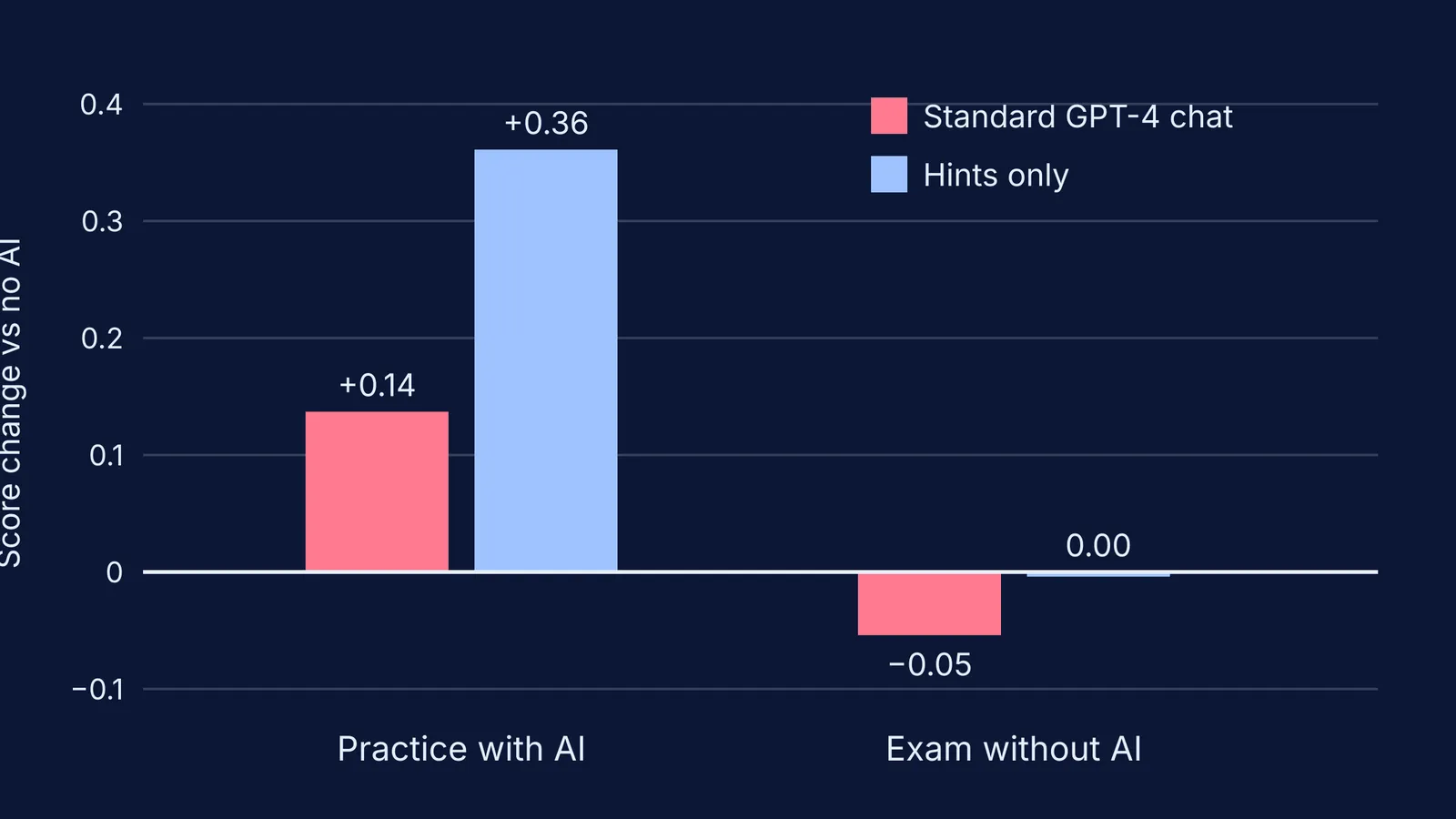
The clearest evidence comes from a field experiment with nearly 1,000 high school maths students in Turkey, published in PNAS in 2025 by Hamsa Bastani and colleagues. One group used a standard GPT-4 chat. Another used a version told to give hints, not answers.
During practice with AI, scores rose 48% with the standard chat and 127% with the hints-only version, compared with students who had no AI. On the later exam without AI, the standard-chat group scored 17% lower than students who never had AI, while the hints-only group was statistically no different.
Same subject, same kind of chatbot. The difference was whether it did the thinking for the student.
Time is not irrelevant, though. In a four-week MIT Media Lab and OpenAI study of 981 adults, participants who chose to use the chatbot more showed consistently worse outcomes: more loneliness, less socialising with people, more emotional dependence and more problematic use. This was a link, not proof that the extra time caused the harm.
Personal chats are common among teens. A Common Sense Media survey of 1,060 US teens found that 72% had used AI companions, and 13% used them daily. About one-third of the teens who used companions had chosen one over a person for a serious conversation.
What does healthy and unhealthy chatbot use look like?
Signs it is going well:
Your teen can explain a chapter in their own words after using the chatbot.
They ask for hints, checks on their working, or a different explanation, then try again alone.
Chatbot sessions have a start, a goal and an end.
Friends, sport, sleep and family meals are where they were.
Signs to talk about soon:
Homework is done fast, but test marks drop or they cannot explain their answers.
They paste in whole questions and copy what comes back.
Late-night chats, or hiding the screen when you walk in.
The chatbot becomes the main place they take worries, instead of friends or family.
Tele MANAS is run by the Ministry of Health and Family Welfare, which describes it as a toll-free number offering 24x7 tele-mental health counselling.
How do you check in without spying?
Try a 10-minute talk every Sunday. Keep the tone curious, not suspicious. Ask your teen to open their chat history with you, by choice.
Purpose: "Show me one chat this week that helped you. What did you learn?"
Thinking: "Pick one answer it gave. Can you explain it to me without the screen?"
Balance: "Roughly how much was study, and how much was just talking?"
Feelings: "Did anything it said feel odd or make you uncomfortable?"
One change: "What is one thing we will try next week?"
A made-up example. Meera is in Class 11 and spends about 90 minutes a day on a chatbot. On Sunday she shows her parents a chat where it solved her projectile numericals. She cannot rework one without it. Her agreed change: type her own attempt first and ask only for a hint at the step where she is stuck. The minutes stay roughly the same; the purpose changes.
If study is the main use, a tool built to teach rather than hand over answers fits this habit. Fermi's AI tutor works out what a student already knows, builds a plan for the session and checks understanding as it goes, so the time has a clear goal.
For more, see our two-bucket plan for AI tutor time and screen time, whether to keep some study days free of AI, and what personal information not to share with a chatbot.


