

On this page
If your phone is always next to your textbook, you are not alone. AI tools can instantly unclog a bottleneck in a tough physics problem or break down an obscure biology concept. But as these tools become a normal part of exam preparation, a question naturally follows: should you have days without using AI for study? The science of how we learn says yes. Taking regular breaks from instant answers is not about rejecting technology; it is about protecting the cognitive friction that builds permanent memory.
Why does learning feel harder without AI?
When you are stuck on a problem and instantly look up a hint, your brain experiences "fluency". The answer makes perfect sense as you read it, making you feel you have learned the concept. But this is often an illusion.
Learning scientists call the alternative "desirable difficulties". When you are forced to dig for an answer from your own memory without external help, the friction you feel is the exact process that strengthens neural pathways. Manu Kapur's research into "productive failure" shows that struggling with a complex maths problem before being taught the canonical solution leads to significantly higher conceptual understanding and ability to transfer knowledge to new problems [[1]](https://doi.org/10.1111/cogs.12107). Your failures map out the boundaries of the problem, making your brain far more receptive when you finally see the correct method.
Does using AI for homework lower exam scores?
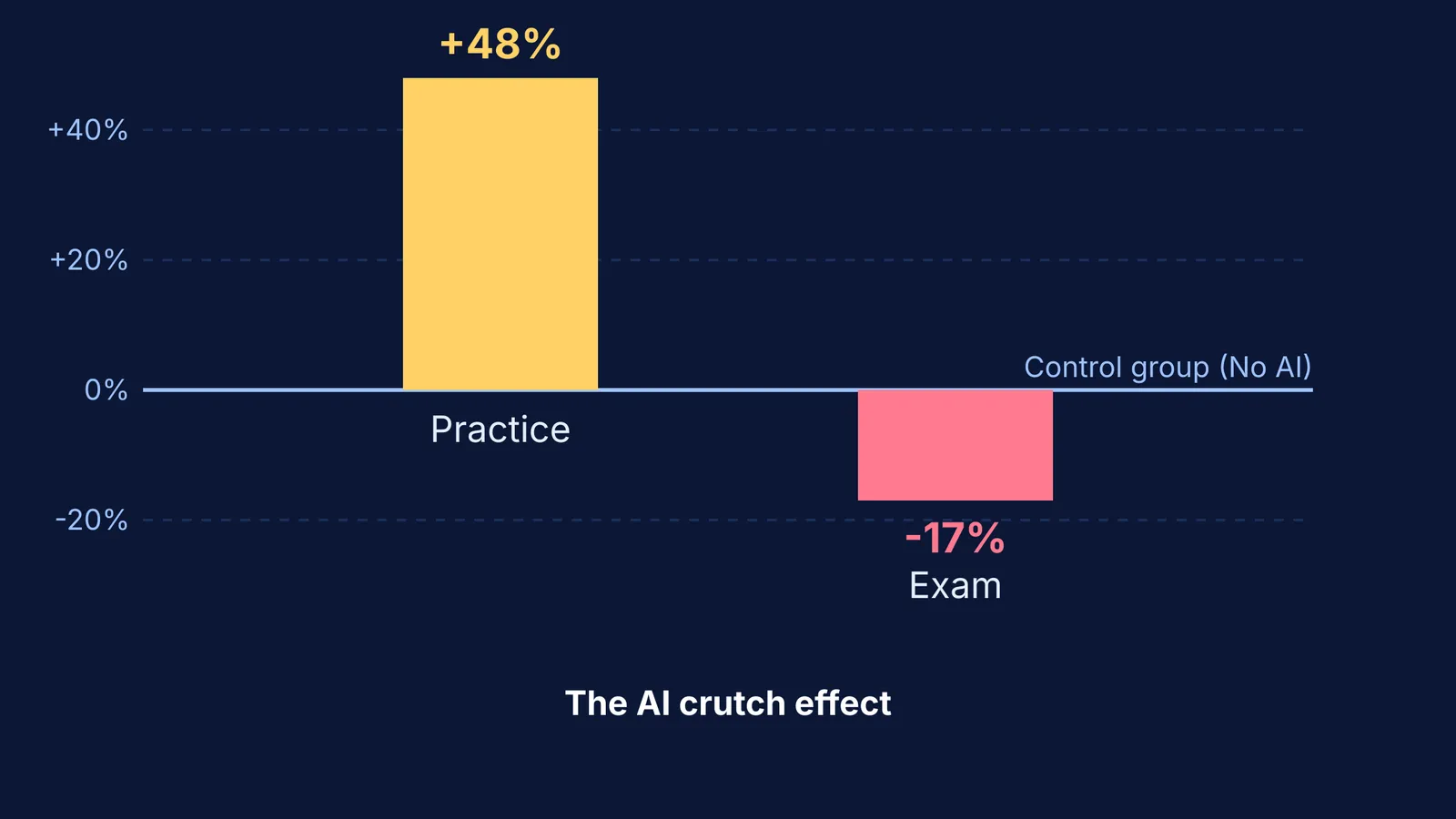
If you rely on AI to guide you through every sticky point, you rob yourself of this productive failure. In a 2025 study published in *PNAS*, researchers from the University of Pennsylvania tracked nearly 1,000 high school students learning mathematics [[2]](https://doi.org/10.1073/pnas.2422633122). The students who used a standard generative AI chatbot for their homework solved 48% more practice problems correctly than a control group.
However, when the AI was taken away for an exam, the AI group scored 17% worse than the students who had studied with no AI at all. The researchers found that the AI acted as a crutch. Because students used it to fetch answers rather than explanations, they offloaded the heavy lifting. They felt confident, but their underlying problem-solving skills had decayed. A 2018 meta-analysis on practice tests confirms that retrieving answers on your own is critical for doing well on new questions.
How should you split your study week?
You do not have to abandon your digital tutor to build independence. Instead, use this practical framework to decide when to study alone and when to seek help.
1. The first attempt rule Never open an AI tool during your first pass at a problem set. Give yourself a solid block of uninterrupted time to struggle. If you cannot solve a physics numerical, draw the free-body diagram, write out the known variables, and list the formulas that might apply. Only when you have exhausted your own mental toolbox should you ask for help.
2. Designate AI-free days for testing If you are preparing for competitive exams like JEE or NEET, treat a specific day each week as a pure retrieval session. Do a mock test or a timed worksheet with only a pen and paper. This simulates the exam environment and forces you to confront exactly what you have retained.
3. Use AI for concepts, not answers When you do use AI, change how you prompt it. The University of Pennsylvania study [[2]](https://doi.org/10.1073/pnas.2422633122) found that students who used an AI tutor designed to give hints—rather than direct answers—did not suffer the 17% exam penalty. (Read more about ChatGPT hints vs human tutor hints). This is exactly how Fermi's AI tutor is built to work. Rather than printing a final answer, Fermi works out what you already know, builds a plan for the session, and teaches through the bottleneck. It holds a line of reasoning, checking your understanding as you go.
Which topics are best to study alone?
Not every subject needs the same treatment. Here is a quick guide on where to apply your AI-free days.
Rote memorisation: Topics that require brute recall, like the names of Class 10 stem modifications or inorganic chemistry exceptions, should be studied entirely without AI. Flashcards and active recall are your best tools here.
Applying known methods: If you understand the theory of rotational motion but need practice, work through the Fermi Problem Library. Its step-by-step solver explains the reasoning rather than just printing the answer, but try the steps yourself first.
Visualising the abstract: Save your AI and screen time for ideas that are genuinely hard to picture, like electric fields or optics. An interactive model in the Fermi Simulation Lab will clear up conceptual confusion much faster than staring at a textbook page for an hour.


