On this page
Keto-enol tautomerism is easy to follow in class and easy to get wrong on paper. The fix is a two-move rule you can check by counting atoms, and an AI chat can count with you if you make it show its working.
What is keto-enol tautomerism?
Tautomers are "readily interconverted constitutional isomers, usually distinguished by a different location for an atom or a group", as the LibreTexts organic chemistry chapter on keto-enol tautomerism/22%3A_Carbonyl_Alpha-Substitution_Reactions/22.01%3A_Keto-Enol_Tautomerism) puts it.
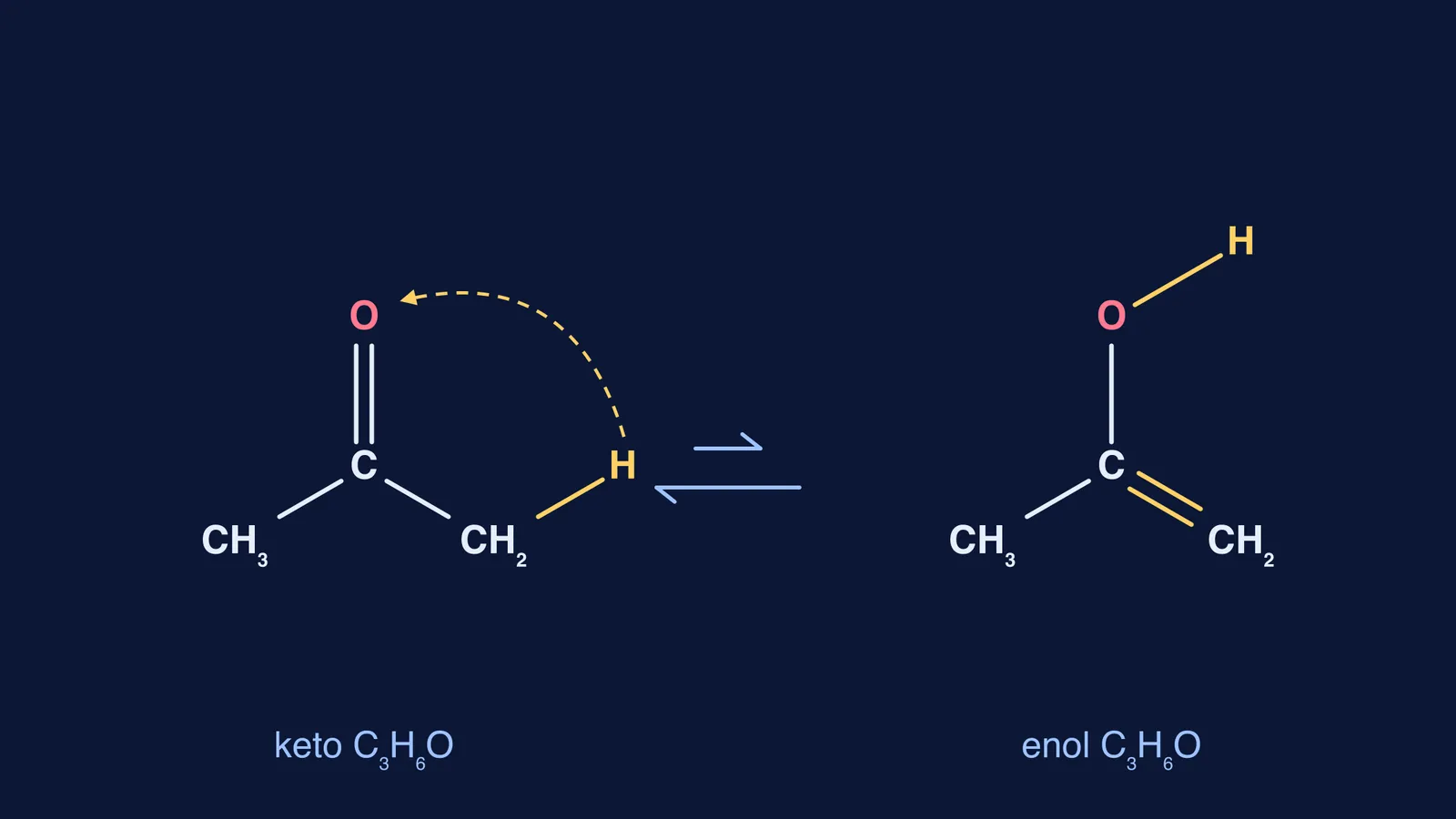
Here, a hydrogen moves from the carbon next to the C=O (the alpha carbon) to the oxygen, and the double bond shifts from C=O to C=C. The keto form is the ordinary carbonyl compound. The enol is named for what it has: "ene" for the C=C and "ol" for the O-H.
Because only positions change, both forms share one molecular formula. That is the check you hand to AI.
How do you draw the enol form from the keto form?
Use the two-move rule. Here it is on acetone, CH3COCH3.
Find an alpha carbon: a carbon bonded directly to the C=O carbon that carries at least one hydrogen. In acetone, both CH3 groups qualify.
Move one hydrogen from that alpha carbon to the oxygen. The oxygen becomes O-H.
Move one double bond. C=O becomes C-O, and a new C=C forms between the carbonyl carbon and the alpha carbon.
Redraw the whole molecule: CH2=C(OH)-CH3, which is prop-1-en-2-ol.
Count atoms. Keto: 3 C, 6 H, 1 O. Enol: 3 C, 6 H (two on CH2, one on O, three on CH3), 1 O. Both are C3H6O.
Count bonds. Every carbon needs four. The old alpha carbon now has two hydrogens and a double bond, which makes four.
How do you check a tautomer with AI?
In the ChemBench study, Adrian Mirza and colleagues tested leading language models on more than 2,700 chemistry question-answer pairs (Nature Chemistry, 2025). The best models, on average, outperformed the best human chemists in that study, but the authors also found that the models "struggle with some basic tasks and provide overconfident predictions". A confident "yes, that's correct" is not a check.
So do your own count first, then paste your two structures and ask:
"Here is my keto form: CH3COCH3. Here is my enol: CH2=C(OH)CH3. Count C, H and O in each, atom by atom, and tell me whether the molecular formulas match."
"List the bonds on every carbon in the enol. Does each carbon have exactly four?"
"Which hydrogen moved, from which atom to which atom? Which double bond moved?"
"Which form is more stable here? Give the reason in terms of bond strengths or extra stabilisation, not just the answer."
If the AI's count differs from yours, trust neither total. Write out every hydrogen one by one; condensed formulas hide hydrogens, for you and for the model.
Which form is more stable, keto or enol?
For simple ketones and aldehydes, the keto form wins. According to the LibreTexts keto-enol chapter/22%3A_Carbonyl_Alpha-Substitution_Reactions/22.01%3A_Keto-Enol_Tautomerism), acetone is more than 99.999% keto tautomer.
The same source says the keto form is preferred by about 45-60 kJ/mol, mainly because the C=O double bond (749 kJ/mol) is stronger than the C=C double bond (611 kJ/mol). It also notes that propanal is 1000 times more likely to be in its enol form than acetone, and that ketones are over 100,000,000 times more likely to be enolised than esters.
The big exception is 1,3-dicarbonyl compounds. LibreTexts reports that 2,4-pentanedione is in its enol form 85% of the time under normal conditions, because the enol forms an intramolecular hydrogen bond and its C=C is conjugated with the remaining C=O. Our post on why acetylacetone has such a high enol content works through that case.
Test the AI's answer against this rule:
Simple ketone or aldehyde: expect keto.
1,3-dicarbonyl: the enol can dominate; look for the hydrogen-bonded ring and conjugation.
AI says enol for a plain ketone: ask for its reason, and treat a vague one as a red flag.
What if AI and your answer still disagree?
Go back to the definition rather than polling a third source. Our keto-enol tautomerism explainer covers the mechanism, and if you keep mixing this topic up with resonance, read how resonance differs from tautomerism: in resonance only electrons move, while in tautomerism an atom moves.
If the gap is in the concept itself, the Fermi Concept Library has a lesson for every concept in chemistry, each with its place in the map. And if you are not sure where your reasoning breaks, Fermi's AI tutor notices where you are stuck and decides whether to explain, ask or show, so you work through the error yourself.
Try it tonight: draw the enols of acetone and 2,4-pentanedione, count every atom, then ask AI to count them too.