On this page
Your project is nearly done, and an AI tool has offered to format the bibliography. That saves typing. It can also hand you a source that does not exist, with your name on it.
What goes in a school project bibliography?
A bibliography is the list, at the end of your project, of every source you actually used, so that a reader can find each one. APA style builds every reference from four elements that answer who, when, what and where: author, date, title and source (Douglas College APA 7 guide).
If your teacher or board gives you a format, use theirs. If not, this simple pattern works for most school projects:
Author. (Year). Title. Where to find it.
Author: surnames and initials of every author, or the organisation (NCERT, WHO, a museum) if no person is named.
Year: the year of publication. For a web page with no date, write n.d. (no date).
Title: the exact title as it appears on the source.
Where to find it: the journal, publisher or website, plus a link. For research papers, use the DOI.
A DOI is a digital identifier for an object such as a published paper, and typing https://doi.org/ followed by the DOI takes you straight to it (DOI Foundation).
List the entries alphabetically by the first author's surname.
What does a correct entry look like?
Here are two real entries in that format, both sources for this article:
Walters, W. H., & Wilder, E. I. (2023). Fabrication and errors in the bibliographic citations generated by ChatGPT. Scientific Reports, 13, 14045. https://doi.org/10.1038/s41598-023-41032-5
DOI Foundation. (n.d.). What is a DOI? https://www.doi.org/the-identifier/what-is-a-doi/
Notice what each one lets a reader do: open the link and land on the same title, by the same people, from the same year.
Why can't you trust an AI-formatted bibliography?
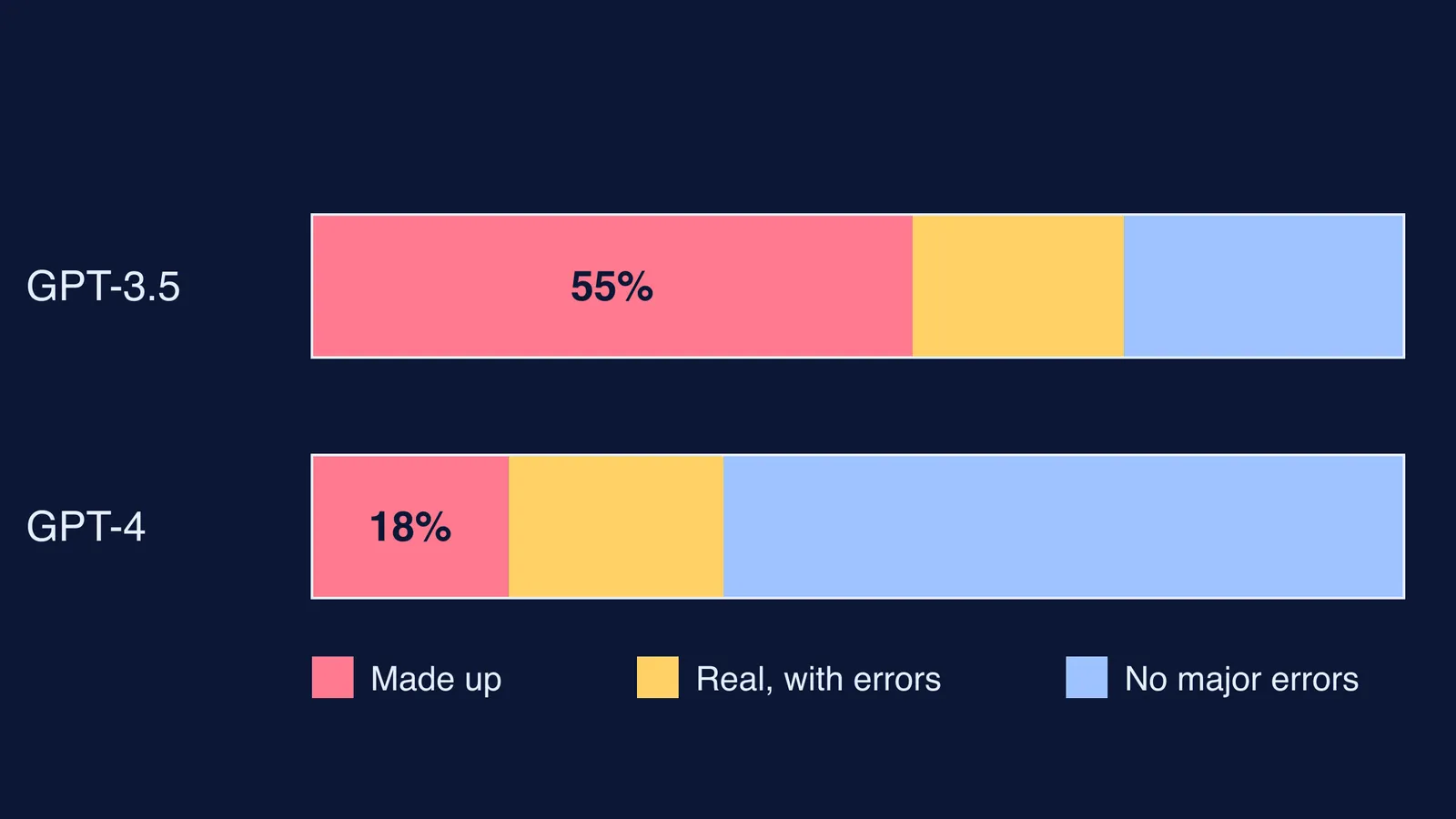
Because chatbots can produce references that look perfect and point to nothing. In a 2023 study, William Walters and Esther Isabelle Wilder used ChatGPT-3.5 and GPT-4 to write short literature reviews on 42 topics and checked all 636 references in them (Walters and Wilder, Scientific Reports). In that study, 55% of the GPT-3.5 citations and 18% of the GPT-4 citations were fabricated. Among the real ones, 43% of GPT-3.5 citations and 24% of GPT-4 citations had substantive errors.
A separate 2023 study checked 115 references that ChatGPT-3.5 attached to 30 short medical papers: 47% were fabricated, 46% were real but inaccurate, and only 7% were both real and accurate (Bhattacharyya and colleagues, Cureus).
Newer tools may do better, but neither study gives you a safe rate to rely on. The made-up entries look exactly like real ones: plausible authors, a fitting title, a journal that exists. We explain why this happens in why AI tools make up sources.
How do you check an AI-formatted list?
Do this for every entry, not a sample.
Open the link or DOI. Does it load, and does it land on this exact work rather than a homepage?
Match the title. Word for word. A title that is close but not identical is a warning sign.
Match every author. All names, spelled correctly, in the same order as on the source.
Match the year. Take it from the source page, not from the AI.
Ask: did I use it? A bibliography lists what you read. A real paper you never opened does not belong.
Fix or delete. If a part is wrong, copy the correct version from the source. If the work cannot be found, delete the entry.
Here is a worked example. Say an AI tool gave you this entry (invented here for illustration):
Walters, W. H. (2021). Errors in citations generated by chatbots. Scientific Reports.
Search the exact title: nothing. Search the author and the journal instead, and you find the real 2023 paper above. Three of the four parts were wrong: a missing co-author, the year and the title. The fix is to copy each part from the real paper, and to cite it only if you have read it.
If AI also helped you write the project itself, your school may want that declared too; see how to cite AI in a school project.
How can parents help without doing the project?
You do not need to know APA to help. Pick a few entries at random and ask:
"Can you open this one for me?"
"Where on the page is the author's name? And the year?"
"What did you use from this source?"
If your child cannot answer the last question, that entry probably came from the AI, not from their reading. The same habit catches invented numbers too; see when AI makes up data in school projects.
Checking a source also means understanding what it says. If a science source uses an idea your child cannot explain in their own words, the Fermi Concept Library has a lesson for every concept in physics, chemistry, biology, mathematics and computing, so they can read up before quoting it.
Tonight, open your project's bibliography and run the six checks on the first entry.