On this page
Your teacher does not need a confession, just a clear record: which AI tool you used, at which step, and what you did with its output. Your school's or fair's own rules come first, so check them before you start.
What counts as AI use you need to mention?
The Modern Language Association says you should cite generative AI whenever you paraphrase, quote or incorporate content it created, and acknowledge "all functional uses of the tool (like editing your prose or translating words)" in a note or your text (MLA Style Center).
The Regeneron ISEF rules say AI "may be used as a project resource but must be cited and given proper acknowledgment", and that a student may not use generative AI to write the research plan, abstract or poster, or to create citations (Society for Science, Rules for All Projects).
The Society for Science also publishes a table of acceptable generative AI uses, useful even for school projects:
No citation needed: having AI pick out the key points of an article before you read it yourself; fixing only grammar and syntax in text you wrote; fixing the format of your bibliography (you still check every reference).
Allowed with conditions: developing ideas (keep a prompt log; cite it where needed); suggesting statistical tests (keep a prompt log); drafting starter code (cite which parts, keep a prompt log); making an image (mark it AI-generated and say how it was made).
Never acceptable: writing the first draft of your research plan, abstract, paper or poster; adding points to your paper; producing your conclusions; supplying your bibliography or citations.
Once you have written a draft yourself, AI refinement is allowed with explicit citation and a log. The table notes that affiliated fairs may adopt stricter policies.
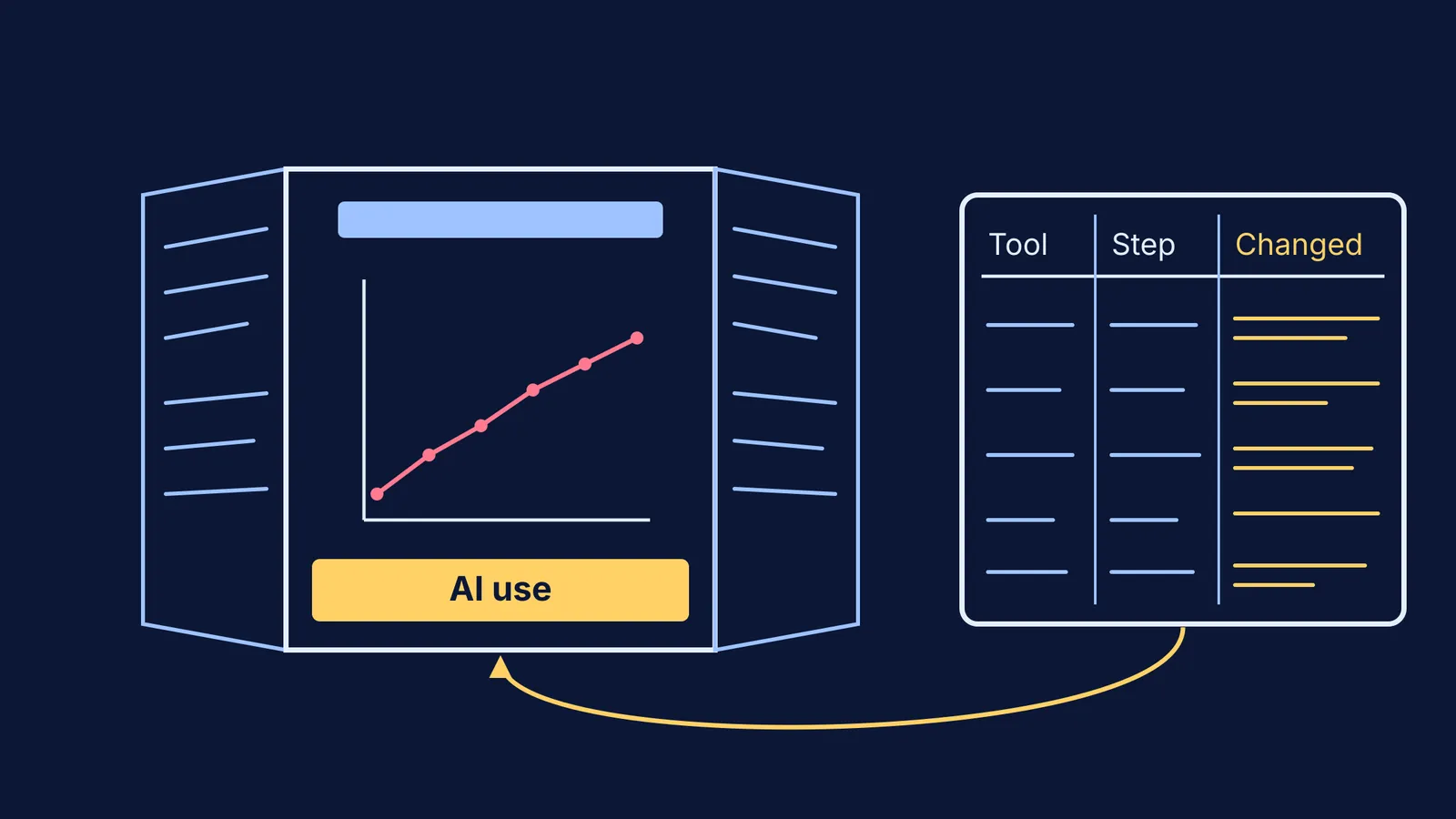
The three-part note: tool, step, change
Every acknowledgement line answers three questions:
Tool: the name, the company, and the date you used it. Add the version if the app shows one.
Step: the stage it touched: choosing a question, planning the method, writing code, making a graph or polishing language.
Change: what you did with the output. Rejected it, reworded it, checked it against a textbook, or kept it?
The third part matters most. It shows where your thinking happened.
A log entry can be this short:
12 Aug, ChatGPT: asked for five project ideas on boiling point. Picked idea 3, changed it to use salt and sugar because our lab has both.
19 Aug, Gemini: asked which graph suits temperature against concentration. Chose a line graph; drew it myself in a spreadsheet.
How do you write an AI acknowledgement in a project report?
Put a short "Use of AI tools" section after your acknowledgements or before the bibliography. Adapt these lines:
"I used ChatGPT (OpenAI, 12 August 2026) to suggest possible research questions. I chose one and changed it to fit the equipment in our school lab."
"I asked Gemini (Google, 19 August 2026) which type of graph suits my data. I made all graphs myself from my own readings."
"Lines 1-14 of the Python script in Appendix B were first drafted by [tool, date]. I wrote lines 15-30, tested the script on readings I had worked out by hand, and fixed one error. My prompts are in Appendix C."
If you quote, paraphrase or include AI output, MLA's works-cited template starts with a description of what the AI made (its own example uses the prompt), then tool, version, company, date and web address: "Explain why salt raises the boiling point of water" prompt. ChatGPT, [version], OpenAI, 12 Aug. 2026, chatgpt.com.
To talk it through with your teacher, see how to tell your teacher you used AI.
How do you show AI use on a science fair board?
Use one boxed line near your references:
"AI use: ChatGPT helped me brainstorm topics; Gemini suggested a statistical test. All data, graphs, text and conclusions are my own. Prompt log in my project notebook."
For an AI-made image: "AI-generated diagram, made with [tool] on [date] from the prompt '...'. Labels added by me."
If you used none: "No AI tools were used in this project."
Bring the notebook to the fair. If AI helped you pick your topic, the four-filter test for AI project ideas checks whether it is doable.
Where does an AI tutor fit in?
If you used AI only to understand the science, log that too: "I used an AI tutor to understand colligative properties before writing my discussion."
Fermi's AI tutor teaches rather than answers, checking your understanding as it goes, so the explanation in your report stays your own. If one idea is the gap, the Fermi Concept Library has a lesson for each concept in physics, chemistry, biology and mathematics.
Once your draft is done, you can also get AI feedback on your investigatory project report and record that in your log the same way.