

On this page
Every year, thousands of secondary science students face the same challenge: you have spent weeks collecting readings in the physics or chemistry laboratory, and now you must turn rows of data into a formal report. In Indian board examinations such as CBSE Class 12, practical assessments carry 30 marks, as established in the CBSE Senior School Curriculum. The investigatory project report and its accompanying viva voce account for up to 8 of those marks.
When writing this report, many students turn to artificial intelligence tools. Used carelessly, generative models blur the line between editing and fabrication. Used deliberately, an AI tool acts as an impartial second reader that spots missing sections, clarifies dense sentences, and flags logical gaps before your teacher sees the file. The key is understanding where automated critique helps and where your scientific ownership must remain absolute.
Why should you use AI for editing instead of writing?
The primary purpose of an investigatory project is to demonstrate authentic inquiry. An external examiner is not looking for prose that mimics a professional review paper. They want to see that you conceived a testable question, assembled the apparatus, recorded observations systematically, and understood what the data showed.
If you ask an AI to write your report, it will generate sanitized explanations and synthetic deductions that do not match your laboratory observations. More importantly, when the examiner asks during the viva why a reading drifted or why your graph had a non-zero intercept, an AI-authored script leaves you stranded.
Using AI strictly for structural critique preserves your voice and your data while highlighting organizational gaps. For guidance on maintaining this boundary during school assignments, read our analysis of academic honesty when working with AI.
Which parts of your project report must remain untouched?
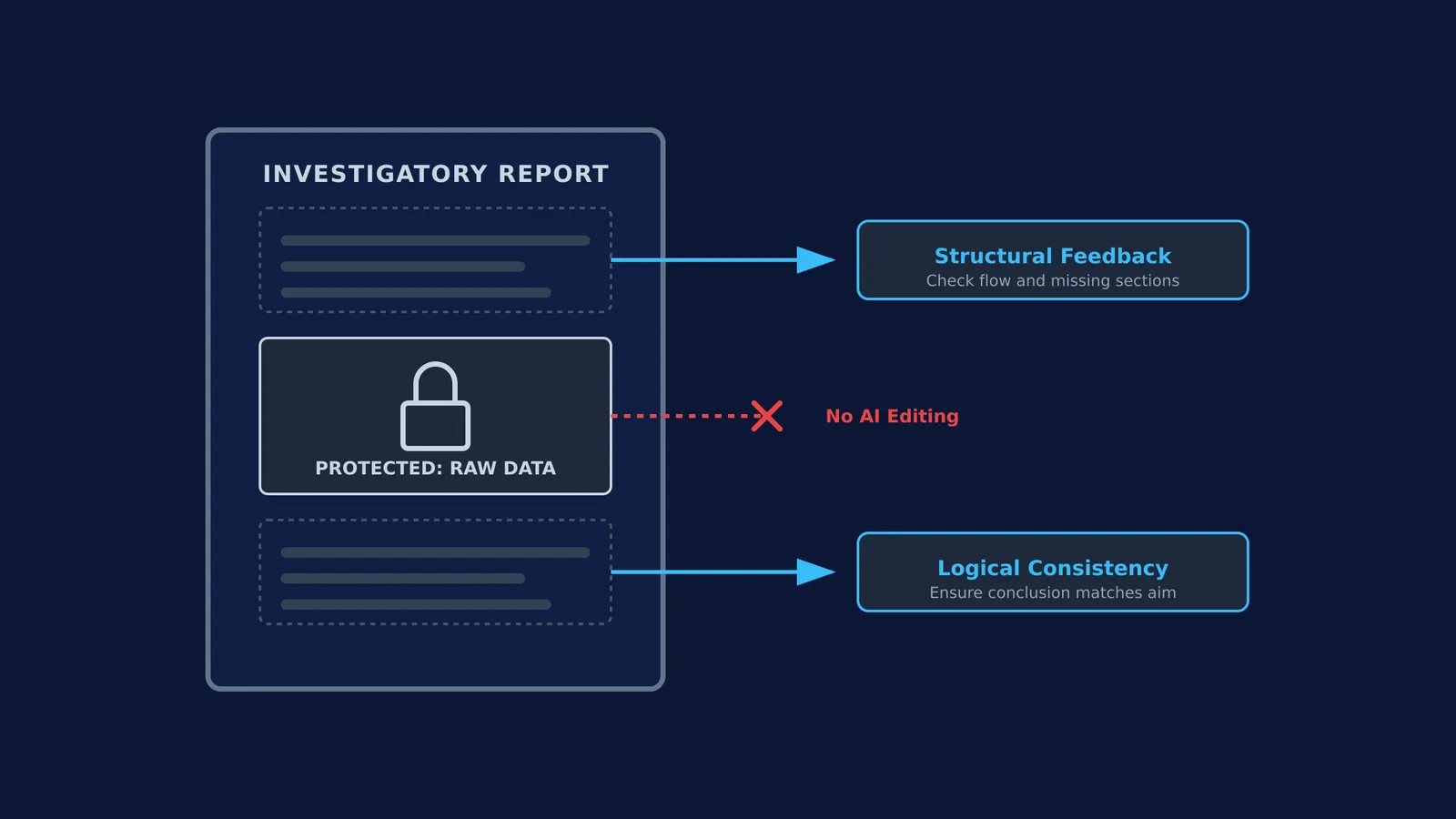
To safeguard your scientific credibility, divide your report into protected student territory and open feedback territory.
The protected core must never be altered by software:
Raw observation tables: Every ammeter reading, burette measurement, or timing interval must represent your actual experimental trials, including outliers.
Arithmetic and error calculations: Your percentage error calculations, least-count bounds, and graphical gradients must come from your own arithmetic.
Empirical deductions: Your conclusion must reflect what your data actually revealed, even if the result diverged from textbook values.
AI feedback should be restricted entirely to organizational quality: identifying repetitive phrasing, highlighting awkward passive transitions, and confirming that every stated objective has a corresponding discussion point. If you are still refining your experimental question, consult our guide on doing a science project from question to experiment.
How do you prompt an AI for structural feedback?
To prevent an AI model from rewriting your prose, provide explicit role boundaries. Use a structured, critique-only prompting protocol:
Section audit prompt: "Review this draft of my physics investigatory project report. Do not rewrite my text or edit my numbers. Check whether I have included all standard sections: Aim, Apparatus, Principle, Procedure, Observations, Calculations, Sources of Error, Precautions, and Conclusion. List any missing components or structural inconsistencies."
Flow and transition prompt: "Analyze the transition between my Observations and Discussion sections below. Identify any sentences where the logical link between data and deduction is ambiguous. Suggest what explanatory step is missing, but do not supply replacement text."
Logical consistency prompt: "Read my stated Aim and final Conclusion. Does my conclusion directly answer the aim using only the evidence provided in my report? Flag any unsupported assertions."
When you need to master the underlying physical laws or reaction mechanisms behind your project topic, Fermi's AI tutor can work out what you already know and build a plan for the session, guiding your conceptual understanding without replacing your independent problem solving.
What does the learning research say about AI feedback?
Educational research confirms that formative AI feedback can strengthen student writing when learners remain active editors. In a 2026 meta-analysis published in *Cogent Education* (DOI: 10.1080/2331186X.2026.2665494), researchers Wenyun Luo and Ying Zhan synthesized findings from 43 studies with 234 effect sizes. They identified a significant, moderate positive impact of AI feedback on student writing performance, reporting a pooled effect size of g = 0.58. The study emphasized that AI feedback is most effective when paired with active learner evaluation.
However, uncritical reliance carries measurable cognitive risks. In a randomized controlled study published in the *British Journal of Educational Technology* (DOI: 10.1111/bjet.13544), Yizhou Fan and colleagues examined 117 university students working on writing tasks. While students using ChatGPT improved immediate essay scores, they exhibited "metacognitive laziness," offloading critical evaluation to the machine. Crucially, their knowledge retention and transfer scores showed no significant gain over students who worked through feedback independently.
Retaining full ownership of your analysis prevents this cognitive trap.
How can an AI tutor help you prepare for viva voce?
The true test of your investigatory project arrives during the practical examination viva voce. You can use an AI model as an interrogation partner by asking it to simulate an external examiner.
Prompt the AI with your finalized Aim, Apparatus, and Conclusion: "Act as an external CBSE physics examiner. Based on this summary, ask me five challenging viva questions focusing on instrument zero errors, circuit limitations, and why alternative methods were not chosen."
To understand your experimental apparatus under varying parameters, dynamic visualization can make theoretical relationships intuitive. The Fermi Simulation Lab provides interactive simulations for the ideas that are easier to see than to read, reinforcing the physical intuition you need on exam day. For a complete strategy on oral questioning, review our guide on preparing for your CBSE physics practical and viva.


