On this page
Long before weather stations, Chinese officials and poets wrote down when lakes froze, when snow fell and when crops were harvested. In the early 1970s the meteorologist Zhu Kezhen turned those notes into a temperature history of China. You can try a small version of his method where you live.
Who was Zhu Kezhen?
Zhu Kezhen (also written Chu Coching) was born in Zhejiang in 1890 and died in Beijing in 1974, according to Zuoyue Wang's entry in the Complete Dictionary of Scientific Biography. He earned a Harvard PhD in 1918 with a thesis on the typhoons of the Far East, directed the Institute of Meteorology in Nanjing from 1928, and became vice president of the Chinese Academy of Sciences in 1949. The entry adds that on his last evening he noted the day's weather in his diary, as he had every day for sixty years.
He also co-wrote a well-received book on phenology, the entry notes; a 1990 paper by Wan Minwei reviews that work. Phenology is the study of recurring life-cycle stages, such as first flowers or first cicada calls, and the seasonal timing of non-living events, as defined in a 2021 study in Climate of the Past.
How did Zhu Kezhen reconstruct China's climate without thermometers?
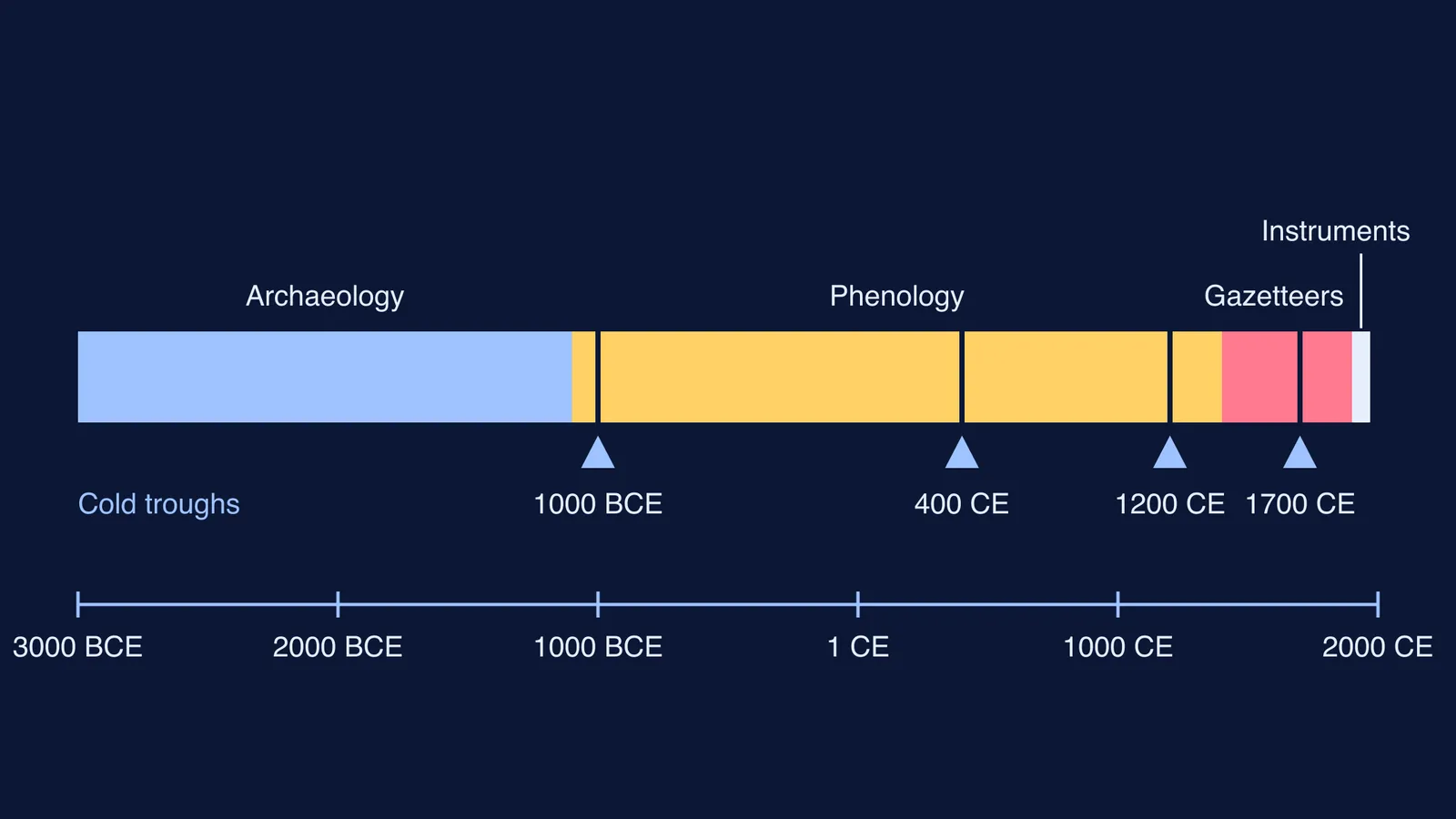
The last paper he published, A Preliminary Study on the Climatic Fluctuations during the Last 5000 Years in China, appeared in Chinese and English in Scientia Sinica in May 1973, as a 2025 essay on Zhu in The Paper records. He split the 5,000 years by the kind of evidence each stretch offers:
Archaeological period, about 3000 to 1100 BCE: excavated remains and oracle-bone inscriptions.
Phenological period, 1100 BCE to 1400 CE: dated notes on plants, crops, snow and ice in books and poems.
Local gazetteer period, 1400 to 1900: local records detailed enough to count.
Instrumental period, from 1900: thermometer readings.
Official Chinese records mostly note when water froze and thawed, the first and last snow and frost, and farm dates such as spring ploughing and the wheat and millet harvests, explains the Climate of the Past study by Liu and colleagues. It counts 17 pieces of evidence from poems in Zhu's paper, 11 of them phenological records from the Tang and Song dynasties.
The logic: if a lake that rarely freezes now froze often, the climate was different then. His curve closely matched Norwegian snow-line heights and Greenland ice-core data, the Wang entry notes.
What did Zhu Kezhen find about China's climate history?
Over the last 3,000 years, Zhu found warm and cold phases lasting about 400 to 800 years, with temperature swings of 1 to 2°C, according to The Paper's 2025 summary. Inside each phase were shorter swings of 50 to 100 years and 0.5 to 1°C. The cold troughs fell near 1000 BCE, 400 CE, 1200 CE and 1700 CE.
The Sui and Tang period was warm: the capital Chang'an repeatedly had winters with no ice or snow, and citrus was grown in the palace, as The Paper reported in 2015.
Zhu read the 20th century as part of a long warming trend and rejected the then-popular idea of a new ice age, writes Erik Baark of the Max Planck Institute for the History of Science. He put climate change down mainly to cycles in solar radiation and did not explicitly point to human greenhouse gas emissions.
Nature introduced the paper in December 1973, and the British climatologist H. H. Lamb cited it in his 1977 book Climate: Present, Past and Future, The Paper's essay notes. For another long record, see how Willi Dansgaard read climate in ice-core oxygen isotopes.
Can a poem really be climate data?
Take the oranges of Chang'an, a worked example of testing evidence. Tang poems mention orange trees in the Guanzhong region around the capital, and Zhu used them as evidence of warmth. Some later studies argued that those trees were transplanted from elsewhere and tended by palace staff, so they say less about the open-air climate, report Liu and colleagues. The same study found most of Zhu's poem evidence valid and confirmed by other work, and it used 86 records from Tang poems to estimate temperatures in specific years between 600 and 900 CE.
Their filters work for any old record. Ask four questions:
Did the writer see it, or repeat what others said?
Did people protect, water or move the plant?
Can you name the species and the exact stage, such as bud, full bloom or ripe fruit?
Do other records from the same place and decade agree?
How can you try historical climatology yourself?
Keep a one-season phenology diary, the way Zhu kept his weather diary.
Pick three events: one tree (mango flowering), one animal (the koel's first call), one non-living event (the first monsoon shower).
Each time, write the date, place, what you saw and its stage.
Ask a grandparent when the mango trees flowered when they were young, then test their memory with the four questions.
Next year, compare dates, or swap diaries with a friend in another city.
To place your city on the map of climates, read how Köppen climate zones get their letters. For the career route, see the subjects and routes to becoming a climate scientist in India.
To turn the diary into a science-fair project, Fermi's AI tutor can work out what you already know and build a plan for the session, so you start with a clear next step.
Start your diary this week.