On this page
Most of us meet DNA as a code. Yamuna Krishnan, a chemist now at the University of Chicago, also treats it as a building material, folding short strands into machines that get inside living cells and report how acidic each compartment is.
Who is Yamuna Krishnan?
Her University of Chicago faculty profile says she earned a BSc from Madras University in 1993, then an MS in 1997 and a PhD in 2002 from the Indian Institute of Science, Bangalore. After a fellowship at the University of Cambridge, she built her lab at the National Centre for Biological Sciences (NCBS) in Bangalore before moving to Chicago. She won the Shanti Swarup Bhatnagar Award in 2013, and IISc notes that her 2017 Infosys Prize was "for her pioneering work in DNA nanodevices".
In a 2017 interview with Scroll she said: "My lab seeks to use DNA, like wool on the nanoscale, to knit it into little nanobots and thereby harness DNA to map chemical environments of cells inside whole, living organisms."
How does a DNA nanodevice measure pH inside a cell?
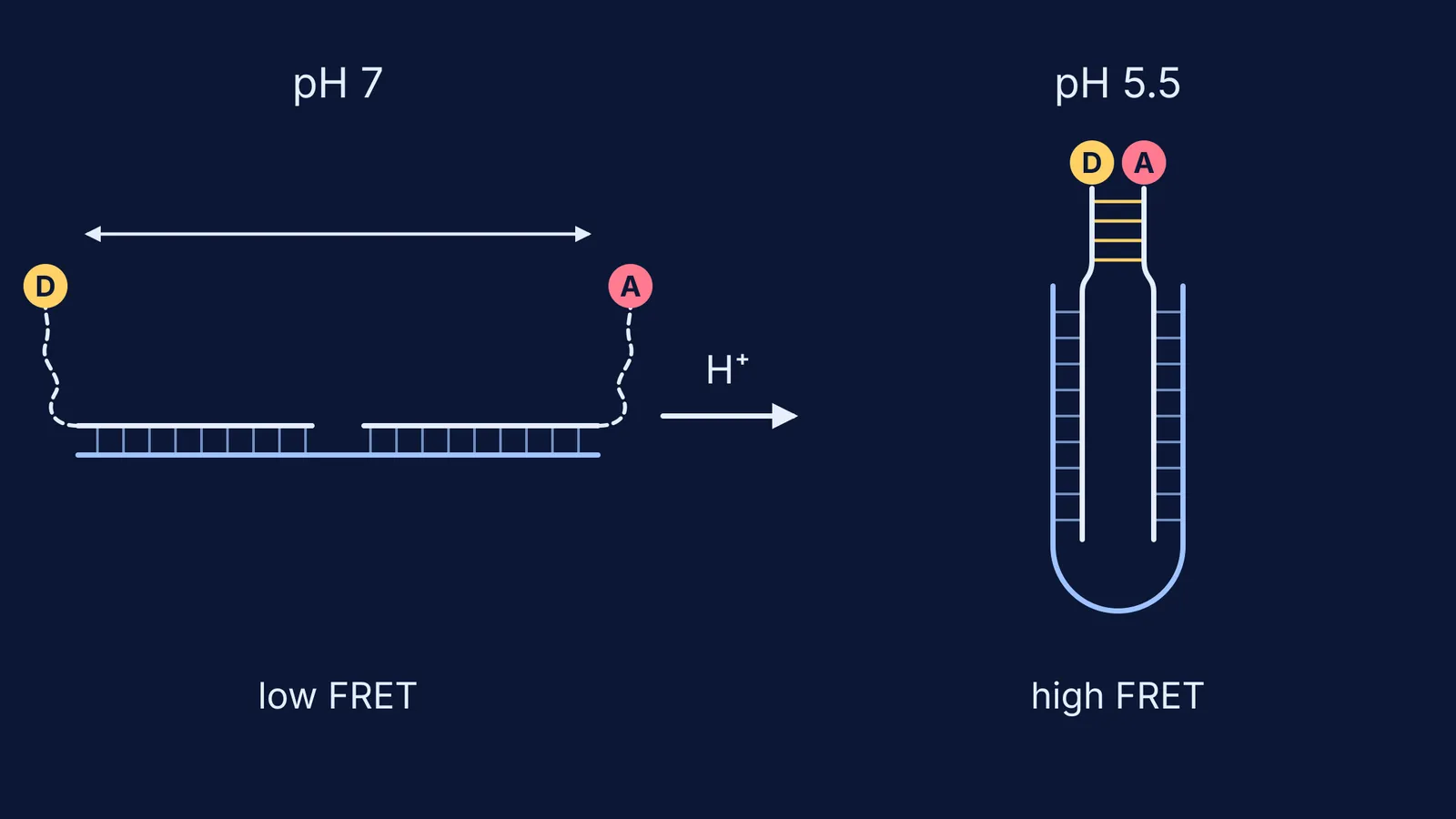
Her first pH device for living cells, the I-switch, came out of NCBS in Nature Nanotechnology in 2009. It is made of three DNA strands. Two short strands pair with a longer one, leaving a small gap that works as a hinge. Each short strand also has a loose, cytosine-rich tail, as the team's patent on the I-switch describes.
Step by step:
In acid, cytosine bases pick up protons (H⁺). Protonated and neutral cytosines pair up (C·C⁺), and the two tails zip together into a four-stranded knot called an i-motif.
Making that knot folds the device shut at the hinge.
One tail carries a donor dye and the other an acceptor dye. When the device closes, the dyes come close and energy passes from one to the other. This is fluorescence resonance energy transfer (FRET).
The ratio of donor glow to acceptor glow tells you what share of the devices are closed, and that tells you the pH.
The I-switch is "an efficient reporter of pH from pH 5.5 to 6.8", according to the 2009 paper. That suits endosomes, the bubbles a cell uses to take in material, which turn more acidic as they mature; the team mapped that change inside living cells.
What have DNA pH sensors shown in cells and animals?
A whole animal (2011): a pH-triggered DNA nanomachine worked inside the nematode worm Caenorhabditis elegans, mapping pH changes during endocytosis in normal and mutant worms (Nature Communications).
Two devices, one cell (2013): two nanomachines programmed to enter by different routes measured the pH of early endosomes and the trans-Golgi network in the same cell (Nature Nanotechnology).
pH and chloride together (2018): a reporter called 2-IM imaged pH and chloride in the same single lysosome. In skin cells from patients with Niemann-Pick disease, one of the two main lysosome populations was missing, and it came back after treatment (Nature Nanotechnology).
For the textbook side of lysosomes, see why lysosomal enzymes work only at acidic pH.
Why use DNA as a building material?
DNA pairs predictably: A with T, G with C, the rule behind Watson and Crick's double helix model. Design the sequences and you decide which strands stick together and where. Krishnan adds a sequence that changes shape when the chemistry around it changes. (Biology's older glowing reporters are proteins; see Roger Tsien and the colours of fluorescent proteins.)
Krishnan's faculty profile describes her lab's DNA devices as having "measuring modules" that sense a chemical and "targeting modules" that steer the device to one part of the cell.
How does this connect to Class 11 and 12 chemistry?
Worked example: how much more acidic is a pH 5.5 compartment, at the edge of the I-switch's range, than a pH 7 one?
pH = −log[H⁺], so [H⁺] = 10 to the power −pH.
At pH 7, [H⁺] = 1.0 × 10⁻⁷ mol/L. At pH 5.5, [H⁺] = 10⁻⁵·⁵ ≈ 3.2 × 10⁻⁶ mol/L.
Divide: 10 to the power 1.5 ≈ 32. The pH 5.5 compartment holds about 32 times more hydrogen ions per litre.
A pH gap of 1.5 sounds small, but on a log scale it is a big chemical change. Ask these questions of any sensor, from litmus paper to a research paper:
What does it detect? (Here, H⁺.)
What physically changes? (The shape: open to closed.)
What is actually measured? (A ratio of two colours.)
Over what range does it work? (pH 5.5 to 6.8 for the 2009 I-switch.)
How was it tested in real cells or animals?
If FRET or logarithmic pH still feel shaky, the Fermi Concept Library gives each concept its own lesson, so you can fill one gap at a time. For ideas that are easier to see than read, try the interactive simulations in the Fermi Simulation Lab.
Next time you write A, T, G and C in an exam, remember they can also build a pH meter that fits inside a cell.