

On this page
In biology textbooks, lysosomes are often dramatically introduced as the "suicide bags" of the cell. But how does a microscopic sac filled with destructive chemistry avoid digesting itself or the cell it lives in? The answer is a built-in safety lock based on pH.
What are acid hydrolases?
Lysosomes act as the waste disposal and recycling centres of eukaryotic cells. According to the foundational text *Molecular Biology of the Cell*, a typical lysosome contains roughly 40 different types of hydrolytic enzymes. These include proteases that degrade proteins, nucleases that break down nucleic acids, lipases for lipids, and glycosidases for complex carbohydrates.
Biologists classify these diverse digestive tools under the general banner of acid hydrolases. Their collective job is to use water molecules to break down large, complex structures into their basic building blocks, which the cell can then reuse to build new structures. (For a closer look at how biologists categorise other metabolic tools, see our guide to the six enzyme classes: oxidoreductases to ligases, with examples.)
The inner surface of the lysosome itself is heavily protected from this destructive soup. The proteins that make up the lysosomal membrane are highly glycosylated, meaning they are coated in a dense layer of protective sugars that prevents the enclosed proteases from digesting the sac itself.
Why do lysosomal enzymes work only at an acidic pH?
An enzyme is a carefully folded protein. For an acid hydrolase to maintain the specific three-dimensional shape required to cut chemical bonds, it must be surrounded by a high concentration of protons (H⁺ ions).
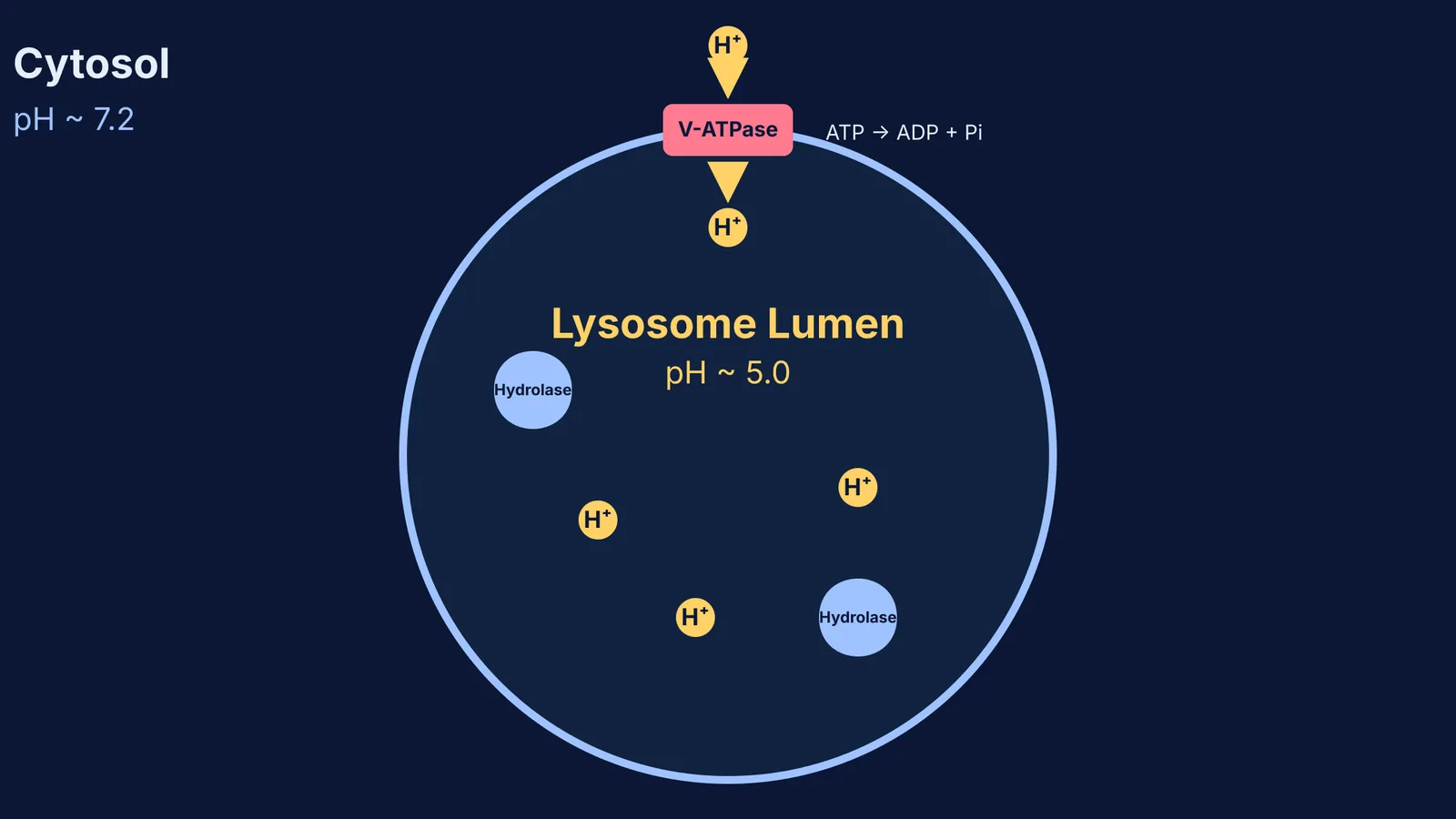
The inside of a lysosome is highly acidic, maintained at a pH of approximately 5.0 (Alberts et al., 2002). However, the cytosol—the fluid filling the rest of the cell—has a neutral pH of about 7.2.
If a lysosome is accidentally punctured and its contents spill into the cytosol, the enzymes immediately find themselves in a neutral environment. Stripped of the necessary protons, the acid hydrolases lose their functional shape and become completely inactive. This elegant dual-protection mechanism ensures that a minor leak does not result in the destruction of the entire cell.
How does the cell keep the lysosome acidic?
Maintaining an internal pH of 5.0 takes constant cellular work. The lysosome achieves this by pumping protons against their concentration gradient, moving them from the less acidic cytosol into the highly acidic lysosomal lumen.
It does this using specialised proton pumps, known as vacuolar H⁺ ATPases or V-type ATPases, which are deeply embedded in its membrane (Alberts et al., 2002). These pumps act as molecular motors. They consume cellular energy in the form of ATP to actively force hydrogen ions inside.
Because the membrane is slightly leaky to protons, this pumping process cannot stop. Without this continuous active transport mechanism, the internal environment would slowly neutralise, the pH would rise, and the acid hydrolases would stop working entirely.
How do lysosomes form from Golgi vesicles?
Lysosomal enzymes begin their long journey on the rough endoplasmic reticulum, where ribosomes manufacture the raw proteins. (This protein-factory pathway was famously mapped by George Palade and the ribosomes in the cell's protein factory.)
From the endoplasmic reticulum, the enzymes travel to the Golgi apparatus. The Golgi acts as the cell's primary post office, sorting newly made proteins for their final destinations. Inside the *cis* Golgi network, the lysosomal enzymes are specifically tagged with a unique chemical marker called mannose 6-phosphate (M6P) (Alberts et al., 2002).
Receptors located in the *trans* Golgi network uniquely recognise this M6P tag. They bind to the tagged enzymes and tightly package them into transport vesicles. These vesicles then bud off and fuse with structures called late endosomes. As the V-type proton pumps actively lower the pH inside the endosome, the receptors release their cargo, and the environment matures into a fully functional lysosome.
If you want to review this entire pathway, the Fermi Concept Library has a lesson for every concept in biology, each with its own place in the map.
What does 'suicidal bags' really mean?
The Belgian cytologist Christian de Duve discovered lysosomes in 1955. Through a technique called cell fractionation, his team observed that the cell's own digestive enzymes remained inactive unless their surrounding membrane was artificially broken (*Biochemical Journal*, 1955). This discovery of "latent" enzymes eventually led to the dramatic nickname "suicide bags."
While a single leaky lysosome cannot digest a cell because of the neutral cytosol, mass rupture is a different story. If a cell is severely damaged, dying, or fighting an overwhelming infection, the simultaneous bursting of many lysosomes can flood the cytosol with protons and enzymes. This drastic drop in cytosolic pH activates the hydrolases, leading to autolysis—the cell intentionally digesting itself from the inside out.
This process of controlled destruction is closely tied to healthy cellular maintenance. To learn more about how cells safely digest their own worn-out parts without dying, read about Yoshinori Ohsumi and how cells recycle themselves.
How should you answer lysosome questions in your exams?
Use this checklist to secure those marks in your biology paper:
The digestive enzymes are called acid hydrolases.
They operate optimally at pH 5.0, protected by a neutral cytosol of pH 7.2 (Alberts et al., 2002).
The acidity is maintained by active transport via V-type proton pumps that consume ATP.
The enzymes receive their M6P tags and are packaged by the Golgi apparatus.


