On this page
The transformer on your local electricity pole does a job one engineer showed working on a single street in 1886. William Stanley ran alternating current (AC) down Main Street in a small American town and used transformers to change its voltage.
What did William Stanley do in Great Barrington in 1886?
The IEEE marked it with a plaque in 2004. The IEEE Milestone citation says: "On 20 March 1886 William Stanley provided alternating current electrification to offices and stores on Main Street in Great Barrington, Massachusetts." According to the same page, he "demonstrated the first practical system for providing electrical illumination using alternating current with transformers to adjust voltage levels of the distribution system."
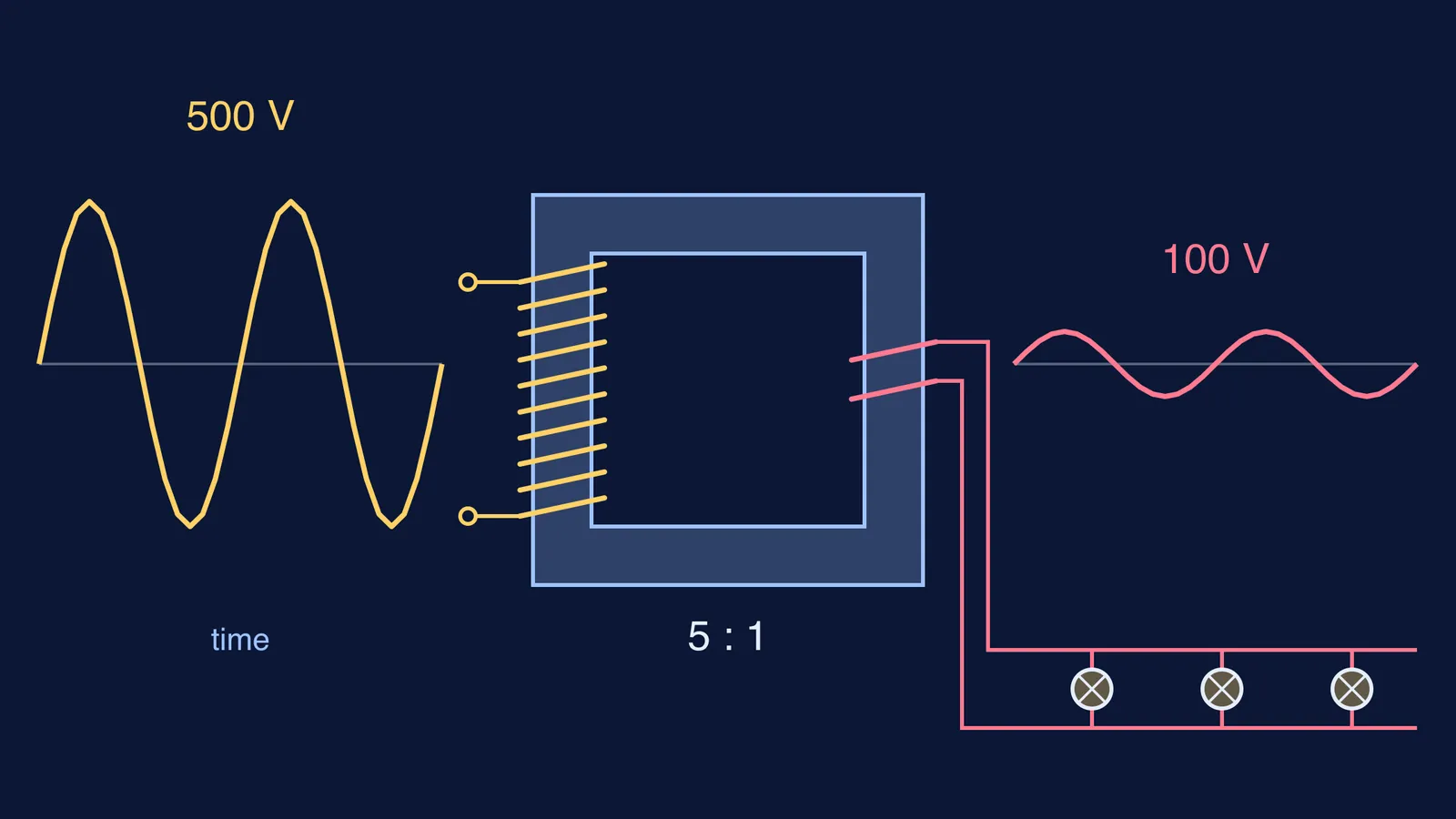
The system first ran on 6 March 1886, and the public demonstration came on 20 March, says the milestone record. A steam-driven Siemens AC generator sat in an old rubber mill near Cottage Street. Wires fastened to the elm trees carried its 500-volt output along Main Street. Six step-down transformers in the basements of Main Street buildings lowered it to 100 volts, and twenty businesses were lit with incandescent lamps. The Edison Tech Center gives the same 500 V and 100 V figures.
Stanley, born in Brooklyn on 22 November 1858, was 27. His IEEE biography says Westinghouse contracted him in 1884. Westinghouse backed the transformer research and bought the rights to an earlier transformer by Gaulard and Gibbs, as the Edison Tech Center's account describes.
How did Stanley's transformer work?
A transformer is two coils of wire wound on one iron core. An alternating current in the first coil makes a changing magnetic field in the iron, and that changing field induces a voltage in the second coil. This is Faraday's law, from Class 12 physics. The voltage changes in proportion to the number of turns on each coil.
The milestone record singles out two design choices that Stanley got right:
Parallel connection. He connected the transformers in parallel, so a change in load on one did not interfere with the others. Gaulard and Gibbs had specified a series connection for theirs.
A closed iron core. He saw that the magnetic path through the core had to be a closed loop, so that the voltage from the secondary coil could be regulated.
The milestone page adds that his 1886 method was "virtually identical" to the way power is distributed today. See our explainer on how transformers and AC generators work.
Why did stepping the voltage up and down matter?
Transmitting a given power P at voltage V needs a current I = P/V. The heat lost in the wires is I²R. Raise the voltage and the current falls, so the loss falls with the square of the current. Our post on why power lines carry high voltage works through this in detail.
The milestone record says he stepped the generator's 500 volts up to 3,000 volts, lit a string of thirty 100-volt lamps connected in series, and stepped the voltage back down to 500 volts.
How do you check Stanley's numbers yourself?
The test string. Thirty lamps in series, each needing 100 V, need 30 × 100 = 3,000 V. That is exactly the voltage Stanley stepped up to, per the milestone record.
The Main Street transformers. They took 500 V down to 100 V, so the turns ratio was 500 : 100 = 5 : 1. The street-side coil had five turns for every one on the lamp side.
The current. An ideal transformer keeps power the same, so the current goes up by the same factor that the voltage goes down. Suppose a shop drew 1,000 W, an easy number to work with. At 100 V it needs 10 A. On the 500 V street line it needs only 2 A.
The loss. Loss goes as I². Five times less current means 5² = 25 times less heat in the same wires. At 3,000 V the current would be one-thirtieth of 10 A, and the loss 900 times smaller.
Real transformers fall a little short of these ideal figures; see where transformers lose energy.
If it is hard to picture the flux changing inside the core, the Fermi Simulation Lab has interactive simulations for the ideas that are easier to see than to read. For more transformer numericals, the Fermi Problem Library has worked problems with a step-by-step solver that explains the reasoning rather than printing an answer.
What happened after Great Barrington?
In 1890 Stanley left Westinghouse and formed the Stanley Manufacturing Company. General Electric acquired it in 1903, according to his IEEE biography. He died in Great Barrington on 14 May 1916. The pole transformer outside your home still does what his basement transformers did: it takes a high line voltage down to one you can use safely.