On this page
On the night of 10 October 1846, a Liverpool brewer named William Lassell pointed a telescope he had paid for and helped build at a planet that had been known for barely two weeks, and saw a faint point of light beside it. That point was Triton, Neptune's big moon. His story shows what patient work at the edge of your tools can do.
Who discovered Triton, and when?
Triton was discovered on 10 October 1846 by British astronomer William Lassell, just 17 days after Neptune itself was discovered, according to NASA's Triton page. Neptune was big news because it was the first planet located through mathematical predictions rather than by watching the sky (NASA on Neptune).
On 1 October 1846, Sir John Herschel wrote him a note urging him to look for "satellites with all possible expedition!!" The note reached Starfield, Lassell's Liverpool home, the next day, and that night he made his first observation of Neptune. On the 10th he had his first glimpse of Triton (Journal of the British Astronomical Association). For the planet discovered before Neptune, read how William Herschel found Uranus.
How did a brewer build a telescope good enough to find it?
Lassell, born on 18 June 1799, made a substantial fortune as a brewer of beer and spent much of it on astronomy, says the Linda Hall Library. His first major instrument was a 24-inch reflector with a 20-foot tube: its main mirror was 24 inches (about 61 cm) across. Three choices made it work.
A mirror, not a lens. It was a Newtonian reflector (BAA Journal), the same layout as Isaac Newton's first reflecting telescope. His later 48-inch was, says the Linda Hall Library, the last of the great speculum reflectors, with a metal mirror made mostly of copper and tin.
An engineer's help. He built the 24-inch with the assistance of James Nasmyth, inventor of the steam hammer (BAA Journal).
A mount that follows the sky. Lassell put his telescopes on an equatorial mount, where the main axis of the mount is parallel to Earth's axis (Linda Hall Library). Turning that one axis keeps a target in view as Earth rotates, which matters when you are hunting a faint dot next to a bright planet.
With the same telescope he found two moons of Uranus, Ariel and Umbriel, in 1851 (Astronomy magazine). Later he built a 48-inch reflector and took it to Malta as Liverpool's air got worse for observing (Linda Hall Library).
Why is Triton such a strange moon?
Everything below comes from NASA's Triton page.
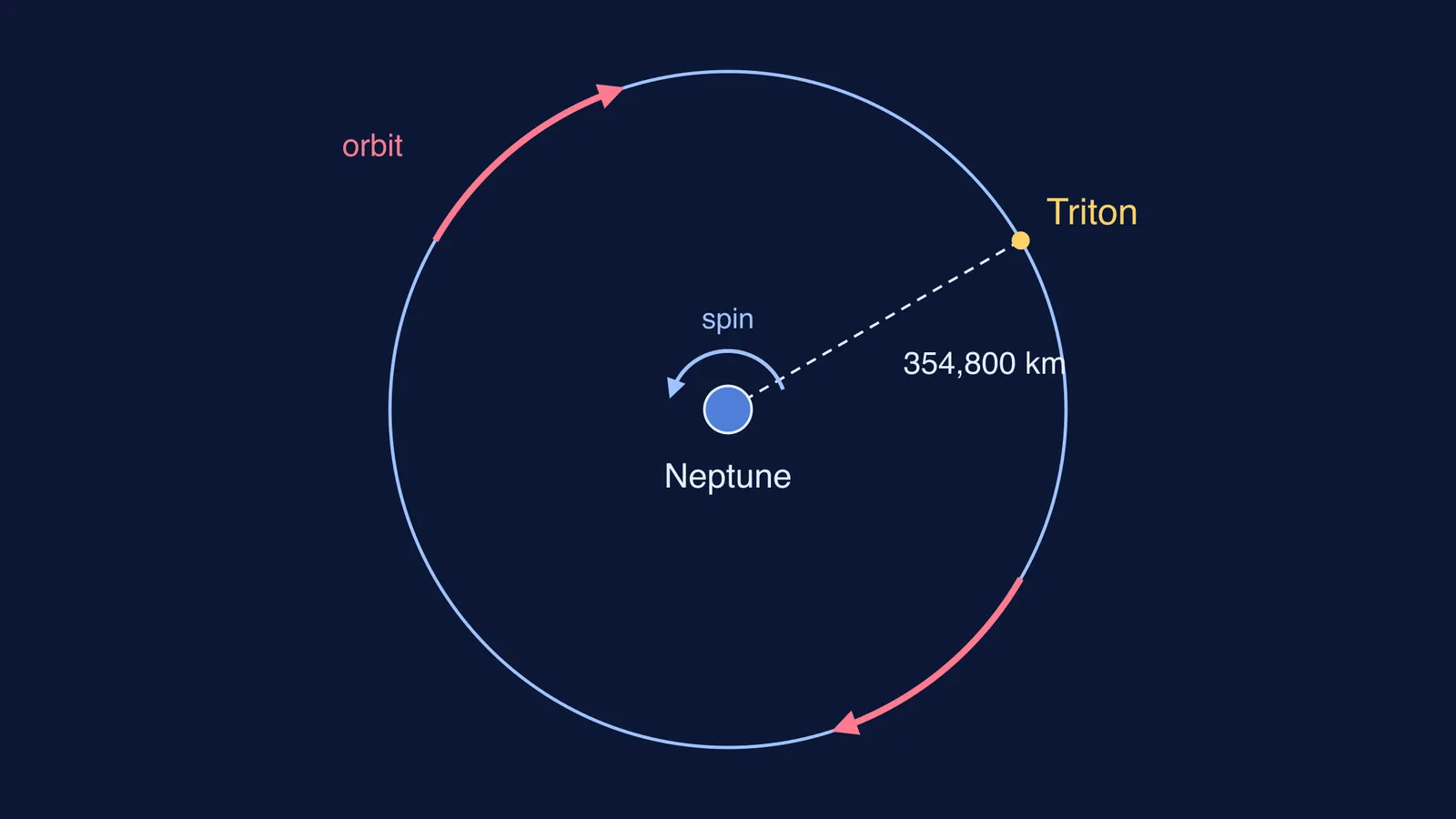
It goes the wrong way. Triton is the only large moon in our solar system that orbits in the opposite direction to its planet's rotation.
It is large. Triton has a diameter of 2,700 kilometres.
It is cold but active. Voyager 2, the only spacecraft to fly past it, found surface temperatures of -235 degrees Celsius and active geysers during its 1989 flyby.
It was probably captured. Scientists think Triton is a Kuiper Belt object captured by Neptune's gravity millions of years ago.
How can Triton's orbit weigh Neptune?
Once you know a moon's orbit, Newton's gravity and Kepler's third law give you the planet's mass. NASA JPL lists Triton's orbit with a semi-major axis of 354,800 km, a period of 5.8792 days and an eccentricity of 0.000 (JPL satellite orbits). That is a circle, so the algebra stays simple.
Gravity supplies the centripetal force: GMm/r² = m(2π/T)²r, so M = 4π²r³/(GT²).
Convert to SI units: r = 3.548 × 10^8 m and T = 5.8792 × 86,400 s = 5.080 × 10^5 s.
Work out the powers: r³ = 4.466 × 10^25 m³ and T² = 2.580 × 10^11 s².
Divide: M = (39.48 × 4.466 × 10^25) ÷ (6.674 × 10^-11 × 2.580 × 10^11) ≈ 1.024 × 10^26 kg.
JPL's measured mass for Neptune is 102.4092 × 10^24 kg, which is 1.024 × 10^26 kg (JPL planetary physical parameters). A moon first glimpsed in 1846 is enough to weigh its planet to four figures. Notice that Triton's own mass never appears: m cancels in step 1, which is why the method works for any moon much lighter than its planet.
For more practice with the same law, try these Kepler's third law period-ratio problems. If unit conversions trip you up, the Fermi Problem Library has a step-by-step solver that explains the reasoning rather than printing an answer. Orbits are often easier to see than read, which is what the Fermi Simulation Lab is for.
What can you learn from Lassell's discovery?
Act on a good tip quickly. Lassell was at the telescope the night Herschel's note arrived.
Build the tool the problem needs, and ask for help. A brewer teamed up with an engineer.
Keep using what works. The telescope that found Triton later found two more moons.
Next time you solve an orbit problem, try it with Triton's real numbers: 354,800 km and 5.8792 days.