On this page
Every planet a student meets in school was known to ancient sky-watchers except two, and the first of those was found by an organist. William Herschel spent his evenings building telescopes and sweeping the sky. In 1781 that habit gave him Uranus, and nineteen years later a simple experiment with a prism and some thermometers gave him infrared radiation. This post tells both stories, works through the physics behind them with numbers, and ends with what you can borrow from the way he worked.
Who was William Herschel?
According to the MacTutor biography of William Herschel, he was born on 15 November 1738 in Hanover, in present-day Germany. He played the oboe in the Hanoverian Foot Guards band, moved to England, and worked as a music copyist and band leader before becoming organist at the Octagon Chapel in Bath in 1766.
Astronomy began as a hobby. A small telescope he hired performed poorly, so he decided to make his own mirrors, and by the end of 1773 he was polishing them. His sister Caroline joined him in Bath in 1772 and became his assistant, and later an astronomer in her own right; our profile of Caroline Herschel and her comets tells her story.
How did he discover Uranus?
On 13 March 1781, while examining double stars in the constellation Gemini, Herschel noticed an object near a pair of stars that showed a small disc rather than a point of light. Three days later it had moved, and MacTutor notes that he was unsure whether it was a planet or a comet. He reported it to the Royal Society as an Account of a Comet, published in the Philosophical Transactions that year.
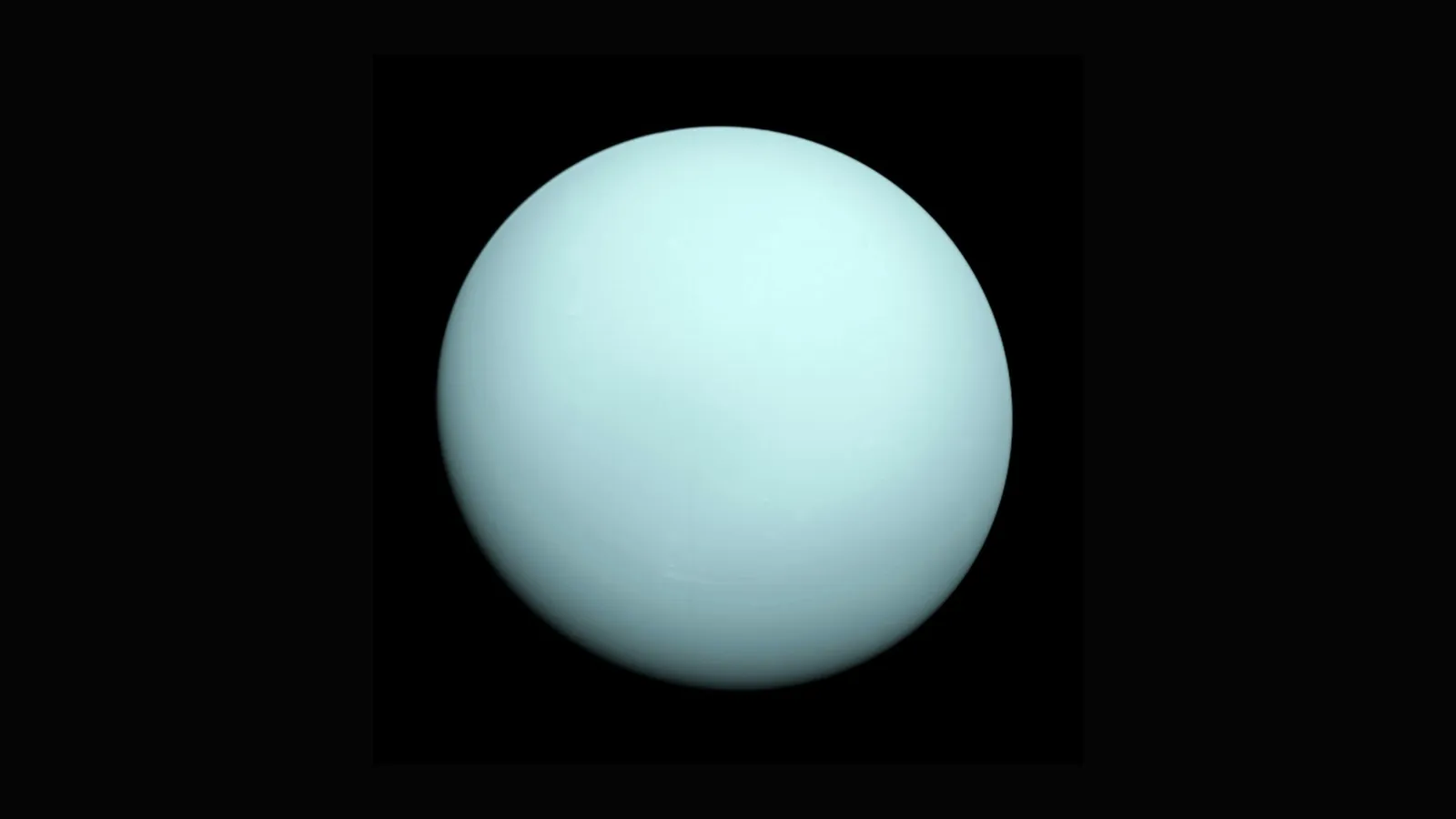
It turned out to be a planet. NASA's Uranus facts page calls it the first planet found with the aid of a telescope, and notes that Herschel first thought it was a comet or a star. He tried to name it after King George III, but the name Uranus, suggested by Johann Bode, was the one that stuck.
The discovery changed his life. He received the Copley Medal in November 1781 and was elected a Fellow of the Royal Society on 6 December 1781. The king offered him a pension of 200 pounds a year on condition that he live near Windsor, and his last musical performance was on 19 May 1782, according to MacTutor. In 1787 he went on to discover two of Uranus's moons, Titania and Oberon, as NASA's Uranus moons page records.
Worked example: how long is a year on Uranus?
The NASA Uranus fact sheet gives the semi-major axis of its orbit as 19.19 AU (astronomical units, where 1 AU is the Earth to Sun distance).
For anything orbiting the Sun, Kepler's third law in these units is T² = a³, with T in years and a in AU. It works because Earth has T = 1 and a = 1.
T = a^(3/2) = 19.19^(1.5).
√19.19 = 4.381.
T = 19.19 × 4.381 = 84.1 years.
NASA gives the orbital period as about 84 Earth years (30,687 days, which is 84.0 years), so the law checks out. Since 1781, Uranus has completed only about 2.9 orbits.
Common mistakes. Putting a in kilometres while keeping T in years breaks the shortcut; the simple form T² = a³ only holds in years and AU. Another slip is squaring instead of taking the 3/2 power. Our post on Kepler's laws of planetary motion has more practice.
How did he discover infrared?
In 1800 Herschel published Experiments on the refrangibility of the invisible rays of the sun in the Philosophical Transactions. Caltech's IPAC outreach page on the Herschel experiment describes what he did. He passed sunlight through a glass prism to spread it into a spectrum, and used thermometers with blackened bulbs to measure the heating in each colour. The temperature rose from the blue end to the red end. Then he placed a thermometer just beyond the red, where no light was visible, and found it was warmer still. There had to be invisible radiation beyond the red. It became known as infrared.
Worked example: why your body glows in the infrared
Wien's displacement law says that a hot body radiates most strongly at a wavelength λmax = b/T, where the CODATA value of Wien's constant is b = 2.898 × 10⁻³ m K and T is in kelvin.
Human skin is at about 310 K, so λmax = 2.898 × 10⁻³ / 310 = 9.35 × 10⁻⁶ m, about 9.3 μm.
The Sun's surface is at 5772 K according to the NASA Sun fact sheet, so λmax = 2.898 × 10⁻³ / 5772 = 5.02 × 10⁻⁷ m, about 502 nm, in the visible range.
Your body's peak is far beyond the red end of the visible spectrum, which is why thermal cameras work in the infrared. The electromagnetic spectrum guide shows where each band sits.
Common mistake. Using 37 (degrees Celsius) instead of 310 K gives 78 μm, a wavelength eight times too long. Always convert to kelvin first.
What can a student take from how he worked?
Know your instrument. Herschel made his own mirrors when a hired telescope disappointed him. When you understand how a measurement is made, you can spot when it goes wrong.
Be systematic. Uranus turned up during a planned survey of double stars, not a lucky glance. Regular, organised practice finds things that random effort misses.
Report what you see, not what you hope. He called the object a comet until the evidence said otherwise.
Put a thermometer where nothing is expected. Checking just outside the visible spectrum was a control that became a discovery. In your own lab work, measure the places you think are empty.
If the link between temperature and peak wavelength is hard to picture, the Fermi Simulation Lab has interactive simulations for ideas that are easier to see than read.
Try it yourself: use T² = a³ with Saturn's semi-major axis from the NASA fact sheets, and check your answer against its listed orbital period.