

On this page
Telescopes in the 17th century, like those used by Galileo and Johannes Kepler, were refracting telescopes (Wikipedia). They used convex and concave glass lenses to gather light and magnify distant objects. But they had a persistent flaw: bright objects, like the Moon or planets, appeared surrounded by blurry fringes of colour.
What is chromatic aberration?
This effect is known as chromatic aberration. The refractive index of glass varies with the wavelength of light. When white light passes through a lens, the lens acts like a prism, causing the dispersion of white light by bending different colours by different amounts.
Because the colours do not meet at a single focal point, the resulting image loses sharpness (Wikipedia). While later inventors like John Dollond would tackle this directly by creating an achromatic lens without colour fringes, early astronomers had no way to fix their glass lenses.
Why did Newton build a reflecting telescope?
Isaac Newton realised that chromatic aberration was a fundamental property of how glass bends light, not just a manufacturing defect. In his experiments with prisms, he proved that white light is composed of a spectrum of colours. He concluded that any telescope relying on refraction would inherently suffer from colour dispersion.
To solve this, Newton built a reflecting telescope. Mirrors do not refract light; they reflect it. According to the law of reflection, a curved mirror bounces all colours of light to exactly the same focal point, completely avoiding chromatic aberration.
How did the 1668 prototype work?
In 1668, Newton completed his first working model, which became the earliest known functional reflecting telescope (Wikipedia).
Instead of a primary glass lens, he cast a 1.3-inch (33 mm) concave primary mirror at the base of the tube. To make it highly reflective, he used an alloy of six parts copper to two parts tin, an early form of speculum metal.
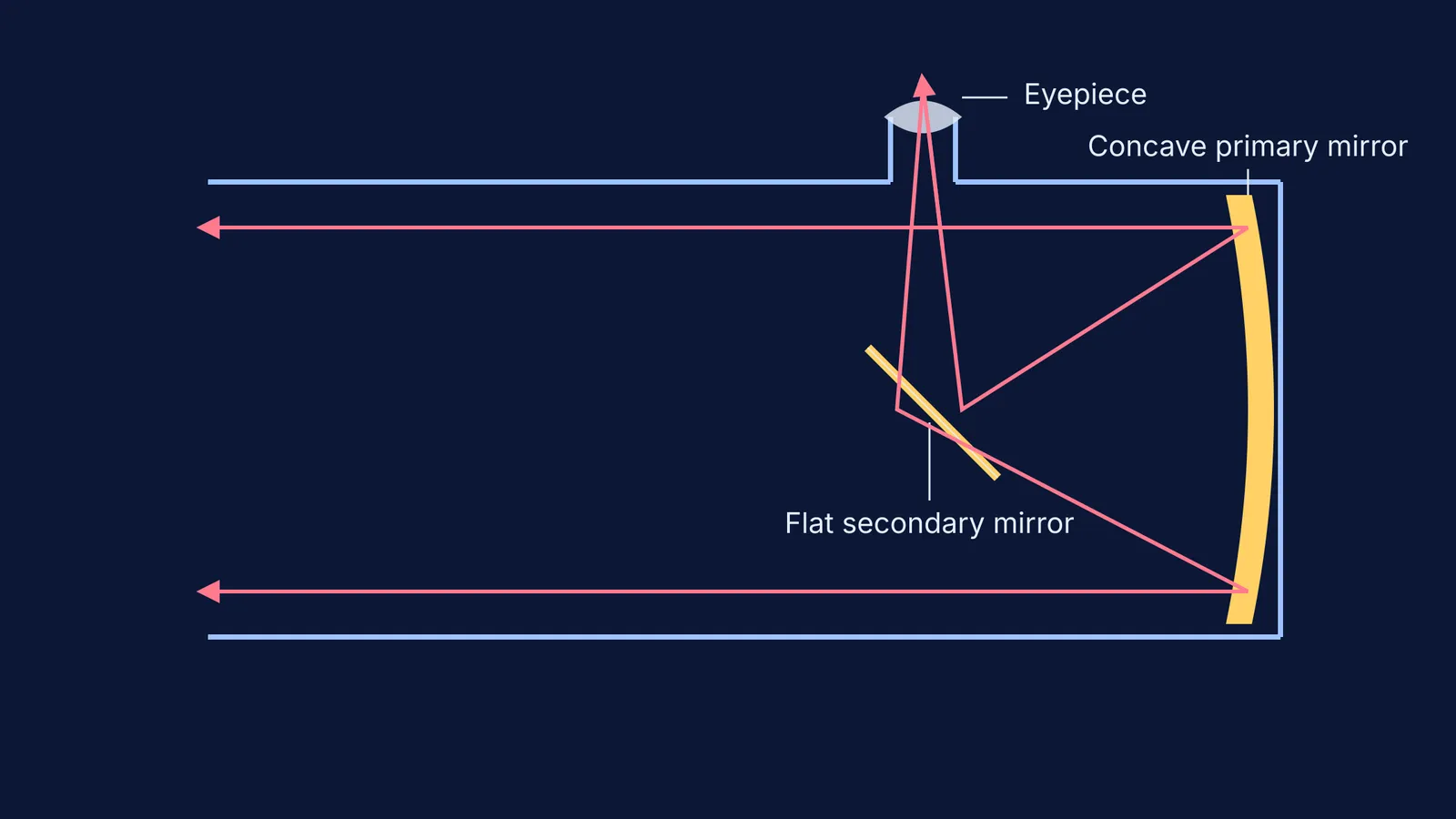
This mirror gathered incoming light and reflected it back up the tube towards a focal point. Just before the focus, Newton placed a small, flat secondary mirror to bounce the light at a 90-degree angle. This redirected the light out the side of the tube into a small eyepiece lens, allowing the observer to look without blocking the incoming starlight with their head.
With a focal length of 6.25 inches (158 mm), this small instrument provided a magnification of 35 times.
How does the Newtonian telescope connect to optics?
The Newtonian reflector is a classic application of ray optics. It relies on the properties of spherical mirrors to gather light, functioning similarly to the concave mirror images for all six object positions taught in Class 10 and 12 physics.
While Newton originally chose a spherical shape for his mirror because it was easier to grind, modern reflectors use parabolic mirrors to avoid spherical aberration—another defect where light rays striking the edges of a spherical mirror focus slightly differently than those hitting the centre. However, his core idea of using reflection instead of refraction remains the foundation of almost all large astronomical telescopes today.
If you struggle to visualise how parallel rays converge or why a secondary mirror is needed, the Fermi Simulation Lab lets you trace light paths through concave and flat mirrors. You can see directly how changing the mirror's radius moves the focal point.
For exam practice on optical instruments, such as calculating the magnifying power of telescopes, you can use the Fermi Problem Library. Its step-by-step solver explains the reasoning behind the mirror formula and magnification equations rather than just printing an answer.


