On this page
In the spring of 1755, a professor of medicine at Glasgow reported something he believed nobody had seen before: ice made in a room at about 53 °F, just by pumping the air out of a receiver holding a vessel of ether. William Cullen's essay, “Of the Cold produced by Evaporating Fluids, and of some other Means of producing Cold”, was read in Edinburgh on 1 May 1755 and printed in 1756 in the second volume of Essays and Observations, Physical and Literary. Most fridges and air conditioners still rely on the idea he showed: a liquid that evaporates takes heat from whatever it touches.
What did William Cullen do in 1755?
It started with a pupil. According to Cullen's essay, a student noticed that a thermometer lifted out of spirit of wine (alcohol) always sank two or three degrees, even when the spirit was at the temperature of the air. Cullen repeated the trial, wetting the bulb again and again, best with a feather, and moving the air around it, and drove the thermometer from 44 °F to below freezing.
He then ranked about a dozen liquids by the cold they produced, from a volatile spirit of sal ammoniac and two ethers down to brandy, wine and oils such as turpentine: “the power of evaporating fluids in producing cold, is nearly according to the degree of volatility in each.”
Next he worked under the receiver of an air pump. With the ethers and the spirit of sal ammoniac, the liquid gave off a great quantity of gas as the air was pumped out. In one trial the thermometer in it fell from 50 °F to below 20 °F, roughly from 10 °C to below −7 °C.
The decisive trial used nitrous ether, with the air at about 53 °F (about 12 °C). Cullen stood the vessel of ether inside a slightly larger vessel of water and pumped out the receiver. After a few minutes in the vacuum, he “found the most part of the water frozen, and the vessel containing the ether surrounded with a thick and firm crust of ice.” He added: “Such a means of producing cold, and to so great a degree, has not, so far as I know, been observed before.”
Nitrous ether is an old name for ethyl nitrite, which boils at 17 °C at normal air pressure, according to PubChem.
Why does a liquid boil when you lower the pressure?
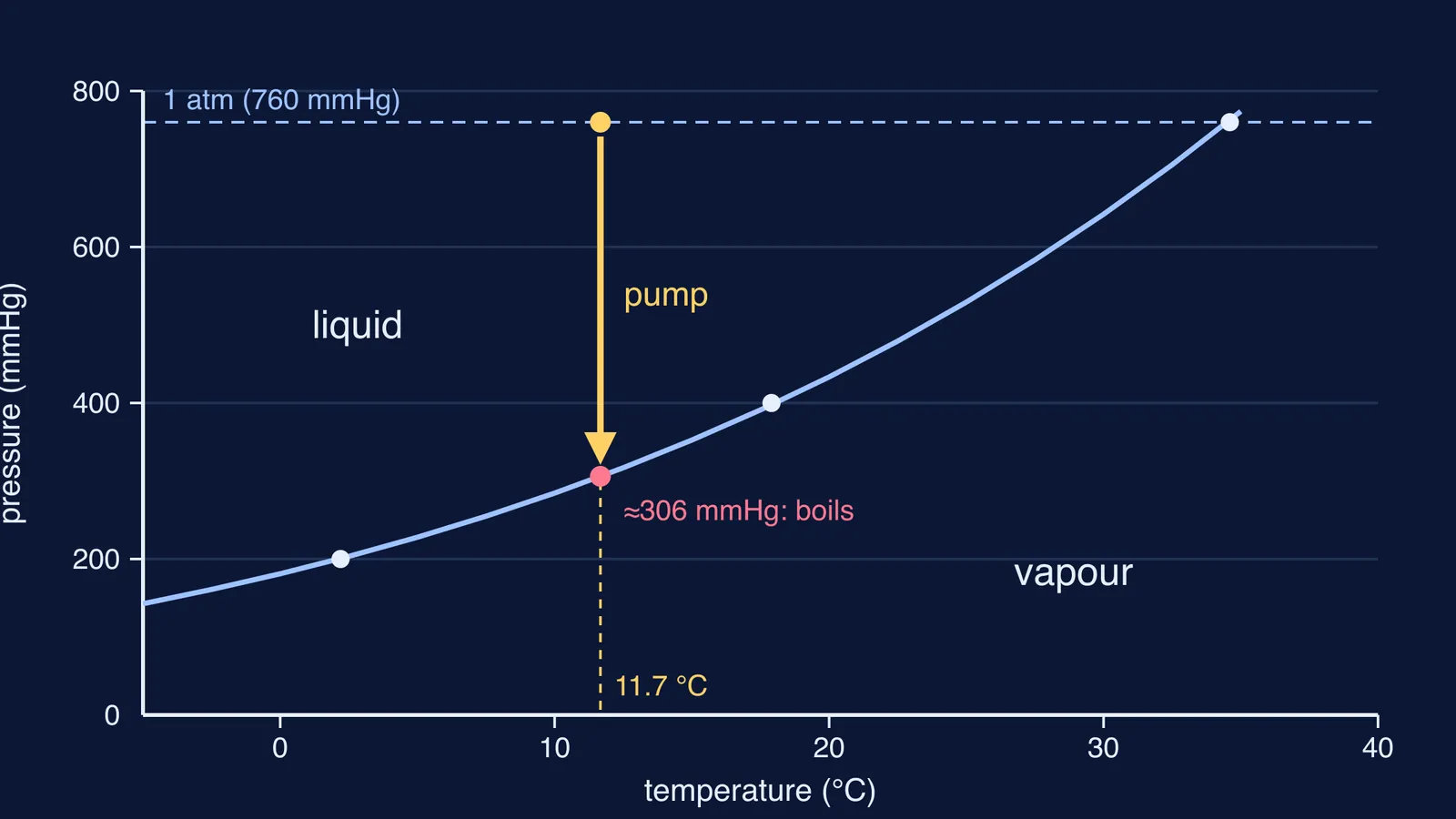
A liquid boils when its vapour pressure equals the pressure of the gas above it, so lowering the pressure lowers the boiling point. PubChem lists the boiling point of diethyl ether, today's common ether, as 34.6 °C at 760 mmHg, 17.9 °C at 400 mmHg and 2.2 °C at 200 mmHg. A curve fitted through those values says that in Cullen's 12 °C room, diethyl ether boils once the pressure falls below about 306 mmHg, roughly 0.4 of an atmosphere.
Each gram of diethyl ether that turns to vapour needs 89.80 calories at 30 °C, about 376 joules, according to PubChem. The pump carries the vapour away, so evaporation keeps going.
The same physics keeps water cool in a clay pot, as our post on how a matka keeps water cool through evaporation explains. If vapour pressure is hard to picture, the Fermi Simulation Lab has interactive simulations for ideas that are easier to see than to read.
How much ether does it take to freeze water?
Liquid water has a specific heat of 4.18 J per gram per degree, and ice at 0 °C has a heat of fusion of 334 J per gram, according to Case Western Reserve University's physics demonstrations page. Take 10 g of water at 11.7 °C (53 °F) and PubChem's 376 J per gram for diethyl ether.
Cool the water to 0 °C: 10 × 4.18 × 11.7 ≈ 489 J.
Freeze it: 10 × 334 = 3,340 J.
Total: about 3,830 J.
Ether needed: 3,830 ÷ 376 ≈ 10 g.
In the ideal case, about one gram of ether boils off for each gram of water frozen, and freezing takes nearly seven times as much heat as cooling to 0 °C. In a real apparatus heat also leaks in from the glass and the room, so you need more ether.
Three questions work on any evaporative-cooling problem in a Class 11 or JEE paper:
What is evaporating, and what is it taking heat from?
What sets the rate: pressure, air movement, temperature, dryness?
Does the energy balance? Mass evaporated × latent heat of vaporisation = heat removed.
If latent heat itself is the shaky part, the Fermi Concept Library gives each concept in physics and chemistry its own lesson.
Why didn't Cullen build a fridge?
Cullen wrote that his result “seems to deserve being further examined by experiments” and declined to speculate until that was done (Cullen's essay). A working machine came decades later; our post on Jacob Perkins and the 1834 patent behind your fridge picks up the story.
His ideas also travelled through his students. Joseph Black studied under Cullen (University of Edinburgh, Our History), and Black's own essay was printed straight after Cullen's in the same 1756 volume. For where the heat goes when ice melts or water boils, read Joseph Black and the heat that thermometers cannot see next.