On this page
In the 1970s, three chemists taught computers to do something neither branch of physics could manage alone: follow a chemical reaction inside a molecule as big as a protein. In 2013 Martin Karplus, Michael Levitt and Arieh Warshel shared the Nobel Prize in Chemistry "for the development of multiscale models for complex chemical systems". You can borrow their way of thinking for your own chemistry answers.
What did Warshel, Levitt and Karplus win the Nobel Prize for?
Before their work, chemists modelling molecules on a computer had to choose either classical physics or quantum physics, says the Royal Swedish Academy of Sciences' announcement. Classical physics, the physics of Newton, gave simple calculations that could handle very large molecules, but it had no way to simulate a chemical reaction. Quantum physics could simulate reactions, but it needed so much computing power that it only worked for small molecules.
The three laureates used both at once. In the Academy's example of a drug binding to its target protein, the computer runs quantum calculations only on the protein atoms that interact with the drug and treats the rest classically.
Karplus was born in 1930 in Vienna, Levitt in 1947 in Pretoria and Warshel in 1940 at Kibbutz Sde-Nahum in Israel, according to the Nobel press release.
Why couldn't chemists just use quantum physics for everything?
Because a quantum calculation has to track every electron and every nucleus. The Academy's popular science background compares this to pixels in a photo: more pixels give a sharper picture but need more computer power. In the 1970s that meant quantum calculations were limited to small molecules, and the surrounding solvent had to be left out, even though most real reactions happen in solution.
How the two worlds met, from the same background document:
At the Weizmann Institute of Science in Israel, Warshel and Levitt used the institute's computer, called Golem, to build a classical-physics program that could model even large biological molecules.
In 1970, after his PhD, Warshel joined Karplus's lab at Harvard, where the group worked on quantum chemistry.
In 1972 Karplus and Warshel published a program that used quantum physics for electrons free to move across several atoms and classical physics for everything else (Journal of the American Chemical Society). It only worked for molecules with mirror symmetry.
Warshel and Levitt then spent several years, first in Rehovot and then in Cambridge, making classical and quantum physics work together more smoothly. In 1976 they published the first computer model of an enzyme reaction, a study of the enzyme lysozyme (Journal of Molecular Biology90311-9)).
How does a multiscale model actually work?
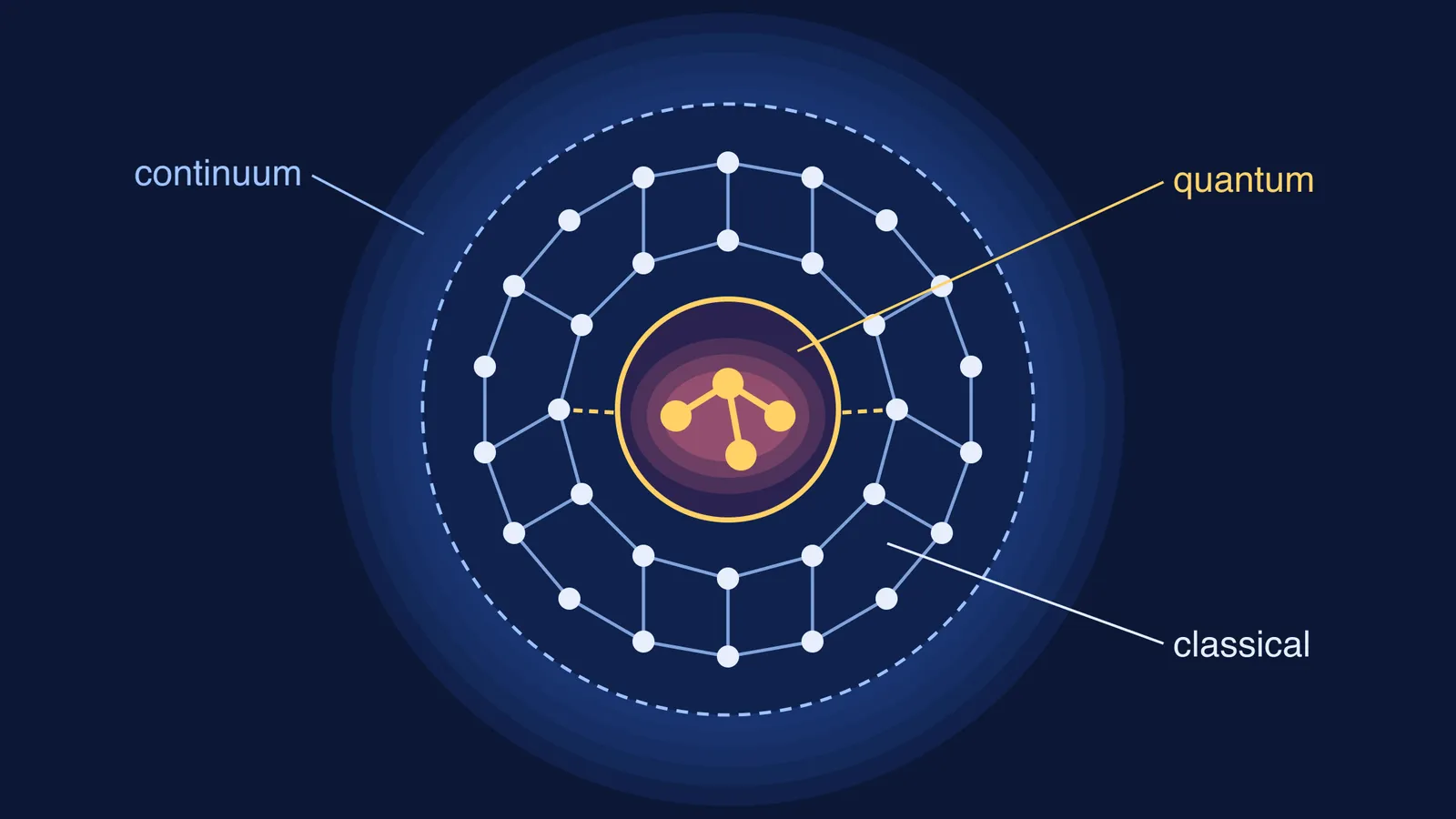
A multiscale model describes different parts of one chemical system at different levels of detail, so that computing power goes where the chemistry happens. The Academy's background describes a quantum layer and a classical layer, plus a third layer that modern calculations add, as in the diagram above:
Quantum core: the electrons and nuclei that take part directly in the reaction, calculated with quantum physics.
Classical shell: the rest of the molecule, calculated with simpler classical equations.
Continuum: areas far from the reaction, where atoms and molecules are bundled into one smooth mass called a "dielectric medium".
If you have read how Henry Eyring described the transition state, the quantum core is where that fleeting state forms, now inside huge molecules.
How can you use multiscale thinking in a chemistry answer?
Look at the title of the 1976 paper: "Theoretical studies of enzymic reactions: Dielectric, electrostatic and steric stabilization of the carbonium ion in the reaction of lysozyme" (Crossref record90311-9)). It asks how the surroundings stabilise a charged intermediate. You can ask the same kind of question, layer by layer, on many mechanism questions in Class 12 or JEE organic chemistry.
Worked example: why does tert-butyl bromide react with water by SN1?
Core: which bonds change? The C-Br bond breaks and a carbocation forms ("carbonium ion" is the older name).
Shell: what do the neighbours do? The three methyl groups push electron density towards the positive carbon and stabilise it. Their bulk also crowds the back of that carbon, which blocks SN2 attack.
Environment: what does the solvent do? Water is polar and protic, so it surrounds and stabilises the ions as they form. That favours SN1.
Going core, shell, environment stops you quoting a rule ("tertiary means SN1") without the reason examiners mark.
If the carbocation step itself feels shaky, the Fermi Concept Library gives each chemistry concept its own lesson and its place in the map, so you can go back one step. For ideas that are easier to see than to read, the Fermi Simulation Lab has interactive simulations.
Where does computer chemistry go from here?
The Academy's background notes that Levitt has written about a dream of simulating a living organism at the molecular level. To see the physics the quantum layer is built on, start with Schrodinger's wave equation. For another way computers now help with proteins, read how Demis Hassabis and AlphaFold predicted protein structures.