On this page
In February 1935, Henry Eyring, then at Princeton, published The Activated Complex in Chemical Reactions in The Journal of Chemical Physics. The abstract describes calculating absolute reaction rates by applying statistical mechanics to the activated state. Eyring's question: what do molecules look like halfway between reactants and products?
Who was Henry Eyring?
The National Academy of Sciences biographical memoir by Walter Kauzmann gives the outline. Eyring was born on 20 February 1901 in Colonia Juarez, Mexico. The Mexican Revolution drove his family to the United States in 1912. He studied mining engineering at the University of Arizona and earned a PhD at Berkeley in 1927.
From 1929 to 1930 he worked at the Kaiser Wilhelm Institute in Berlin with Michael Polanyi. Together they calculated a potential energy surface for the reaction H + H2 → H2 + H, a map of the energy for every arrangement of the three atoms. He was at Princeton from 1931 to 1946. In 1946 the University of Utah approached him to become dean of its graduate school, and he spent the rest of his career in Salt Lake City. He died on 26 December 1981.
The same memoir records that the 1935 paper "was first rejected when submitted to the Journal of Chemical Physics, but the editor was persuaded to change his mind".
What is the activated complex in transition state theory?
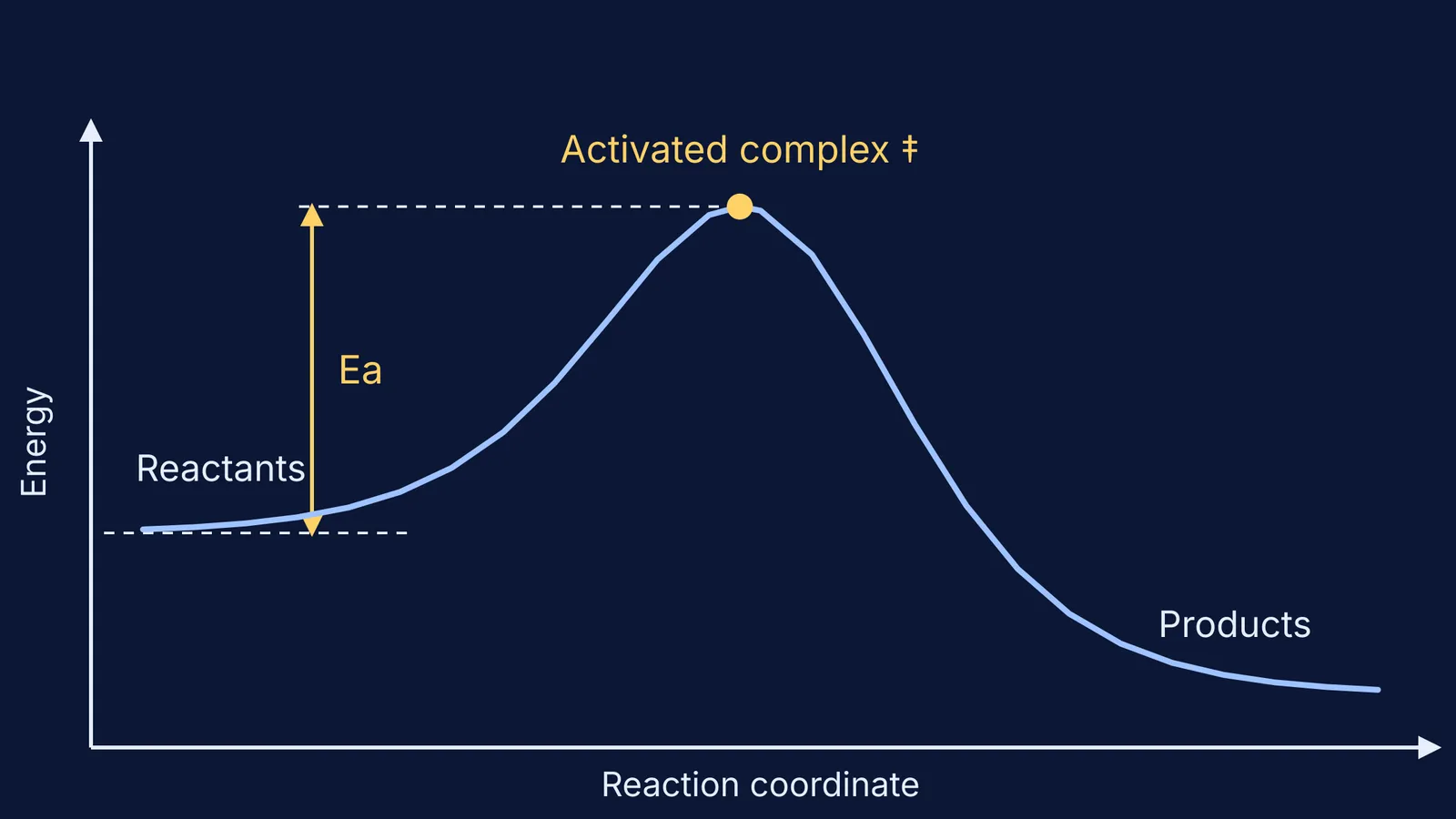
Picture the energy map as a landscape: reactants in one valley, products in another, and the lowest route between them crossing a mountain pass, a saddle point. The arrangement of atoms at the top of that pass, with old bonds half broken and new bonds half formed, is the activated complex.
The Kauzmann memoir says Eyring treated the activated complex as "an entity controlling the rates of chemical reactions with a definite mean lifetime", something you could describe with thermodynamics and statistical mechanics. The central assumption is that activated complexes are in equilibrium with the reactants, written A + B ⇌ AB‡ → products (LibreTexts). So the rate depends on two things: how many complexes are at the top, and how fast they cross over.
Eyring was not alone. In the same year, M. G. Evans and Michael Polanyi published a paper applying the transition state method to reaction rates, especially in solution, in the Transactions of the Faraday Society.
What does the Eyring equation say?
In its common form, the Eyring equation is k = (kBT/h) e^(−ΔH‡/RT) e^(ΔS‡/R), where ΔH‡ is the enthalpy of activation and ΔS‡ the entropy of activation (LibreTexts).
The front factor uses only Boltzmann's constant (1.381 × 10^-23 J/K) and Planck's constant (6.626 × 10^-34 J s). At 298 K, kBT/h works out to 6.21 × 10^12 per second, the same for every reaction.
ΔH‡ measures how high the pass is; ΔS‡ measures how ordered the complex must be. A tightly lined-up complex has a negative ΔS‡ and forms less often.
Plotting ln(k/T) against 1/T gives a straight line with slope −ΔH‡/R and intercept ln(kB/h) + ΔS‡/R, a cousin of the Arrhenius plot in our guide to finding activation energy from rate data with the Arrhenius equation.
Worked example: how much do height and tightness matter?
Use the equation and constants from LibreTexts, with R = 8.314 J/(K mol).
Front factor at 298 K: kBT/h = 6.21 × 10^12 s^-1.
Take ΔH‡ = 50 kJ/mol and ΔS‡ = 0. Then ΔH‡/RT = 50000 / (8.314 × 298) = 20.18, and e^(−20.18) = 1.72 × 10^-9. So k = 1.07 × 10^4 s^-1.
Keep the same barrier, but let the complex be tightly ordered: ΔS‡ = −100 J/(K mol). The entropy factor is e^(−12.03) = 5.97 × 10^-6, so k falls to about 0.064 s^-1, roughly 170,000 times slower.
Warm the first reaction to 308 K. The ratio is (308/298) × e^((50000/8.314)(1/298 − 1/308)) = 1.034 × 1.93 ≈ 1.99. The rate almost exactly doubles, which matches the rule of thumb in our post on the temperature coefficient of reaction rate.
The lesson: barrier height sets how strongly temperature matters, but the shape of the complex alone can shift the rate by orders of magnitude.
To practise numericals like this, the Fermi Problem Library has worked problems with a step-by-step solver that explains the reasoning rather than printing an answer.
Was transition state theory proved right?
Not without argument. The Kauzmann memoir calls the activated complex probably Eyring's most important scientific contribution and notes it was applied to viscosity and diffusion. It also says the validity of the theory's basic assumptions "frequently have been questioned and discussion on this continues to this day".
In a 2010 paper on Eyring's career, Douglas Henderson wrote that "most chemists are surprised, if not shocked, that he was never awarded a Nobel Prize".
For how experiments later caught molecules mid-reaction, read Ahmed Zewail and the camera that filmed chemical reactions.
If the saddle point is hard to picture from a flat diagram, the Fermi Simulation Lab has interactive simulations for ideas that are easier to see than to read.