

On this page
What is the protein folding problem?
Every biological function in your body—from transporting oxygen in red blood cells with haemoglobin to breaking down cellular sugars with enzymes—relies on proteins folding into precise three-dimensional architectures. In 1961, biochemist Christian Anfinsen demonstrated that the linear sequence of amino acids contains all the instructions needed to fold a protein into its lowest-energy, native state, as detailed in Christian Anfinsen's 1973 review in Science. Ever since James Sumner's crystallisation of urease confirmed that enzymes are proteins, structural biologists have used experimental tools like X-ray crystallography, cryo-electron microscopy, and nuclear magnetic resonance spectroscopy to capture these shapes atom by atom. Yet each physical structure often demanded months or years of painstaking wet-lab work, costing tens of thousands of dollars.
The theoretical bottleneck became famous as Levinthal's paradox, formulated in Cyrus Levinthal's 1968 analysis. Consider a modest protein composed of 100 amino acid residues. Because each residue possesses two flexible backbone dihedral angles (phi, φ, and psi, ψ) with at least three stable conformations apiece, the chain could theoretically adopt 3¹⁹⁸ ≈ 10⁹⁵ possible spatial arrangements. If the molecule sampled a new conformation every picosecond (10⁻¹² seconds), a random combinatorial search would take roughly 10⁸³ seconds—far longer than the 4.3 × 10¹⁷ seconds that make up the age of the universe. Yet proteins inside cells routinely fold within milliseconds.
To decipher this mystery computationally, researchers founded the Critical Assessment of Structure Prediction (CASP) in 1994, running biennial blind tests where computational teams attempt to predict unpublished structures. For over two decades, progress plateaued, with models struggling to achieve atomic precision when homologous templates were missing.
How does AlphaFold predict 3D protein structure?
Enter Demis Hassabis, a former child chess prodigy who reached master standard at age 13 and completed a doctorate in cognitive neuroscience at University College London in 2009, as documented in the Nobel Prize biographical background. Having co-founded DeepMind in 2010 with the mission to solve fundamental intelligence, Hassabis directed the lab's machine learning capabilities toward structural biology, as highlighted in Nature's report on the 2024 Chemistry Nobel. Together with lead scientist John Jumper, he reimagined structure prediction not as brute-force physics simulation, but as an integrated spatial attention problem.
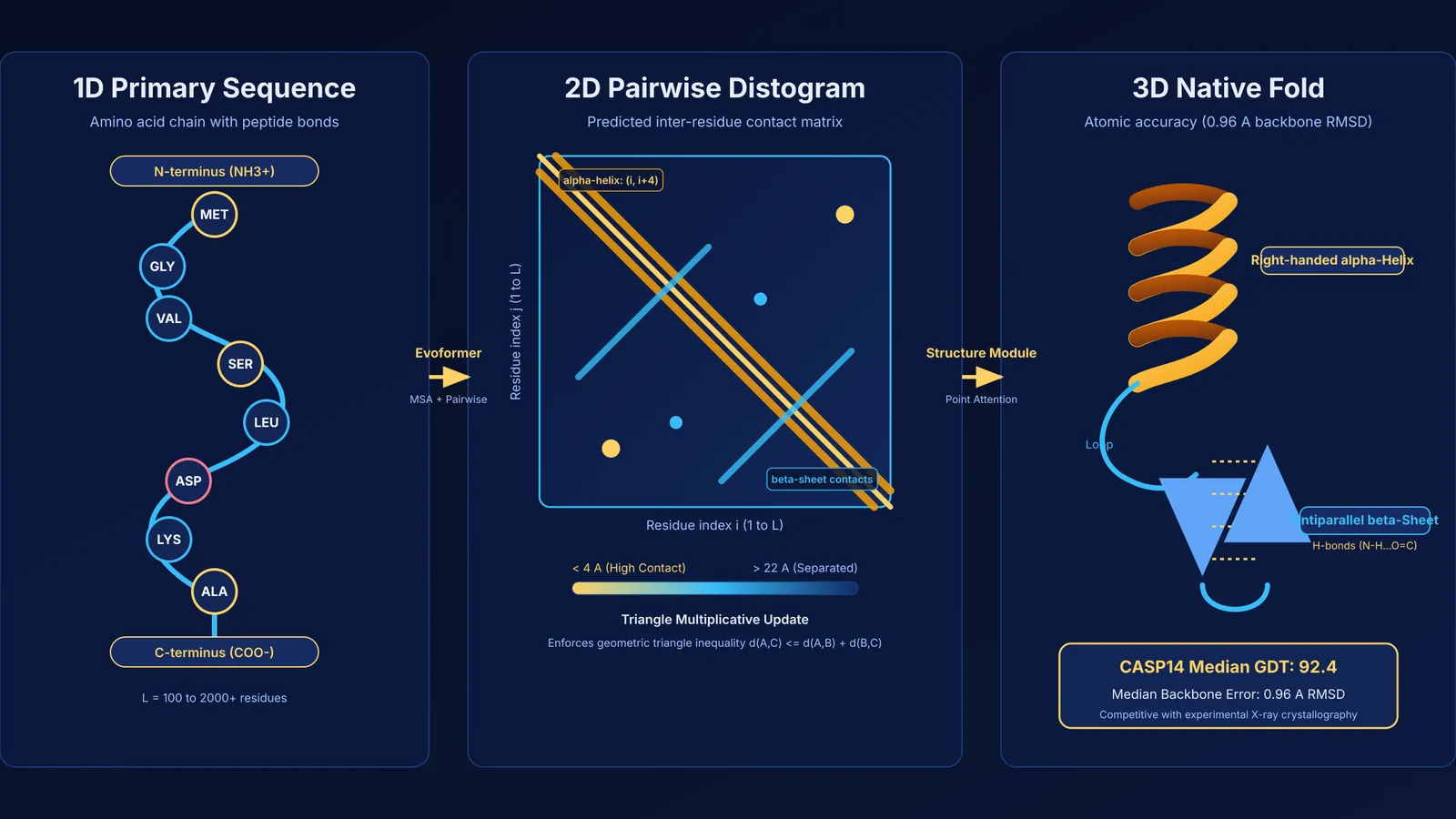
Published in Nature in 2021 by Jumper, Hassabis, and colleagues, AlphaFold2 operates through three interconnected steps:
Multiple Sequence Alignment: AlphaFold searches public sequence databases, tracing evolutionary history. Just as Margaret Dayhoff's pioneering protein database laid the groundwork for comparative genomics, AlphaFold looks for co-mutations across millions of years. If a mutation at position 15 changes an amino acid residue's charge, a contacting residue at position 82 often mutates concurrently to preserve the bond.
The Evoformer: A deep neural network processes sequence alignment information and pairwise distance representations in parallel. Using axial attention and triangle multiplicative updates, it enforces geometric consistency, ensuring that if residue A is near B, and B is near C, the distance between A and C satisfies the triangle inequality.
The Structure Module: The model directly translates these representations into three-dimensional Cartesian coordinates for the protein backbone and side chains, rotating rigid peptide frames using invariant point attention.
Understanding how individual amino acids link into polymer chains starts with drawing and naming peptide bonds. To master these foundational ideas, students can explore the Fermi Concept Library, where every concept in biology and chemistry has its own lesson and its place in the map. Visualising how electrostatic repulsion and hydrophobic residues guide molecular shapes is also supported by the Fermi Simulation Lab, offering interactive simulations for the ideas that are easier to see than to read.
Why did AlphaFold mark a turning point at CASP14?
At the 14th CASP assessment in 2020, AlphaFold2 achieved what biologists considered a generational leap. Performance at CASP is judged by the Global Distance Test (GDT), a metric ranging from 0 to 100, where scores above 90 indicate accuracy competitive with experimental X-ray crystallography. As documented in the independent assessment by Kryshtafovych and colleagues in Proteins, AlphaFold2 achieved a median GDT score of 92.4 across all targets, with a median backbone error of 0.96 Ångströms—roughly the width of an atom. In the earlier CASP13 competition in 2018, the initial AlphaFold model had reached a median GDT of nearly 60, making the 2020 leap historic.
On October 9, 2024, the Royal Swedish Academy of Sciences awarded the 2024 Nobel Prize in Chemistry, honouring Demis Hassabis and John Jumper jointly with one half of the prize for protein structure prediction, alongside David Baker for computational protein design. Partnering with the European Bioinformatics Institute (EMBL-EBI), DeepMind initially mapped 98.5% of human proteins, as reported in Nature's human proteome study, before expanding the AlphaFold Protein Structure Database to over 200 million catalogued protein structures freely accessible to researchers worldwide.
How can students explore protein structures today?
For students in Class 11 and 12 biology or chemistry, navigating protein biochemistry becomes far easier when broken into four distinct hierarchical levels:
Primary Structure: The linear sequence of amino acid residues joined by covalent peptide bonds, dictated by genetic codons.
Secondary Structure: Local folding stabilised by backbone hydrogen bonds, producing right-handed α-helices and β-pleated sheets.
Tertiary Structure: The global 3D conformation stabilised by side-chain interactions, including hydrophobic collapse, disulfide bridges, ionic bonds, and van der Waals attractions.
Quaternary Structure: The arrangement of multiple folded polypeptide subunits into a functional multi-mer, such as the tetrameric structure of haemoglobin.
When working through multi-step biochemistry problems, Fermi's AI tutor notices where a student is stuck across a whole session, works out what they already know, and builds a plan to teach through concepts rather than just giving an answer.


