On this page
In 1887 a physiologist in Kiel, Germany, gave one name to everything that drifts in the sea. Then Victor Hensen tried to count it. He measured the water his net filtered and counted the organisms in a known fraction of the catch. His methods were still in use a century later, and so were some of their problems.
Who coined the word plankton?
Victor Hensen introduced the term plankton in 1887 to describe all matter drifting in the sea, according to a 2021 profile by John Dolan in the Journal of Plankton Research. The profile says he was the first to identify the drifting plants (phytoplankton) and drifting animals (zooplankton) as plankton.
The word comes from the Greek for "drifter" or "wanderer", as NOAA's Ocean Service explains.
Hensen (1835 to 1924) was named professor of physiology at the University of Kiel in 1868, according to a history of his expedition by Damkaer and Mrozek-Dahl.
Why did Hensen want to count plankton?
Hensen's political work led to a commission for the scientific study of German seas, founded at Kiel in 1870. From the start, his goal was to study "the productivity of the ocean" so that fisheries could be kept healthy, Damkaer and Mrozek-Dahl write.
Fish larvae eat plankton, so a fishery depends on how much plankton there is. Hensen also assumed that where sea conditions were uniform, one haul of a fine net pulled straight up would give a dependable estimate for the whole area. That assumption later caused him trouble.
How did Hensen measure plankton in sea water?
Dolan describes the method in the Journal of Plankton Research profile:
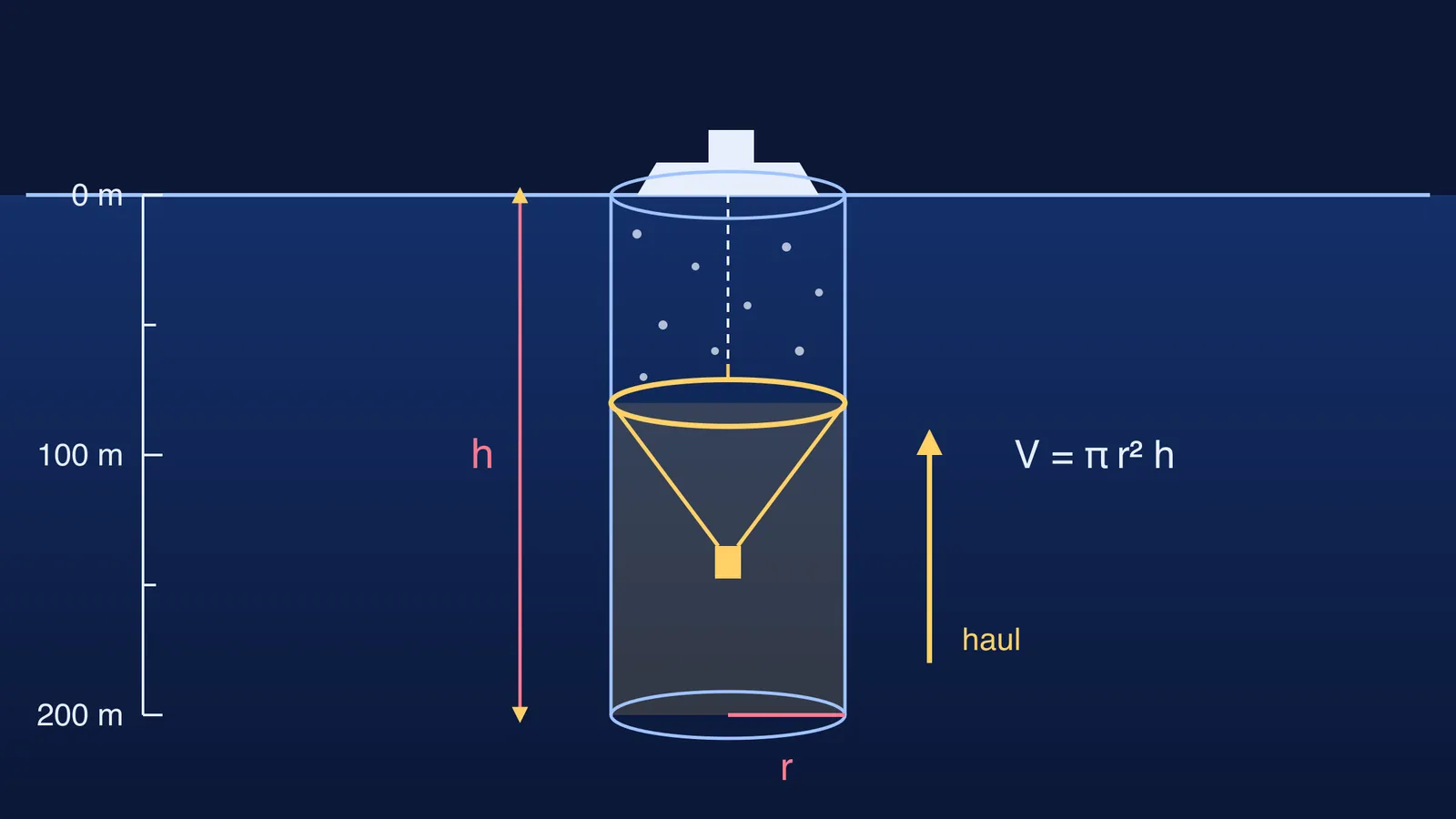
Lower a net designed for vertical hauls to a set depth and pull it straight up.
Work out the volume of water sampled from the net's diameter and the depth fished.
Put aliquots (measured fractions) of the catch on glass plates with lines etched in them to mark lanes.
Scan each plate, lane by lane, under a Leitz microscope fitted with a large stage.
Scale the count up to the whole catch, then divide by the volume of water.
The water the net passes through is a cylinder, so its volume is V = πr²h, where r is the radius of the net's mouth and h is the depth of the haul.
Worked example: from a haul to a density
These numbers are made up for practice, not taken from Hensen's records.
Net mouth diameter 0.5 m, so r = 0.25 m. Haul from h = 200 m.
Volume filtered: V = π × 0.25² × 200 ≈ 39.3 m³, about 39,300 litres.
The catch is rinsed into a 500 mL bottle. You count a 1 mL aliquot and find 120 copepods.
Whole catch: 120 × (500 ÷ 1) = 60,000 copepods.
Density: 60,000 ÷ 39.3 ≈ 1,530 copepods per cubic metre, or about 1.5 per litre.
Under each square metre of sea surface, down to 200 m: 1,530 × 200 ≈ 306,000 copepods.
If you tend to lose track of units when you scale up, the Fermi Problem Library has worked problems with a step-by-step solver that explains the reasoning, not just the answer. Practise more with our guide to Fermi estimation problems.
Writing in 1980, Damkaer and Mrozek-Dahl noted that Hensen's problem of measuring all the plankton in a stated volume of water "remains unsolved".
What did the Plankton Expedition find?
The steamer National left Kiel on 15 July 1889. It covered 16,000 miles, from southern Greenland to the mouth of the Amazon, and was back by 7 November, according to Damkaer and Mrozek-Dahl. The team sampled more than 100 open-ocean stations with the quantitative net, usually hauling it from 200 m to the surface.
The result went against expectation: warm tropical seas held much less plankton than cold northern seas. The expedition botanist Franz Schütt put it this way, as quoted by Damkaer and Mrozek-Dahl: "the pure blue is the color of desolation of the high seas".
Ernst Haeckel, the zoologist who coined the word ecology, attacked the findings in 1893. In the English translation quoted by Damkaer and Mrozek-Dahl, he wrote: "I am convinced that the whole method employed by Hensen for determining the plankton is utterly worthless." Haeckel also disputed Hensen's claim that plankton is evenly spread, and on that point he was right: Dolan notes in the 2021 profile that the claim was soon shown to be untrue in various places. So one haul cannot stand for a whole area.
Why does plankton counting still matter?
Today scientists ask Hensen's question using satellites. A 1998 study in Science by Field and colleagues put global net primary production at 104.9 petagrams of carbon a year, split roughly equally between land and oceans.
Read how ecosystem productivity and the 10% law work. If primary production or trophic levels are still hazy, the Fermi Concept Library gives each biology concept its own lesson and shows where it sits in the map.