On this page
Any chatbot can define ecosystem productivity; the test is whether it can use the idea. Here are three prompts for a clear explanation, then a numerical we set with one trap built in.
What are gross and net primary productivity?
The definitions here come from NCERT's Class 12 Biology chapter on Ecosystem, the textbook for CBSE Class 12 Biology.
Primary productivity is the rate of biomass production by plants, expressed in g m⁻² yr⁻¹ or (kcal m⁻²) yr⁻¹.
Gross primary productivity (GPP) is the rate of production of organic matter during photosynthesis.
Net primary productivity (NPP) is GPP minus respiration losses (R): GPP − R = NPP.
NCERT calls NPP the biomass available for consumption by heterotrophs (herbivores and decomposers), so everything else depends on it. The same chapter says the annual NPP of the whole biosphere is about 170 billion tons (dry weight), and the oceans, despite covering about 70 per cent of the surface, produce only 55 billion tons of it.
What is the 10 per cent law in energy flow?
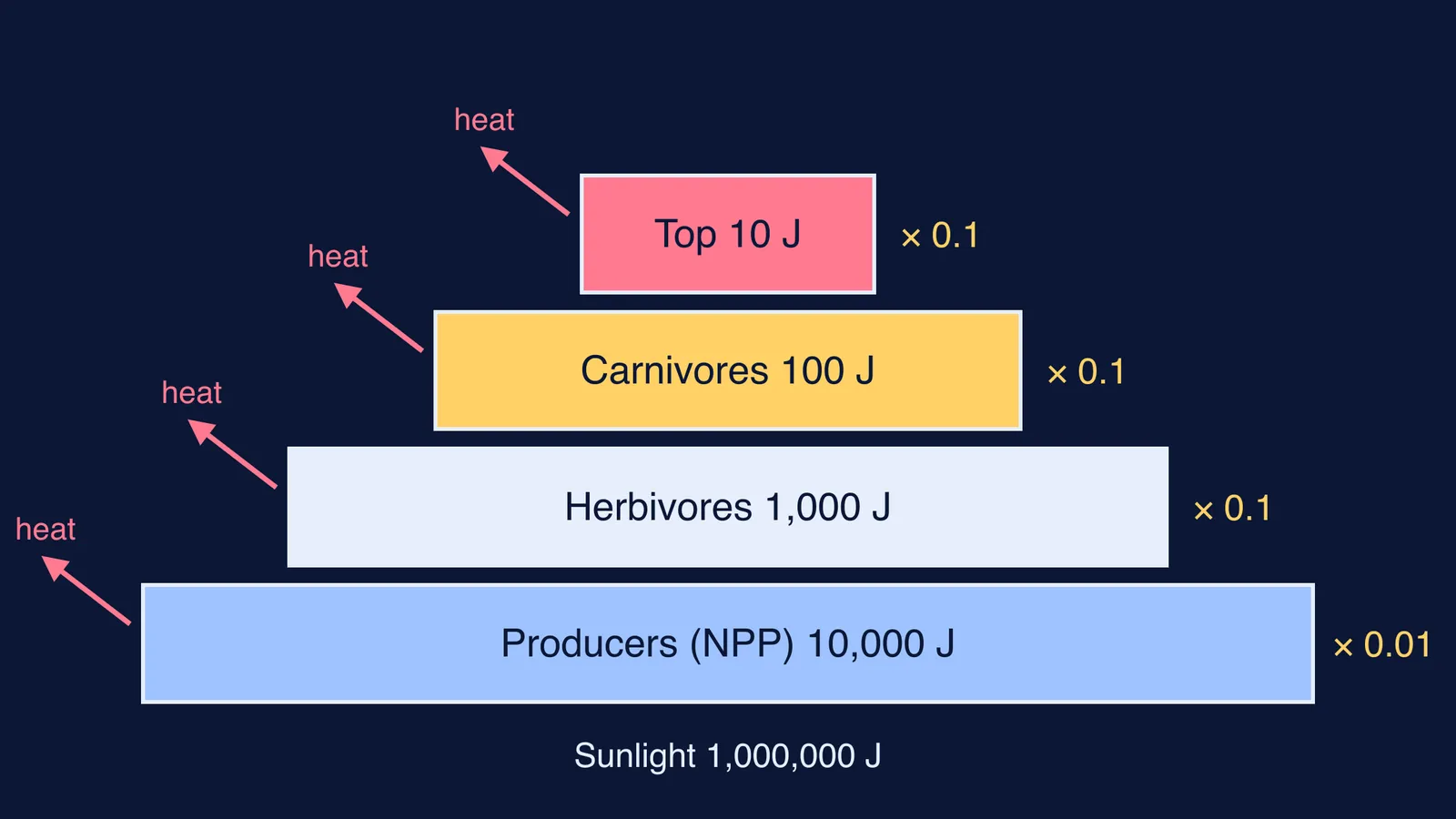
NCERT states that only 10 per cent of the energy is transferred to each trophic level from the lower trophic level (NCERT Ecosystem chapter). Its ideal pyramid of energy starts with 1,000,000 J of sunlight, of which producers convert only 1% into NPP: 10,000 J. Then come 1,000 J for herbivores, 100 J for carnivores and 10 J for top carnivores. Some energy is lost as heat at every step, which is why NCERT says a pyramid of energy can never be inverted.
Treat 10 per cent as a textbook rule of thumb. A 2021 review in Trends in Ecology and Evolution suggests that real transfer efficiency in marine ecosystems is “highly variable”, affected by fishing and likely to decline with climate change (Eddy and colleagues, 2021). In an exam, use 10 per cent unless the question gives you another figure.
How do you get an AI to explain productivity properly?
Paste these one at a time, with the NCERT Ecosystem chapter open beside you.
“Using NCERT Class 12 Biology, define gross and net primary productivity in one sentence each, give the equation linking them, and state the units.”
“Explain the 10 per cent law. In NCERT's pyramid of energy, does the first 10 per cent step start from the producers' GPP or NPP? Point to the numbers.”
“Where does the other 90 per cent go, and why can a pyramid of energy never be inverted?”
A good answer gives GPP − R = NPP with units, starts the steps at NPP and names heat loss. If it skips the units or the starting number, ask again.
How do you test the AI with a numerical?
Give it a problem you have already solved, like this one we made up using NCERT's 10 per cent law:
“In a pond, producers have a gross primary productivity of 8,000 kJ m⁻² yr⁻¹ and lose 3,000 kJ m⁻² yr⁻¹ in respiration. Using the 10 per cent law, how much energy reaches the secondary carnivores at the fourth trophic level? Show each step.”
The working:
NPP = GPP − R = 8,000 − 3,000 = 5,000 kJ m⁻² yr⁻¹.
Herbivores (second level): 10 per cent of 5,000 = 500 kJ m⁻² yr⁻¹.
Primary carnivores (third level): 10 per cent of 500 = 50 kJ m⁻² yr⁻¹.
Secondary carnivores (fourth level): 10 per cent of 50 = 5 kJ m⁻² yr⁻¹.
If the AI says 8, it applied the law to GPP. If it says 50, it stopped one level early. Then push back: “My friend got 8. Are you sure?” A good tutor explains why it started from NPP instead of simply agreeing. If it changes its answer without a reason, open the textbook yourself; our guide on what to say when an AI tutor gives a wrong answer covers that conversation.
Finally, run it backwards: “A top carnivore at the fourth level receives 2 kJ m⁻² yr⁻¹. What was the producers' NPP?” Working back down three levels, multiplying by 10 each time, gives 2,000 kJ m⁻² yr⁻¹.
Where does this fit in the rest of the chapter?
Productivity feeds both kinds of food chain. Our comparison of grazing and detritus food chains and our notes on the role of decomposers in an ecosystem pick up from there.
If you get stuck at step one, unsure which number is NPP, the Fermi Problem Library has worked problems with a step-by-step solver that explains the reasoning rather than printing an answer. If you don't know where to start, Fermi's AI tutor works out what you already know and builds a plan for the session, checking your understanding as it goes.
Tonight, set your own numerical with different numbers and see whether the AI still starts from NPP.