On this page
On 10 January 1832, the Medical and Chirurgical Society of London heard a paper about swollen glands by Thomas Hodgkin of Guy's Hospital. The printed version says it was "presented by Dr. R. Lee" and "read January 10th and 24th, 1832" (full text on the Internet Archive). The paper ran to pages 68–114 of volume 17 of Medico-Chirurgical Transactions (PubMed Central scan). It is the reason a cancer of the lymph system carries his name.
Who was Thomas Hodgkin?
Hodgkin (1798–1866) was a Quaker doctor who, in 1826, became the first lecturer in morbid anatomy and museum curator at the new Guy's Hospital Medical School in London, according to a biography by physician Marvin Stone in Baylor University Medical Center Proceedings. Morbid anatomy means studying the organs of people who have died to understand what disease did to them.
The same biography says he performed hundreds of autopsies, catalogued more than 3,000 specimens, brought the first stethoscope to Guy's, lectured there on how to use it in 1822, and in 1827 published microscope observations of red blood cells with Joseph Jackson Lister. Lister's story is in our post on the wine merchant who perfected the microscope lens.
What did Hodgkin describe in 1832?
The paper was titled "On some morbid appearances of the absorbent glands and spleen". "Absorbent glands" was the old name for lymph nodes. It described seven patients with enlarged lymph nodes and spleens (Stone, 2005).
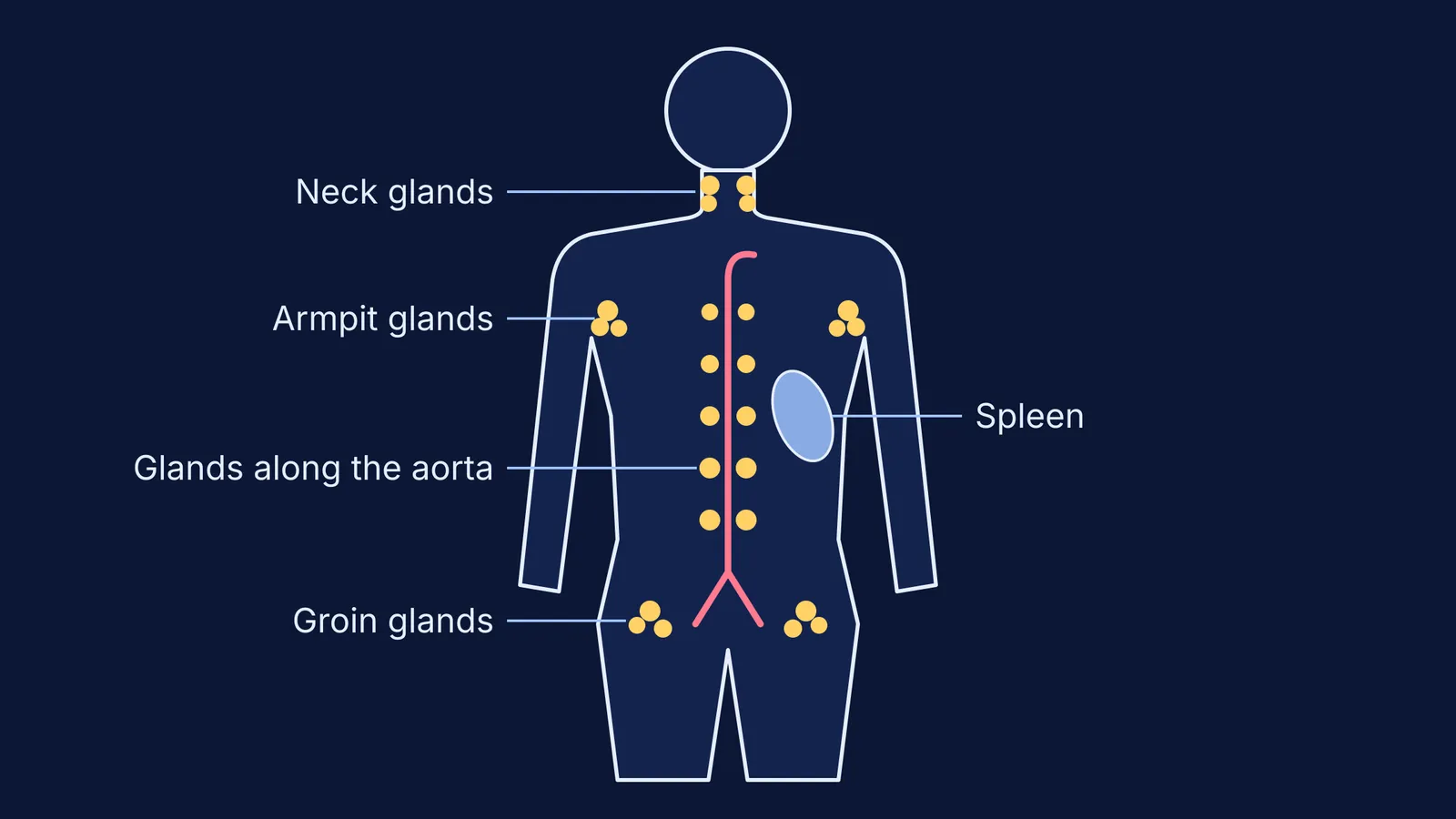
Hodgkin noticed the same pattern in every case. In his words, "all these cases agree in the remarkable enlargement of the absorbent glands accompanying the larger arteries", naming the glands of the neck, the armpit (axillary), the groin (inguinal) and those along the aorta in the chest and abdomen (1832 text).
He also noted that the spleen, "with one exception in all the cases that I have had the opportunity of examining, has been found more or less diseased" (1832 text). If the lymph system feels hazy, our explainer on what lymph nodes do covers filters, lymphocytes and fluid return.
How did Hodgkin argue it was a new disease?
Hodgkin had no modern stains or lab tests, only careful reasoning from autopsies. You can use the same steps on any biology case study.
Spot the pattern. List what every case shares. For Hodgkin: large glands near the big arteries, plus a diseased spleen.
Name the usual explanation. Swollen glands are often a sign of inflammation, so that was the explanation to beat.
Test it against the signs. Inflammation brings pain, heat and pus. Hodgkin wrote that these glands were "unattended with pain, heat, and other ordinary symptoms of inflammation" and showed no tendency to form pus (1832 text).
Rule out the next suspect. He argued the enlargement came from growth of the whole gland itself, not from tuberculous matter deposited inside and pushing the gland aside.
Propose a sequence. Because one patient had far-advanced gland disease but only tiny spleen deposits, he suggested the spleen was affected later, "a posterior effect".
If one of those steps stalls because a concept is missing, the Fermi Concept Library has every concept in biology with its own lesson and its place in the map, so you can fill the gap and get back to the case.
How did it get the name Hodgkin's disease?
Not straight away. In 1865 Samuel Wilks published "Cases of enlargement of the lymphatic glands and spleen (or Hodgkin's disease) with remarks", using the term "Hodgkin's disease" (Stone, 2005).
Later doctors went back to the evidence. In 1926 Herbert Fox looked at tissue from three of Hodgkin's patients under the microscope and confirmed that two had Hodgkin's disease; the third had lymphosarcoma, now known as non-Hodgkin lymphoma (Stone, 2005). A 2015 review in the Sultan Qaboos University Medical Journal notes that only two of the archived cases were authenticated by modern immunophenotyping (PMC review).
The cells that define the disease came later: Carl Sternberg described them in 1898 and Dorothy Reed in 1902 (PMC review). Our post on Dorothy Reed and the cells that mark Hodgkin lymphoma tells that part of the story.
What is Hodgkin lymphoma today?
The US National Cancer Institute defines Hodgkin lymphoma as "a disease in which malignant (cancer) cells form in the lymph system" (NCI). To diagnose it, lymph node tissue is viewed under a microscope to look for cancer cells called Reed-Sternberg cells, which are common in classic Hodgkin lymphoma. They are large, abnormal lymphocytes that may contain more than one nucleus (NCI).
The outlook has changed since 1832. In US cancer registry data, five-year relative survival for Hodgkin lymphoma is 89.3% for people diagnosed in 2016–2022 (NCI SEER).
Fermi's AI tutor works out what you already know and builds a plan for the session, so you can move from lymph nodes to Hodgkin's 1832 argument one step at a time.