On this page
Hospital dialysis machines still rely on an idea a Scottish chemist tested with a hoop, a sheet of treated paper and a basin of water. In 1861 Thomas Graham showed that some dissolved substances slip through a membrane while others hardly move, and his names for them, colloid, crystalloid and dialysis, are still in your textbooks.
What did Thomas Graham discover in 1861?
Graham's paper, "Liquid Diffusion Applied to Analysis", appeared in volume 151 of the *Philosophical Transactions of the Royal Society*, pages 183 to 224. He signed it as Master of the Mint, a post he held from 1855 until his death in 1869). This is the same Graham behind Graham's law of gas diffusion.
His starting point was simple. Distillation separates liquids because some evaporate faster than others. Graham argued that dissolved substances also spread through water at very different speeds, so diffusion could be used to separate them too. In the paper's abstract he notes that hydrate of potash (potassium hydroxide) diffuses at roughly double the speed of sulphate of potash, and sulphate of potash at roughly double the speed of sugar.
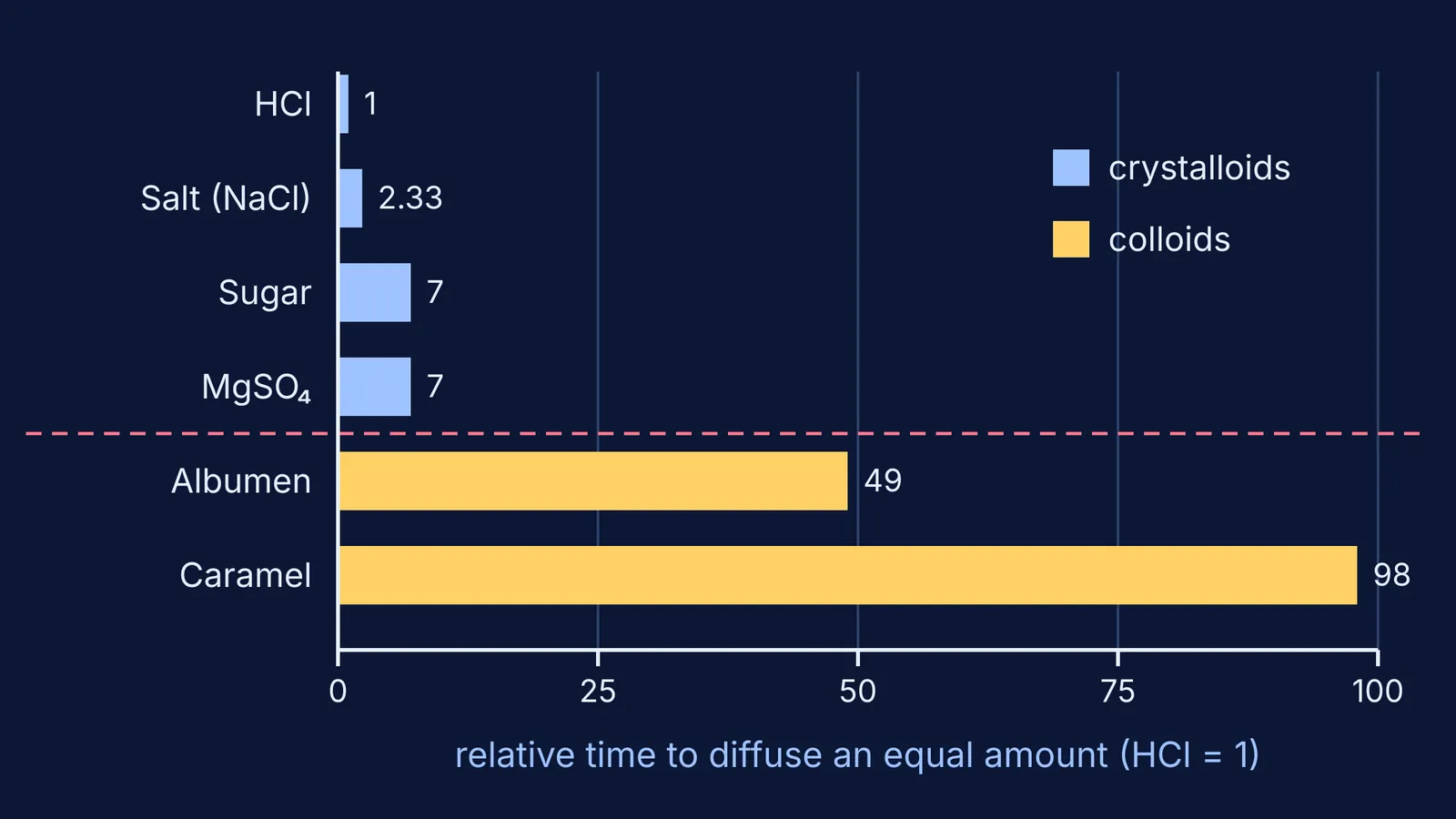
The slowest substances surprised him. In his table of approximate times of equal diffusion, hydrochloric acid takes 1 unit of time, common salt 2.33, sugar 7, albumen 49 and caramel 98.
Why did Graham call them colloids and crystalloids?
The slow group shared another habit: they did not crystallise. His list included starch, dextrin, gums, caramel, tannin, albumen and gelatine, all named in the 1861 paper.
In Graham's own words in the paper's abstract: "As gelatine appears to be its type, it is proposed to designate substances of the class as colloids." Substances in the opposite, crystalline condition he called crystalloids. The word colloid comes from the Ancient Greek kolla, "glue", plus "-oid", meaning "like". A colloid is, literally, a glue-like substance.
How did Graham's dialyser work?
Graham stretched parchment paper over a hoop 2 inches deep and 8 or 10 inches across, making a vessel like a sieve. He poured the mixture inside and floated it on a basin of water. Crystalloids passed through the paper into the water. Colloids stayed behind. He wrote: "It may perhaps be allowed to me to apply the convenient term dialysis to the method of separation by diffusion through a septum of gelatinous matter."
His measurements in Table XII of the paper show how sharp the split was. Over 24 hours, 7.5 grammes of common salt passed through the parchment. Only 0.029 grammes of gum arabic did, a relative rate of 0.004, about 1/250 of salt.
He also tried it on urine. Half a litre dialysed for twenty-four hours gave up its crystalloids to the outside water, and from these he extracted urea as crystals. Water crossing membranes had been studied over a century earlier, in Nollet's pig's bladder experiment on osmosis.
How do you read Graham's diffusion numbers?
Graham's tables make good practice in comparing ratios. Using his times of equal diffusion from the 1861 paper:
How much slower is albumen than salt? 49 divided by 2.33 is about 21. Albumen takes roughly 21 times as long to diffuse the same amount.
How much slower is caramel than hydrochloric acid? 98 divided by 1 is 98 times.
How sharply does parchment sort salt from gum? 7.5 divided by 0.029 is about 260, close to the 250 implied by his rounded relative figure of 0.004.
To sort an unknown substance the way Graham did, ask three questions:
Does it form crystals? If yes, it is probably a crystalloid.
Does it spread quickly through water? Fast points to crystalloid, slow to colloid.
Does it pass through a parchment or cellophane membrane? If it stays behind, it behaves as a colloid.
If you find diffusion speeds hard to picture, the Fermi Simulation Lab has interactive simulations for ideas that are easier to see than to read. For a gas version of the same idea, try our post on Graham's law and heavy versus light gas diffusion.
How did dialysis get from the lab to the kidney?
It took about 80 years. According to the Lasker Foundation, Willem Kolff and a colleague in the Netherlands built the first rotating drum artificial kidney in 1942. Kolff wound 100 feet of cellophane around a horizontal drum, and his first clear success came in September 1945, with a 67-year-old woman.
The principle is still Graham's: small waste molecules such as urea cross a membrane, while large proteins and blood cells stay on their side. Our explainer on how a dialysis machine works follows the modern version step by step. Questions about a family member's treatment belong with their nephrologist.
When you next meet colloids in a chapter on solutions, the Fermi Concept Library gives each concept in chemistry and biology its own lesson and shows its place in the map.