

On this page
An artificial kidney, or hemodialysis machine, relies on fundamental principles of physical chemistry to perform a life-saving function. Stripped of its medical context, the machine is an elegant mass transfer device. It uses concentration gradients, fluid dynamics, and a specialised barrier to separate molecules by size.
What is the principle of a dialysis machine?
The core principle behind hemodialysis is diffusion across a selectively permeable membrane. Diffusion is the spontaneous movement of particles from a region of high concentration to a region of low concentration.
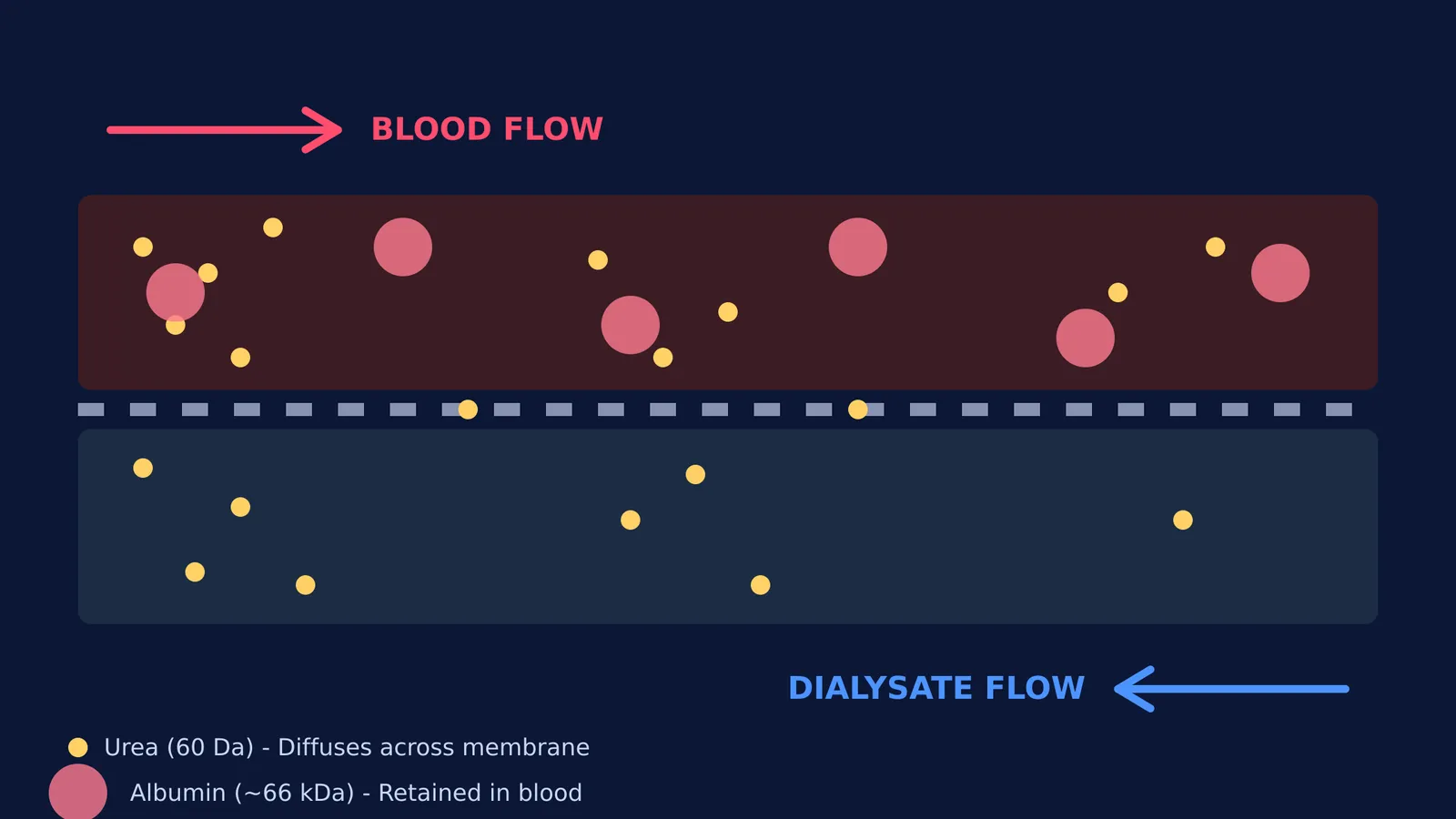
In a dialysis machine, the patient's blood contains a high concentration of nitrogenous waste products. The most prominent of these is urea, a byproduct of protein metabolism. To remove this waste, the blood is pumped through a chamber called a dialyzer. Inside this chamber, the blood flows on one side of a membrane, while a specially formulated cleaning fluid, called dialysate, flows on the other.
The dialysate is initially free of urea. This creates a steep concentration gradient between the blood and the fluid. Driven purely by this gradient, urea molecules diffuse out of the blood, across the membrane, and into the dialysate, which is then continuously flushed away. (For more on how organisms naturally handle this nitrogenous waste, see our guide on ammonotelic, ureotelic and uricotelic animals: why waste differs.)
How does the selectively permeable membrane work?
Not everything in the blood should be removed. The dialyzer must retain red blood cells, white blood cells, and vital proteins, while allowing waste to escape. It achieves this using a selectively permeable membrane.
The membrane contains microscopic pores that act as a sieve, filtering molecules strictly by their physical size and molecular weight. Urea is a very small molecule with a mass of approximately 60 Daltons (Wikipedia). Because these pores are larger than the urea molecules, the waste passes through easily.
However, essential blood proteins like albumin are massive—weighing roughly 66,400 Daltons—and are far too large to fit through the pores (Wikipedia). They bounce off the membrane and remain safely in the bloodstream. If you are struggling to visualise how molecules of different sizes behave in mixtures, the Fermi Concept Library has a lesson for every concept in chemistry and biology, each with its place in the map. (You can also practice the math of mixtures with our average molar mass of a gas mixture: worked air and vapour examples.)
Why is counter-current flow important?
Maintaining a steep concentration gradient is crucial for efficient diffusion. If blood and dialysate flowed in the same direction (concurrent flow), the concentration of urea in the blood would fall, and the concentration in the dialysate would rise, until they eventually equalised. At that point, diffusion would stop, even if the blood had not reached the end of the dialyzer.
To prevent this, dialysis machines use counter-current flow: the blood and the dialysate flow in opposite directions.
Standard blood flow rates range from 200 to 400 mL/min (Wikipedia).
The dialysate is pumped in the reverse direction at a standard rate of 500 mL/min, maintaining a roughly 1:2 ratio with the blood flow to maximise clearance (Wikipedia).
As the blood travels through the dialyzer and loses urea, it encounters dialysate that is increasingly fresh and urea-free. This ensures that a concentration gradient exists along the entire length of the membrane, maximising the total amount of waste removed.
How do you calculate the diffusion rate?
The rate at which a substance diffuses across a membrane can be described by Fick's Law of Diffusion. The rate of transfer (J) is proportional to the membrane's surface area (A), the permeability constant (K) of the membrane for that specific solute, and the concentration gradient (ΔC) across the membrane:
J = K × A × ΔC
If a student is asked how a dialysis machine could be modified to clear urea faster, they can use this framework to find the answers:
Increase ΔC: Increase the dialysate flow rate so that urea is washed away faster, keeping the dialysate-side concentration closer to zero.
Increase A: Use a larger dialyzer with more hollow fibres to provide a greater total surface area for diffusion.
Increase K: Use a "high-flux" membrane with slightly larger pores to offer less resistance to the urea molecules.
When working through complex fluid dynamics or concentration problems, the step-by-step solver in the Fermi Problem Library explains the underlying reasoning for each formula rather than just printing an answer. By breaking down medical technologies into their fundamental physics and chemistry, you can turn a memorisation task into a logical application of science.


