On this page
Most students meet the Lyman series as one line on a formula sheet. Behind it is a Harvard physicist who chased light that air swallows, and waited to publish until he was sure it came from hydrogen.
Who discovered the Lyman series?
Theodore Lyman was born in Boston on 23 November 1874 and died on 11 October 1954, according to the National Academy of Sciences biographical memoir by P. W. Bridgman. He earned his Harvard Ph.D. in 1900 and directed Harvard's Jefferson Physical Laboratory from 1910 to 1947.
After a preliminary paper in 1904, his The Spectrum of Hydrogen in the Region of Extremely Short Wave-Lengths appeared in The Astrophysical Journal in April 1906. Bridgman's memoir says Lyman's 1906 measurements gave wavelengths, to 0.1 Å, of more than three hundred hydrogen lines between 1228 and 1675 Å.
In 1914 Lyman announced the first three members of the series that follow the frequency formula N(1/1² − 1/m²), “a series now known as the Lyman series”, writes Bridgman. His letter An Extension of the Spectrum in the Extreme Ultra-Violet was published in Nature on 7 May 1914.
How did Lyman measure light that air absorbs?
Before Lyman, Victor Schumann had pushed the spectrum to about 1260 Å by putting the whole spectroscope in a vacuum and using fluorite for windows, lenses and prisms, the memoir explains. But his prisms could not give exact wavelengths.
Lyman's teacher W. C. Sabine suggested swapping the prism for a concave ruled grating. Bridgman writes that it took “seven discouraging years” to make this work: vacuum pumps were crude, and the grating produced false lines from visible light. Following an idea from Carl Runge, Lyman proved these came from errors in the grating's ruling. Bridgman notes they became known as Lyman ghosts, and they became the subject of his Ph.D. thesis.
Bridgman's verdict on the 1914 work: “Lyman's caution and meticulousness in assuring himself that this series was really due to hydrogen and not some impurity, and his delay of publication until he was sure, are models of scientific integrity.”
Why do all Lyman lines end at n = 1?
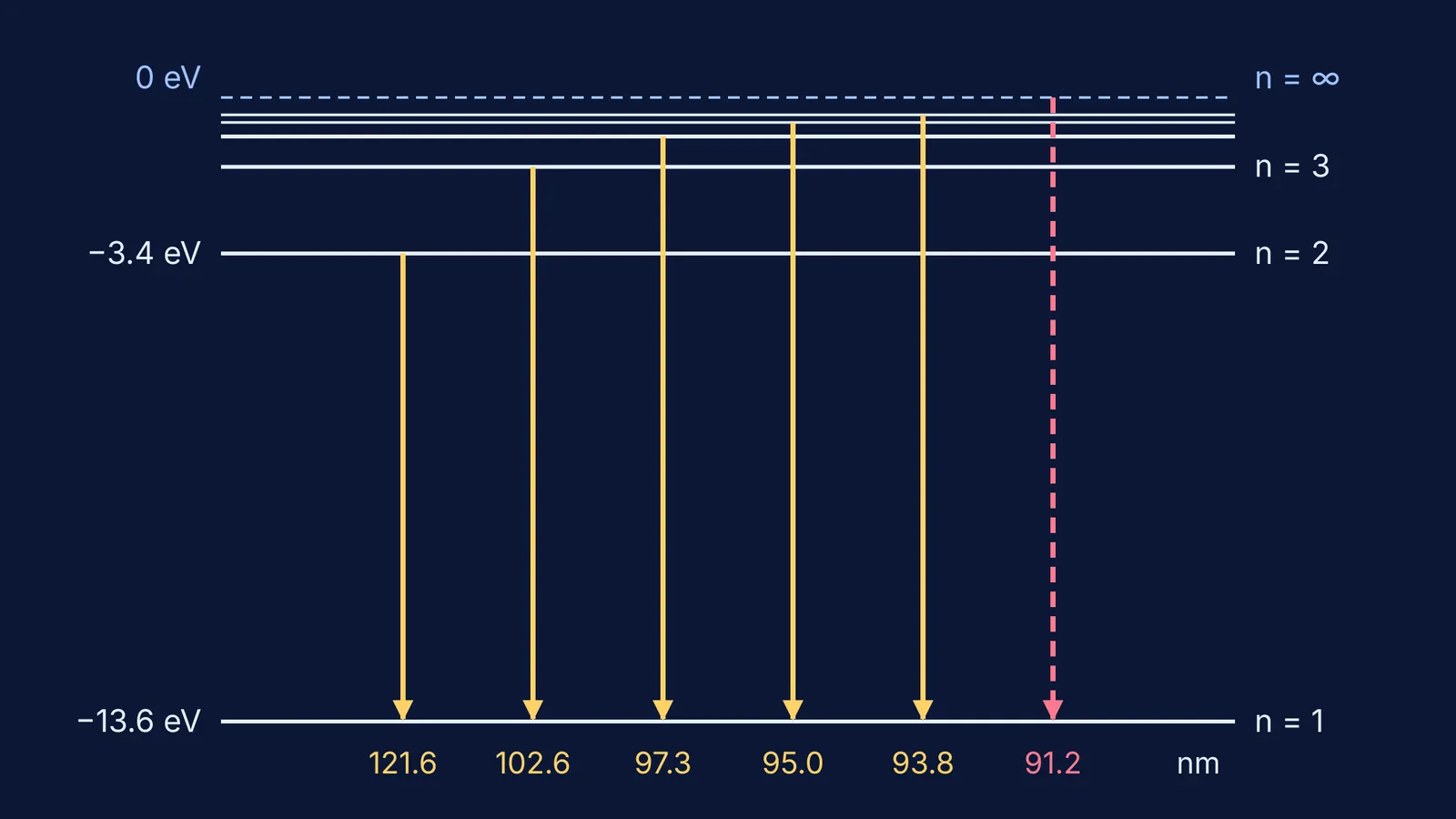
In 1913 Niels Bohr published On the constitution of atoms and molecules, the paper behind your textbook model. In that model, in today's units, a hydrogen electron can only have energies E = −13.6 eV/n², where 13.6 eV is the Rydberg energy (NIST lists 13.605 693 eV). When it falls from a higher level to a lower one, the atom gives off one photon carrying the difference.
A spectral series is the family of lines that share the same lower level. Lyman lines end on n = 1, Balmer lines on n = 2 (Johann Balmer's hydrogen formula) and Paschen lines on n = 3 (Friedrich Paschen's infrared series). For the full model, read how Niels Bohr built his atom.
Falling to n = 1 is the biggest drop, so Lyman photons carry the most energy and have the shortest wavelengths. The smallest Lyman jump, n = 2 to n = 1, releases 13.6 × 3/4 = 10.2 eV.
How do you calculate the Lyman-alpha wavelength?
Lyman-alpha is the n = 2 to n = 1 line.
Write the Rydberg formula: 1/λ = R(1/n₁² − 1/n₂²), with n₁ = 1 and n₂ = 2.
The bracket is 1 − 1/4 = 3/4.
Use R = 1.0974 × 10⁷ m⁻¹, the CODATA 2022 value from NIST.
Then λ = 4/(3 × 1.0974 × 10⁷) m = 1.215 × 10⁻⁷ m, or about 121.5 nm.
Check: the NIST hydrogen line table gives 1215.67 Å, or 121.567 nm. The small gap appears because the simple formula treats the nucleus as infinitely heavy.
Now compare it with the red Balmer line, which the same NIST table lists at 6562.85 Å (656.3 nm). Lyman-alpha's wavelength is about a fifth of that, deep in the ultraviolet. Lyman-beta (n = 3 to n = 1) works the same way; try it, then check your answer against 1025.72 Å in that table.
For the series limit, put n₂ = ∞: the bracket becomes 1, so λ = 1/R, which is about 91.1 nm. Correcting for the proton's mass gives about 91.2 nm.
How do you tell the hydrogen series apart in an exam?
Use this four-step check on any hydrogen-spectrum question:
Find the lower level. That names the series.
Find the upper level. A bigger upper n means a shorter wavelength in the same series.
For “longest wavelength” questions, use the smallest jump (n₁ + 1 to n₁). For “shortest”, use n₂ = ∞.
Count the lines. An electron starting at n = 4 can give only three Lyman lines: 4→1, 3→1 and 2→1.
If you find energy levels hard to picture, the Fermi Simulation Lab has interactive simulations for ideas that are easier to see than to read. For method mistakes, the Fermi Problem Library has worked problems with a step-by-step solver that explains the reasoning rather than printing an answer.