

On this page
In 1885 a Swiss school teacher looked at four numbers and found the rule hiding inside them. Johann Balmer had no theory of the atom and no quantum physics. He had four measured wavelengths of light from glowing hydrogen. The formula he found became a pattern that later models of the atom had to explain.
Who was Johann Balmer?
Balmer was born on 1 May 1825 in Lausen, in the Swiss canton of Basel-Land, and died in Basel on 12 March 1898, according to the MacTutor History of Mathematics biography. From 1859 until his death he taught mathematics at a secondary school for girls in Basel, and from 1865 to 1890 he also lectured in mathematics, mainly geometry, at the University of Basel. MacTutor notes he was sixty when he wrote the hydrogen paper that made him famous.
In the paper he says, "I was encouraged to take up this work by Professor E. Hagenbach" (English translation hosted by Le Moyne College).
What did Balmer have to work with?
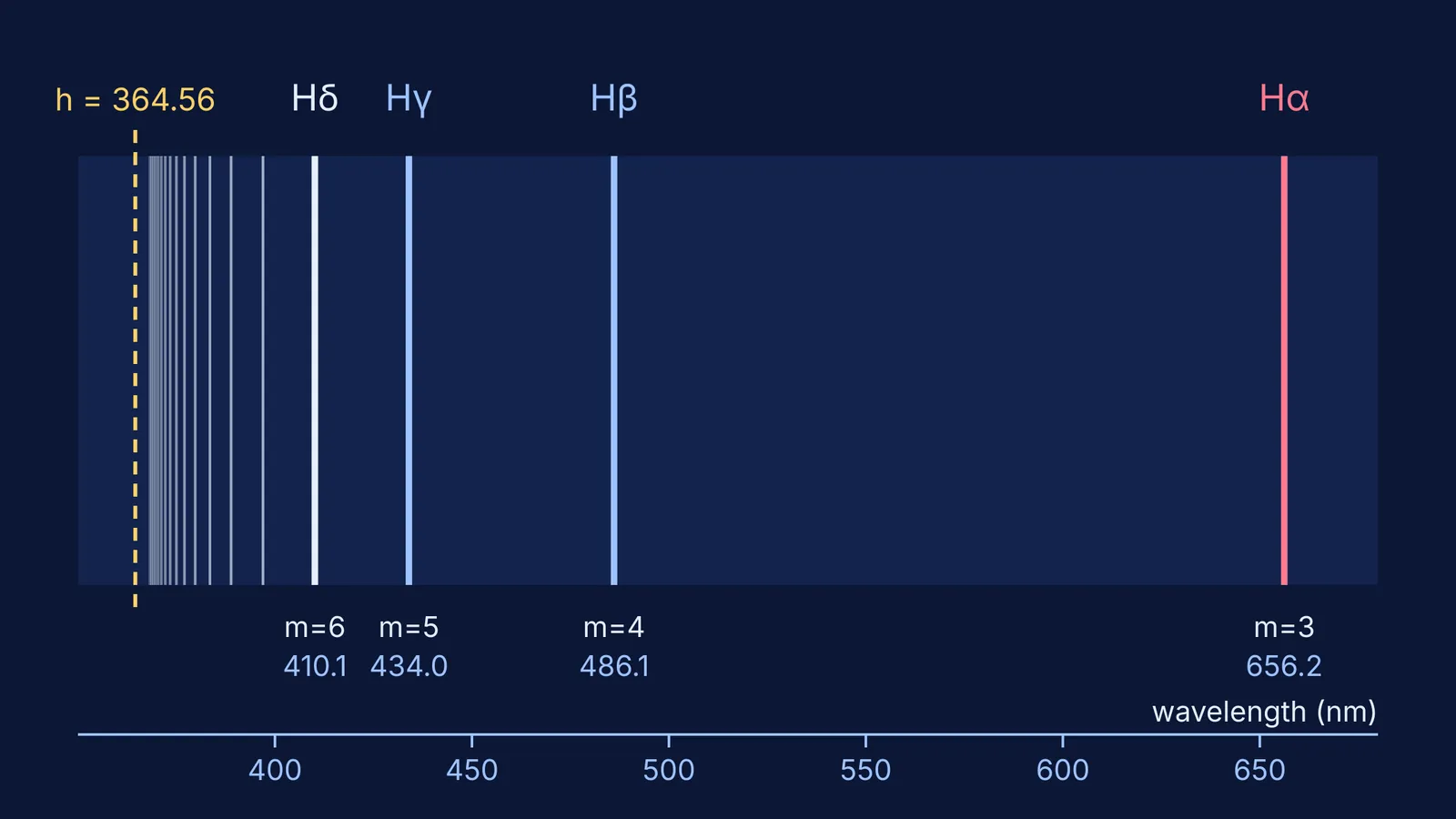
He used Ångström's careful measurements of hydrogen's four visible lines, which Balmer's paper lists as 6562.10, 4860.74, 4340.1 and 4101.2 Å (translation). One ångström (Å) is 0.1 nanometre, so the red line Hα sits near 656 nm and the violet line Hδ near 410 nm.
The paper appeared in 1885 in Annalen der Physik as "Notiz über die Spectrallinien des Wasserstoffs", pages 80 to 87 (Crossref record).
How did Balmer find the hydrogen spectrum formula?
He looked for one number that all four wavelengths shared. He found it: "The wavelengths of the first four hydrogen lines are obtained by multiplying the fundamental number h = 3645.6 in succession by the coefficients 9/5; 4/3; 25/21; and 9/8" (translation).
Those four fractions look random until you rewrite 4/3 as 16/12 and 9/8 as 36/32. Then, in Balmer's words, "the coefficients have for numerators the numbers 3², 4², 5², 6² and for denominators a number that is less by 4."
So Balmer's formula is λ = h × m²/(m² − 4), with h = 3645.6 Å and m = 3, 4, 5, 6. His own comparison with Ångström's values, in the same translation:
Hα: formula 6562.08 Å, measured 6562.10 Å
Hβ: formula 4860.8 Å, measured 4860.74 Å
Hγ: formula 4340 Å, measured 4340.1 Å
Hδ: formula 4101.3 Å, measured 4101.2 Å
No difference is bigger than 0.1 Å, roughly one part in 40,000.
What did the formula predict?
Putting m = 7, Balmer got a fifth line at 3969.65 Å, about 397 nm, and admitted, "I knew nothing of such a fifth line" (translation). MacTutor records that a colleague at the University of Basel then told him the line had already been observed.
Balmer also asked whether other elements might have "other fundamental numbers" of their own. That question led to the general formula told in our post on Johannes Rydberg and his spectral formula.
How did Bohr's model explain Balmer's pattern?
In July 1913 Niels Bohr published "On the constitution of atoms and molecules" in the Philosophical Magazine (Crossref record). His electron jumps between fixed energy states, emitting the difference as light. When the lower state number is 2, Bohr wrote, "we get the ordinary Balmer series"; when it is 3, the infrared series observed by Paschen (Bohr's 1913 text). He expected further series in the far ultraviolet and far infrared, "which are not observed, but the existence of which may be expected."
So Balmer's 4 is 2², the level the electron lands on, and his m is the level it falls from. To see which jumps give which photons, try our Bohr model simulation of the hydrogen spectrum. Energy levels are easier to see than to read, which is what the Fermi Simulation Lab is for.
Rework Balmer's fit in five steps
All you need is a calculator.
Write down Ångström's four wavelengths as listed in Balmer's paper: 6562.10, 4860.74, 4340.1, 4101.2 Å.
Divide each by 3645.6. You get 1.80001, 1.33332, 1.19050 and 1.12497.
Turn each into a simple fraction: 9/5, 4/3, 25/21, 9/8.
Rewrite them so the tops are squares: 9/5, 16/12, 25/21, 36/32. Each bottom is the top minus 4.
Predict before you look: m = 7 gives 3645.6 × 49/45 ≈ 3969.7 Å.
Now turn it into the form in your textbook. Since λ = h m²/(m² − 4), taking the reciprocal gives 1/λ = (4/h)(1/2² − 1/m²). With h = 364.56 nm, 4/h works out to about 1.097 × 10⁷ per metre, the hydrogen Rydberg constant in Balmer's numbers.
Want to practise? Our post on which He⁺ transition matches a hydrogen line uses the same formula, and the Fermi Problem Library has worked problems with a step-by-step solver that explains the reasoning rather than printing an answer.
Next time numbers look messy, try Balmer's move: find the common factor, then rewrite until the pattern shows.