On this page
Stonehenge was built so that, on a midwinter evening, the setting Sun lined up between its two largest stones. A study by Amanda Chadburn and Clive Ruggles, published by ICOMOS with the International Astronomical Union, says the monument's principal axis is aligned upon winter solstice sunset in one direction and summer solstice sunrise in the other.
Why does Stonehenge align with the solstice?
The same study gives the timeline. Work began around 3000 BC with a circular bank and ditch, stones were added around 2500 BC, and the straight stretch of the Avenue nearest the stones, built around 2300 BC, also runs along the solstice axis (Chadburn and Ruggles). The builders dragged stones weighing up to 40 tonnes from as far as 240 km away, then set them so the midwinter Sun went down between the two largest stones, those of the great trilithon.
Midsummer gets the crowds today, but the study notes that most scholars think the stones were used mainly at midwinter. Nobody left a written reason. What the stones do show is people who watched the horizon closely enough to fix the two turning points of the Sun's year.
Why does the sunrise point move during the year?
Earth's spin axis is tilted at 23.44°, according to Royal Museums Greenwich. As Earth orbits the Sun, that tilt carries the Sun's daily path north for half the year and south for the other half.
You can see the result on any horizon. In the northern summer the Sun rises north of east, at the equinoxes it rises due east, and on the June solstice it rises at its most northerly point; in December it rises at its most southerly (Griffith Observatory). The word solstice comes from the Latin solstitium, “Sun stands still”, because the drift stops before it reverses (Royal Museums Greenwich).
How far north does the Sun rise where you live?
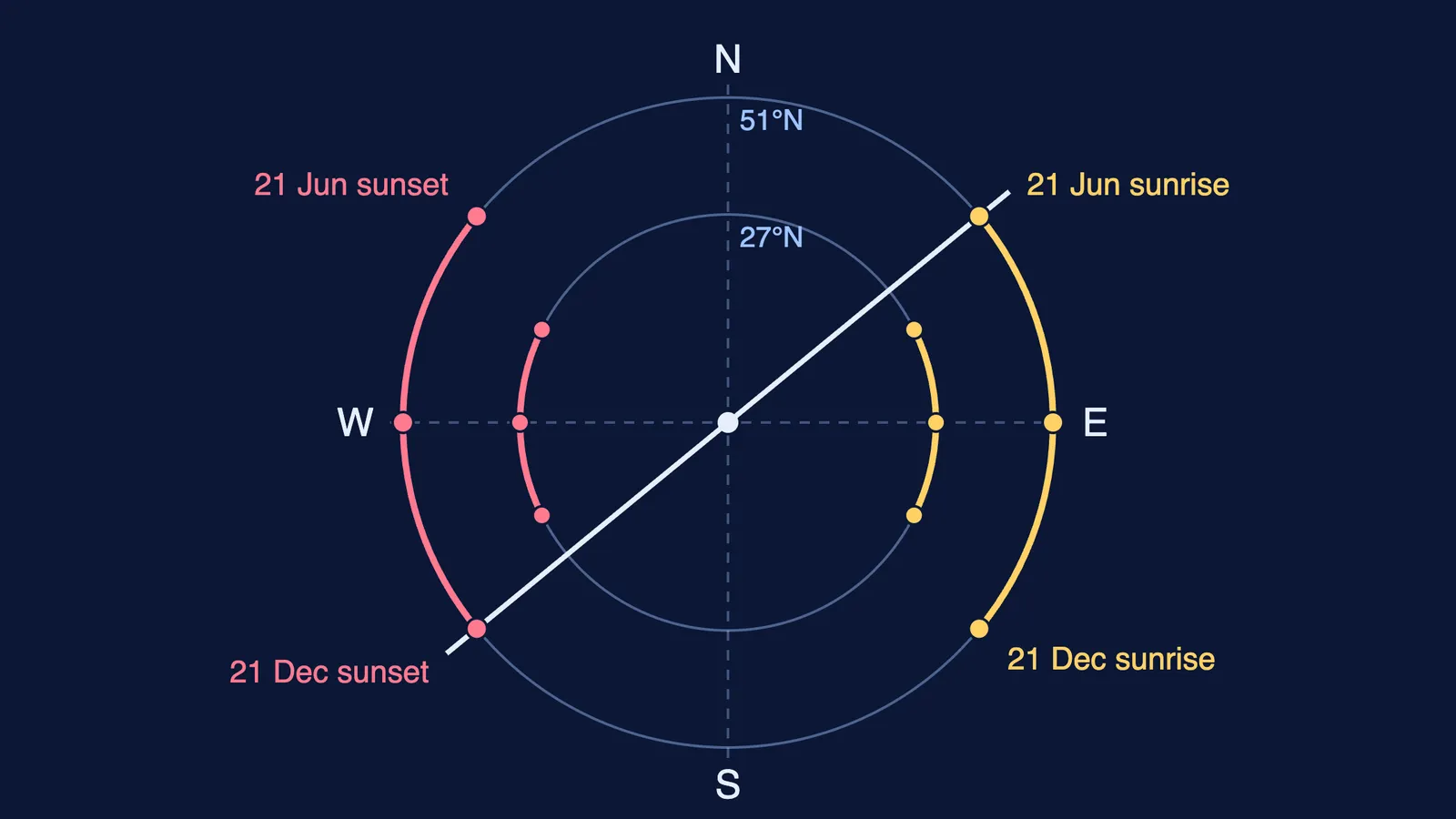
The size of the swing depends on your latitude (Monash University). For a flat horizon, ignoring the slight bending of light by air, the rule is: sin(angle from due east at a solstice) = sin 23.44° ÷ cos(latitude). At the equator the angle is simply 23.44°, the tilt itself.
A worked example:
Stonehenge sits at latitude 51° 10′ 44″ N (Chadburn and Ruggles). sin 23.44° = 0.398 and cos 51.18° = 0.627, so the sine of the angle is 0.635 and the angle is 39.4°. Sunrise sweeps through about 79° of horizon between June and December.
Jaipur sits near 27° N; the great sundial at Jantar Mantar has its face angled at 27°, the city's latitude (Jantar Mantar, Jaipur). cos 27° = 0.891, so the sine is 0.446 and the angle is 26.5°. The sweep is about 53°.
For your own city, look up its latitude and repeat the two steps on a calculator.
Real horizons are rarely flat. At Durrington Walls, close to Stonehenge, two solstice sightlines are several degrees from being exactly opposite because of a high horizon to the north-west, the same study notes.
If declination still feels abstract, the Fermi Simulation Lab has interactive simulations for the ideas that are easier to see than to read.
Which Indian sites track the Sun's rising point?
The Mudumal menhirs in Telangana are around 80 standing stones more than 3,000 years old, and certain rows line up with the rising and setting Sun at the summer solstice and the equinox (Telangana Today). On a hillock nearby, a cuboid rock with cup marks appears to depict the constellation Ursa Major, Outlook Traveller reports. In October 2026 the state heritage department invited bids for excavations at the site, which were expected to begin in November (Telangana Today).
Jantar Mantar in Jaipur, completed in 1734 by Sawai Jai Singh, has 19 instruments, among them the Digamsha Yantra, which measures the Sun's azimuth and is used to forecast sunrise and sunset (Jantar Mantar, Jaipur). Stonehenge marks two moments a year; an instrument like the Digamsha Yantra can measure the Sun's direction on any day. For an older chapter of this story, read how Hipparchus discovered the precession of the equinoxes.
Can you track the solstice sunrise yourself?
Yes. The 2026 winter solstice falls on 21 December at 8.50pm GMT (Royal Museums Greenwich), which is 2.20am IST on 22 December. A plan for the weeks either side of it:
Choose a spot facing east with a fixed skyline: a water tank, a tower, a tree.
Every Sunday at sunrise, photograph it from exactly the same place.
Mark where the Sun first appears. Never look straight at the Sun; work from the photo.
Before you start, use your latitude to predict how far south of east the December sunrise will stop.
Compare: the weekly shift should shrink through December, stop around the solstice, then reverse in January.
If a step in the maths trips you up, the Fermi Concept Library has a lesson for every concept in physics and mathematics. For more sky checks from home, try five ways to check that the Earth is round, then read how sailors found longitude with Harrison's clock.