

On this page
Each check below uses something you can see, measure or work out on paper, and each is a test a flat Earth fails.
How did Eratosthenes measure the Earth with shadows?
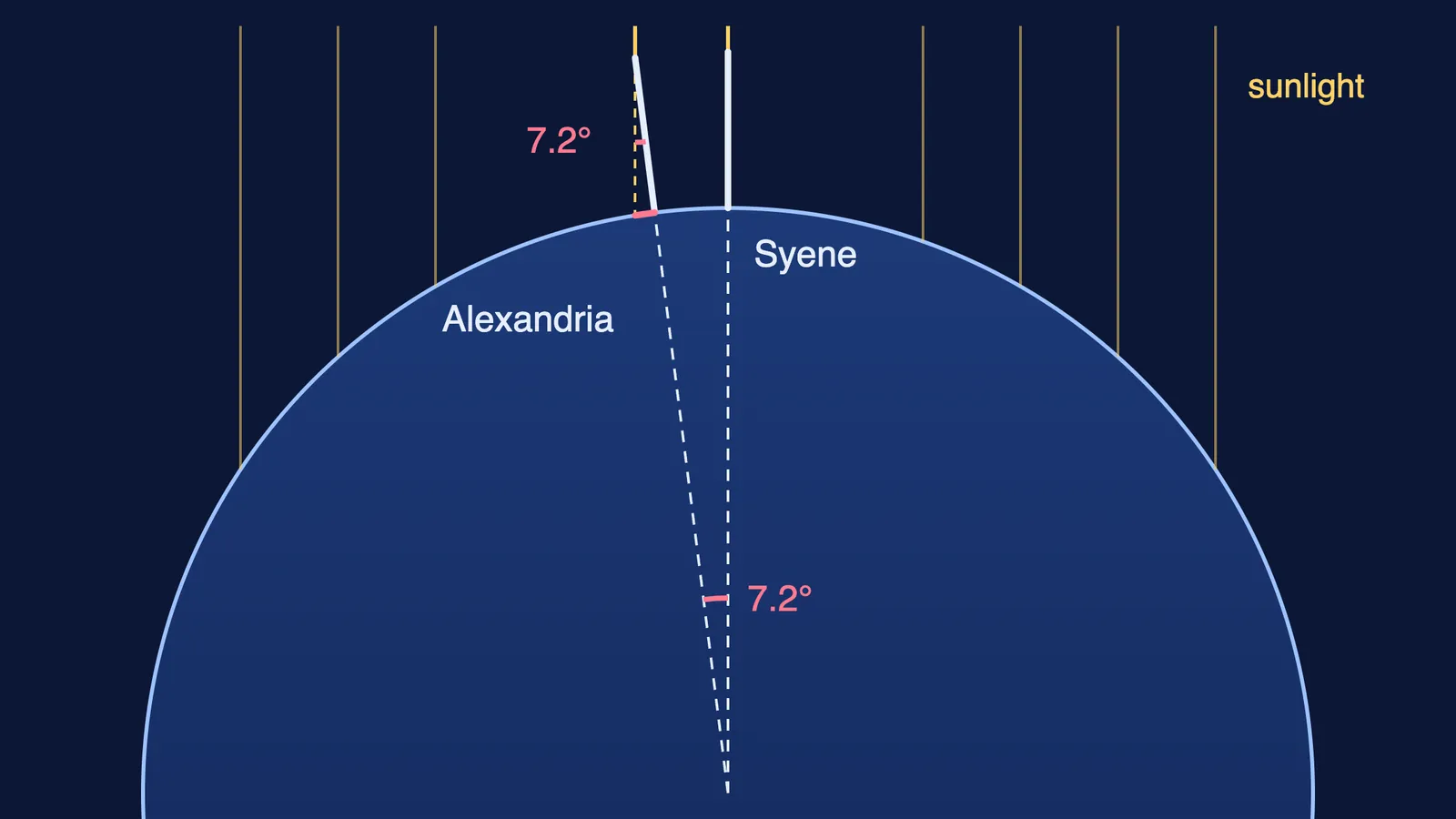
Eratosthenes, a scholar in Alexandria, heard that at noon on the summer solstice the Sun lit the entire bottom of a well in Syene (now Aswan), so it was directly overhead there, according to the American Physical Society's account of the measurement. At noon on the solstice in Alexandria, a vertical stick cast a shadow at an angle of about 7.2 degrees, which is 1/50 of a full circle.
Eratosthenes assumed the Sun is so far away that its rays arrive parallel. If they do, two upright sticks can cast different shadows at the same moment only if the ground between them curves. He took the distance from Alexandria to Syene as about 5,000 stadia and multiplied by 50, getting about 250,000 stadia for the whole circumference (APS).
A worked example with invented but realistic numbers: two schools roughly north and south of each other measure noon shadows on the same day.
Each school's angle is arctan(shadow length / stick length). A 1 m stick with a 15.8 cm shadow gives about 9 degrees.
Say one school reads 9 degrees more than the other, and the schools are 1,000 km apart.
9 degrees is 9/360, or 1/40, of a circle, so the circumference is 40 x 1,000 km = 40,000 km.
Check against NASA's mean Earth radius of 6,371 km (NASA Earth fact sheet): 2 x 3.1416 x 6,371 is about 40,030 km.
Why do ships disappear bottom first over the horizon?
On a flat sea, a departing ship would just shrink to a dot. On a ball, the water bulges between you and the ship, so the hull vanishes first and the mast last; try it with binoculars from Marine Drive or Marina Beach.
The distance to your horizon is the square root of 2Rh, where R is Earth's radius and h is the height of your eyes. With R = 6,371 km from the NASA fact sheet and eyes 1.7 m above the water, your horizon is about 4.7 km away. A ship 15 km out is 10.3 km beyond that, so about (10.3 km) squared divided by (2 x 6,371 km), roughly 8.4 m, of its height is hidden behind the curve. Air bends light a little, so treat this as approximate.
What does a lunar eclipse show about Earth's shape?
Aristotle argued in On the Heavens that in eclipses the shadow's outline is always curved, and since Earth blocks the light, Earth must be spherical (On the Heavens, Book II).
The word that matters is always. A flat disc seen edge-on would cast a thin straight shadow during some eclipses. Only a sphere casts a round shadow from every direction. We go through the shadow geometry in why the curved edge on the Moon proves Earth is round.
How do time zones show the Earth is round?
Earth turns through 360 degrees in 24 hours, so 15 degrees every hour, as the Royal Observatory Greenwich classroom guide works out.
A single Sun shining over a flat plane would be up for everyone at once; night falling on half the world at a time, with the boundary sweeping round 15 degrees an hour, is what a spinning ball predicts. For why the turning goes unnoticed, read why we don't feel the Earth spinning.
Why do the stars change as you travel north or south?
In the Northern Hemisphere, the height of Polaris above the northern horizon equals your latitude: it sits on the horizon at the equator and directly overhead at the North Pole (NSTA). Aristotle noticed the same pattern: some stars seen in Egypt and near Cyprus are not seen further north (On the Heavens).
On a flat Earth, everyone would see the same stars at the same angles. Instead, Polaris sits low for someone in Kanyakumari and much higher for someone in Ladakh. For how surveyors turned this into precise measurement, see how Jean Picard measured Earth's meridian arc in 1670.
A five-check plan you can do this month
Week 1: find local noon with a stick and record the shadow angle.
Week 2: repeat on the same day as a friend well north or south of you, and work out the circumference.
Any clear evening: measure Polaris's height with a protractor, straw and thread; compare it with your latitude.
Next lunar eclipse: sketch the shadow's edge at regular intervals; check it stays curved.
Any sea trip: watch a ship leave and note what disappears first.
Before each check, write down what a flat Earth would predict. Predicting, then testing, is the real skill.
If the geometry is hard to picture, the Fermi Simulation Lab has interactive simulations for ideas easier to see than to read, and Fermi's AI tutor can work out what you already know and build a plan for the session.
Pick one check, do it this week, and keep the numbers.


