On this page
Next time you watch a lunar eclipse, look closely at the dark bite moving across the Moon. Its edge is always part of a circle. That detail rules out a flat Earth, and a coin, a ball and a little geometry show why.
Why does a lunar eclipse prove Earth is round?
A lunar eclipse happens when the Moon moves into Earth's shadow. The umbra is the dark inner part of that shadow, and NASA's Jet Propulsion Laboratory explains it is "much darker because Earth blocks additional sunlight from entering the umbra" (NASA JPL).
In On the Heavens, Aristotle contrasted the Moon's monthly phases, which take shapes "of every kind straight, gibbous, and concave", with eclipses, where "the outline is always curved" (J. L. Stocks translation, MIT Internet Classics Archive). JPL sums up his reasoning: the shadows were round "regardless of where an observer saw them", and he "realized that only if Earth were a spheroid would its shadows be round" (NASA JPL).
The key word is always. A total lunar eclipse can be seen from the entire night-time half of Earth (Richard Pogge, Ohio State University). So some people watch it with the Moon high overhead at midnight, and others with the Moon just rising or setting. Very different viewing angles, same curved edge.
What shadow would a flat disc cast on the Moon?
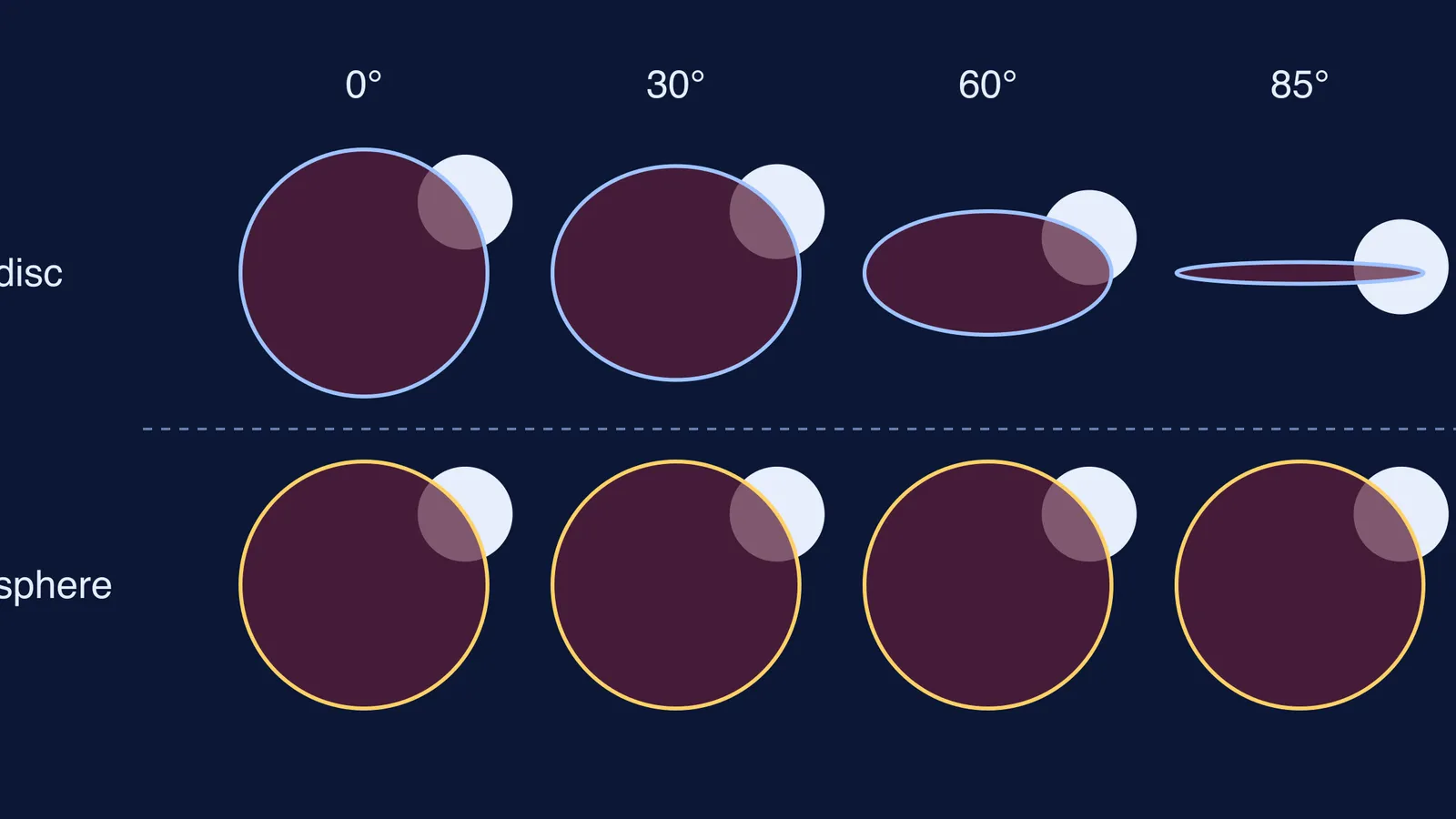
Predict first, then check. Light coming straight along one direction flattens a tilted disc's shadow: its width stays the same, but its height shrinks by the cosine of the tilt angle. A ball has no tilt to change, so its shadow is a circle from every side.
Here is the worked prediction for a disc, with the tilt measured from face-on:
0° (face-on to the Sun): a circle, height 1.00 times the width
30°: an oval, height 0.87 times the width
60°: an oval, height 0.50 times the width
85°: a stripe, height 0.09 times the width
Now put a person on that disc. In an eclipse the Sun, Earth and Moon line up, with the Moon opposite the Sun. If you lived on the flat face of a disc Earth and saw the eclipsed Moon on your horizon, the Sun would be near the opposite horizon, so sunlight would hit the disc almost edge-on.
At the Moon's distance, Earth's umbra is about 9,000 km wide, roughly 2.6 times the Moon's diameter (Pogge, Ohio State University). Squash that by the 85° factor and the shadow would be about 0.23 Moon-widths thick (2.6 x 0.087): a straight-sided band crossing the Moon, not a curved bite. Eclipse watchers at moonrise see the same curved edge as everyone else, so the disc fails the test.
If the 3D geometry is hard to hold in your head, the Fermi Simulation Lab has interactive simulations for ideas that are easier to see than to read. For the Sun, Earth and Moon geometry behind the monthly phases, see our post on predicting all eight Moon phases in a simulation.
How can you check the curved shadow at the next eclipse?
Plan for a long evening: the Moon can spend up to 1 hour 40 minutes in the umbra (Pogge, Ohio State University).
Before the eclipse, sketch two predictions of the shadow's edge: what a disc Earth would show and what a sphere would show.
Note the time and how high the Moon is, counting fist-widths at arm's length above the horizon.
Every 10 to 15 minutes, sketch the shadow's edge on a pre-drawn Moon circle.
Afterwards, extend one traced arc into a full circle with a compass and compare its diameter with your Moon circle. Expect a shadow roughly 2.6 Moon-widths across; hand sketches of a fuzzy edge will not be exact.
Swap sketches with a cousin or friend in another city who watched at a different Moon height.
Earth's air also makes the shadow slightly bigger than simple geometry predicts. One classic method, Chauvenet's, enlarges the shadow diameters by 1/50 to allow for it (Fred Espenak, NASA Goddard).
Doing this with a younger child? See our guide on how to talk to kids about eclipses and launches.
Is the round shadow enough on its own?
A good sceptic will push back: a cylinder seen end-on also casts a round shadow. That is why the word always matters, and why Aristotle did not rely on eclipses alone. In the same chapter he noted that "there are some stars seen in Egypt and in the neighbourhood of Cyprus which are not seen in the northerly regions" (MIT Internet Classics Archive). Travel north or south and the sky changes, which only makes sense on a curved surface.
Once you accept a sphere, the next question is how big it is, which is exactly what Jean Picard set out to measure with his meridian arc. If you want to rehearse the argument before the next eclipse, Fermi's AI tutor can draw the figure with you and check your understanding as it goes.