On this page
In 1985, at Bell Labs in Holmdel, New Jersey, Steven Chu and his co-workers crossed six laser beams and brought a cloud of sodium atoms almost to a standstill. They called the region where the beams met “optical molasses”, because atoms inside it moved as if wading through syrup. The work earned Chu a share of the 1997 Nobel Prize in Physics, with Claude Cohen-Tannoudji and William D. Phillips, “for development of methods to cool and trap atoms with laser light.”
What is optical molasses?
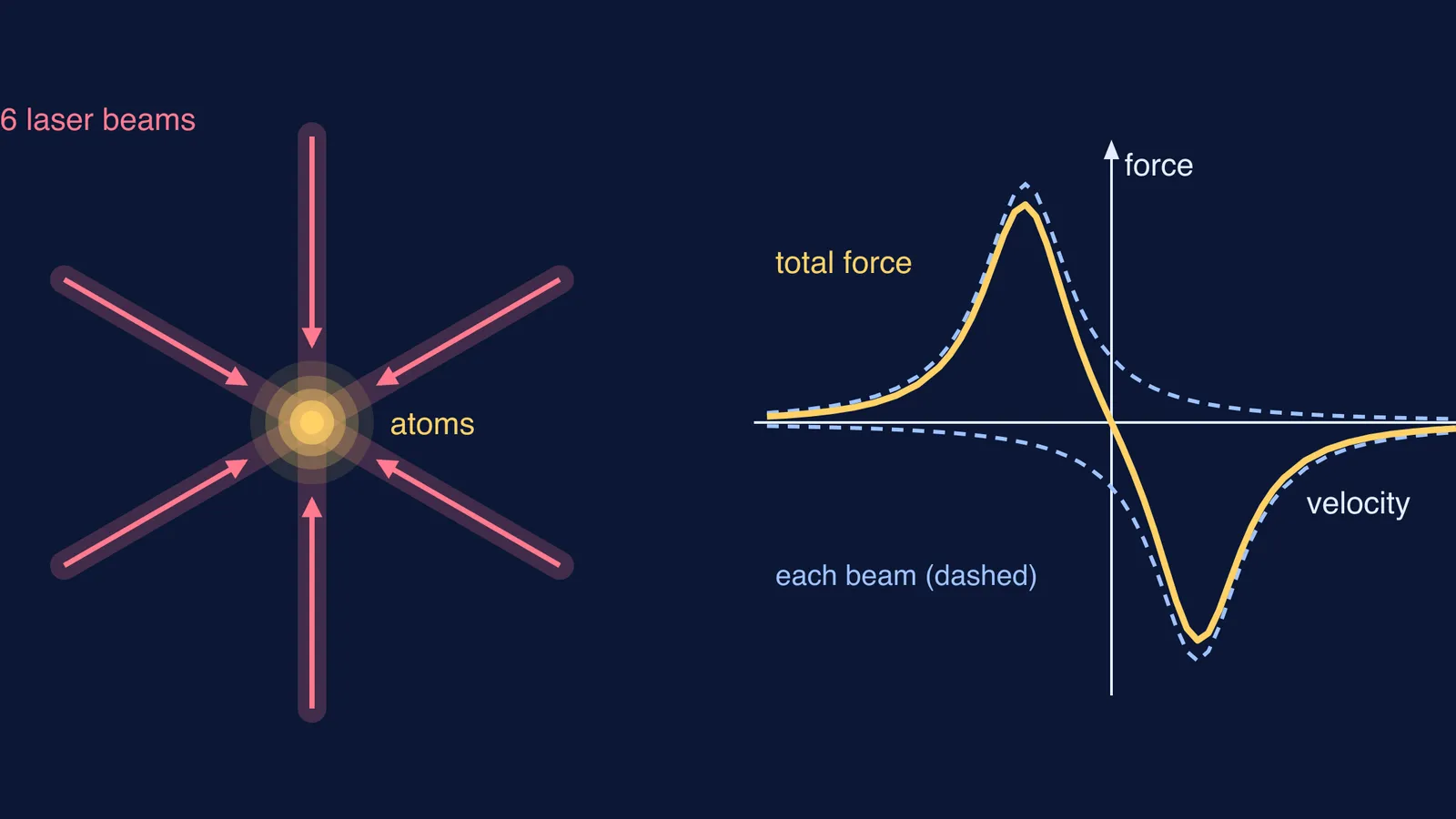
Optical molasses is a region where laser beams cross so that an atom moving in any direction feels a force slowing it down, like a spoon in thick syrup. The Nobel Prize press release describes Chu’s set-up: six laser beams opposed in pairs, along three directions at right angles. Sodium atoms were first stopped by an opposing laser, then led to where the six beams crossed. There they formed a glowing cloud the size of a pea, made of about a million chilled atoms.
The team (Chu, Hollberg, Bjorkholm, Cable and Ashkin) published the result in Physical Review Letters in July 1985. In his Nobel autobiography, Chu says it began with informal talks with his colleague Art Ashkin, who dreamed of trapping atoms with light. Chu realised the atoms had to be made very cold first, so he “promptly dropped most of my other experiments”.
How does laser light slow an atom down?
Light carries momentum. A photon of wavelength λ has momentum h/λ, so an atom that absorbs one gets a small kick along the beam. It re-emits a photon in a random direction, typically about a hundred-millionth of a second later, as the Nobel press release explains. Over many cycles, absorption kicks add up while emission kicks average out.
The clever part is the Doppler effect. An atom absorbs light only near one frequency, and Chu’s lasers were tuned slightly below it. An atom moving towards a beam sees that light shifted up, into resonance, so it absorbs from the beam it is running into and gets pushed back. Light from behind is shifted further away and mostly ignored. With beams from all six directions, every motion is opposed: the force depends on velocity, like friction.
How many photon kicks does it take to stop a sodium atom?
The sodium numbers come from Daniel Steck’s reference tables, Sodium D Line Data.
Photon momentum: the cooling light has a wavelength of 589.16 nm, so p = h/λ = (6.626 × 10⁻³⁴ J s) ÷ (589.16 × 10⁻⁹ m) ≈ 1.12 × 10⁻²⁷ kg m/s.
Speed change per kick: a sodium atom’s mass is 3.82 × 10⁻²⁶ kg, so p/m ≈ 2.95 cm/s, matching Steck’s listed recoil velocity.
Kicks needed: assume a round 1,000 m/s for an atom leaving a hot oven. 1,000 ÷ 0.0295 ≈ 34,000 photons.
Fastest rate: the excited state lives 16.25 ns, so the decay rate Γ is 6.15 × 10⁷ per second. A saturated atom scatters at most Γ/2 ≈ 3.1 × 10⁷ photons per second.
Deceleration: 0.0295 × 3.1 × 10⁷ ≈ 9 × 10⁵ m/s², roughly 90,000 g. The Nobel press release compares it to a ball thrown up on a planet with 100,000 times Earth’s gravity.
Time and distance: about 1.1 ms, over v²/2a ≈ 0.55 m.
There is a catch. At 1,000 m/s the Doppler shift is v/λ ≈ 1.7 GHz, about 170 times sodium’s 9.79 MHz natural linewidth. As the atom slows, it drifts out of tune with a fixed laser; Phillips’s “Zeeman slower” uses a coil’s varying magnetic field to keep it in resonance.
How cold is 240 microkelvin?
The Nobel press release says molecules in room-temperature air move at about 4,000 km/h. Chu’s molasses atoms were at about 240 µK, moving at about 30 cm/s. That matched the predicted “Doppler limit”, which Steck’s tables give as 235 µK for sodium. At 30 cm/s, an atom is moving only about ten photon kicks’ worth.
In 1988 Phillips measured 40 µK, six times below that limit, and Cohen-Tannoudji’s group explained why. Chu later built an atomic fountain for more precise clocks, and laser cooling became the basis for Cornell and Wieman’s first Bose-Einstein condensate.
How can you use this in JEE physics?
Laser cooling is a photon momentum problem with a Doppler twist. Run this checklist:
Write p = h/λ first, in SI units.
Separate kicks that add up (absorbed, along the beam) from kicks that average out (emitted, random).
Find the speed change per photon, then divide to count photons.
Sanity-check the order of magnitude, as in step 5.
Our post on photon momentum and radiation pressure has more worked problems, and Christian Doppler’s 1842 idea covers the shift itself.
If the Doppler argument still feels slippery, the Fermi Simulation Lab has interactive simulations for ideas that are easier to see than to read. Stuck halfway through a numerical? The Fermi Problem Library has a step-by-step solver that explains the reasoning rather than printing an answer.