

On this page
In short In 1995, Eric Cornell and Carl Wieman cooled rubidium-87 atoms to 170 nanokelvin to create the first Bose-Einstein condensate. They later won the Nobel Prize, and Wieman shifted his focus to prove that active learning nearly doubles student performance compared to traditional lectures.
What was the first Bose-Einstein condensate?
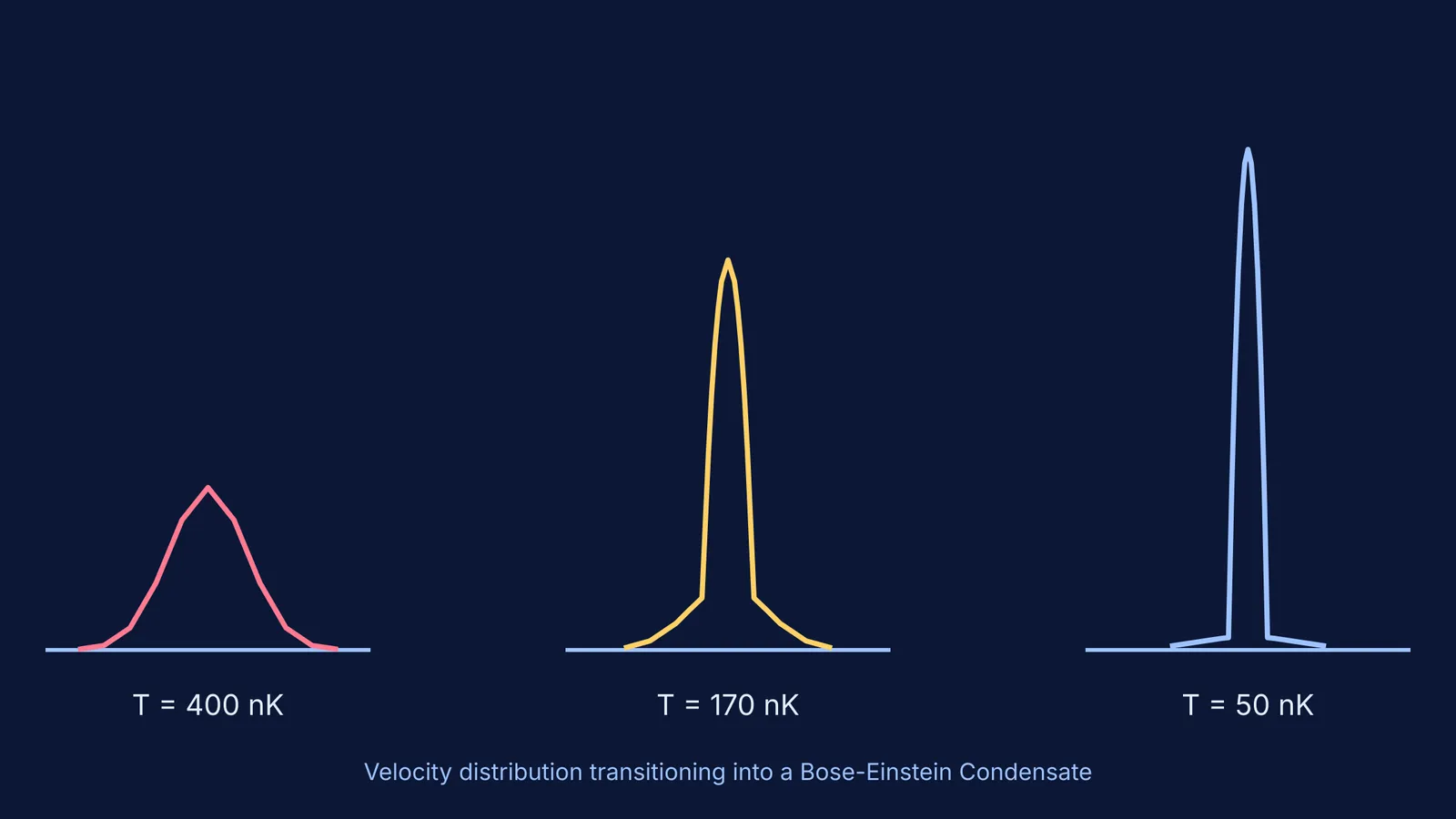
On 5 June 1995, Eric Cornell and Carl Wieman achieved a milestone in physics at the JILA laboratory in Colorado. They created the first Bose-Einstein condensate (BEC), a state of matter predicted 70 years earlier by Satyendra Nath Bose and Albert Einstein. In 1924, Bose had worked out the statistical rules for photons, and Einstein extended those mathematics to massive atoms, predicting that at low enough temperatures, particles would collapse into the exact same quantum state.
The 1995 experiment used a gas of rubidium-87 atoms. By cooling these atoms to roughly 170 nanokelvin—just 170 billionths of a degree above absolute zero—the researchers forced them into the same lowest-energy quantum state. At this critical temperature, the individual atoms lost their separate identities and behaved as a single macroscopic quantum entity. The condensate was preserved for more than 15 seconds, long enough to observe its properties and confirm the theoretical predictions.
How did Cornell and Wieman cool the atoms?
Creating a BEC requires extreme temperatures that cannot be reached with standard refrigeration. The team used a two-step process: laser cooling and evaporative cooling. First, lasers slowed the rubidium atoms, trapping them in a magneto-optical trap. Then, the lasers were turned off, and a magnetic field held the atoms in place. By slowly lowering the magnetic trap's walls, the most energetic atoms escaped, leaving the remaining ones significantly colder. This is similar to how a hot cup of tea cools down as the fastest molecules evaporate as steam.
For this breakthrough, Cornell and Wieman shared the 2001 Nobel Prize in Physics with Wolfgang Ketterle, who independently created a BEC using sodium atoms shortly after. If quantum states and evaporative cooling are hard to picture, that is normal. The Fermi Simulation Lab provides interactive simulations for the ideas that are easier to see than to read.
How did Wieman move from quantum physics to active learning?
After winning the Nobel Prize, Carl Wieman shifted his focus from atomic physics to science education. He founded the PhET Interactive Simulations project and became a leading advocate for treating teaching as a science rather than an art. Wieman argued that traditional lectures leave students passively listening, which is ineffective for deep understanding and long-term retention.
Wieman and his colleagues demonstrated the effectiveness of this approach in a 2011 study published in Science where students in an active learning classroom scored an average of 74% on a test, compared to just 41% for students taught via a traditional lecture. Furthermore, the same study found that attendance increased by 20% in the active learning section. You learn more by doing, which is why interactive physics simulations are so effective. If you struggle with numericals despite knowing the theory, you might be stuck in passive mode. The Fermi Problem Library has worked problems with a step-by-step solver that explains the reasoning rather than printing an answer.
How to study physics like Wieman suggests?
Wieman’s research shows that building expertise requires deliberate practice. Here is a framework to apply his methods to your own study routine to get better results:
Test yourself before the lecture: Read the material ahead of time and answer a few conceptual questions. This primes your brain to look for answers during the class, making the lecture an active search for information rather than passive listening.
Solve it yourself first: Before looking at a worked example or a solution, attempt the problem. Confronting your own incorrect assumptions is how true learning happens and how you build strong mental models.
Check your reasoning: Do not just look at the final number. If you made a mistake, find exactly where your logic went wrong. This is how Carl Wieman moved beyond the lecture and helped students build real scientific thinking skills that last beyond the exam.


