On this page
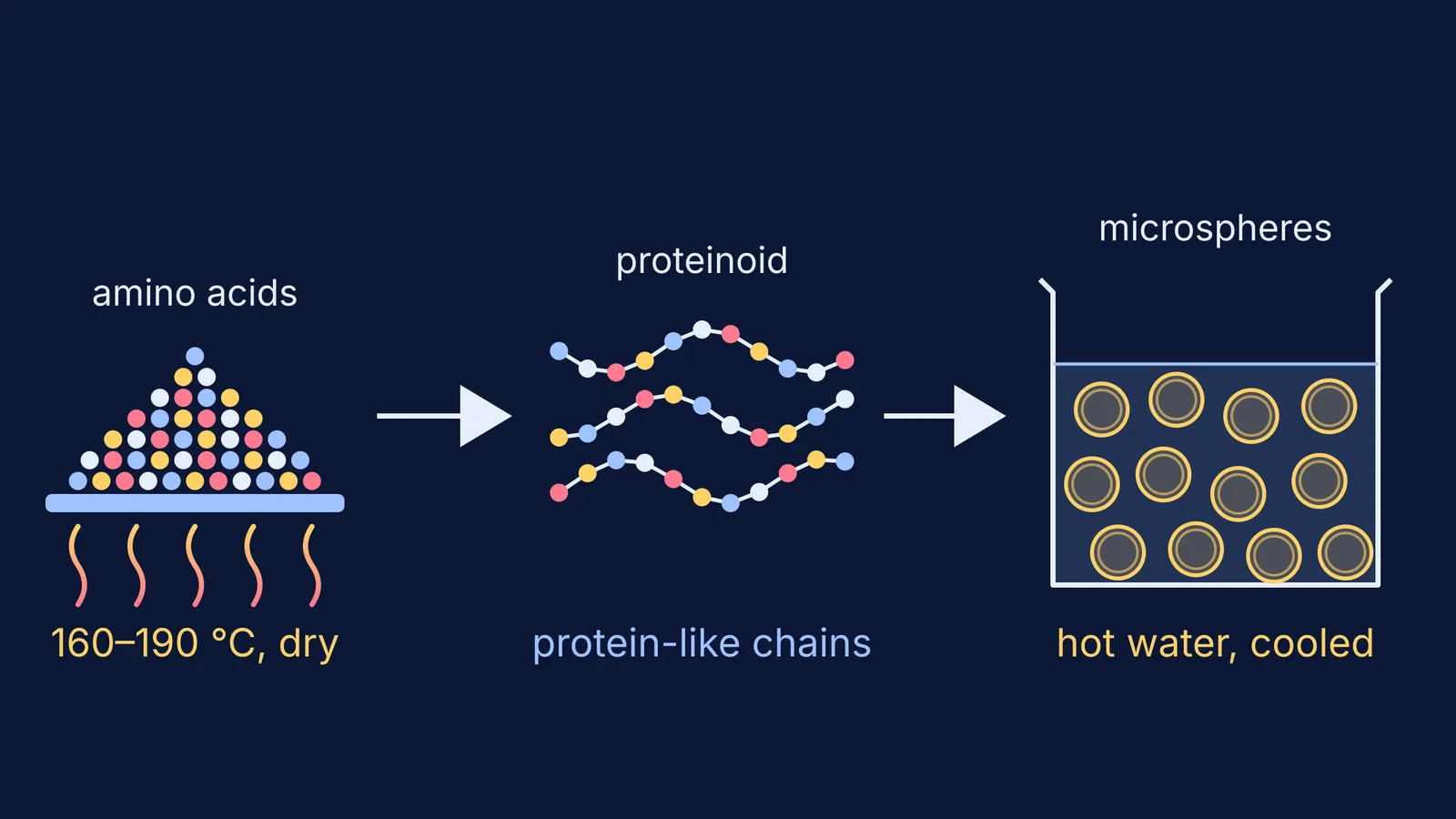
In 1958, Sidney W. Fox and Kaoru Harada of Florida State University reported in Science that heating dry amino acids, the building blocks of proteins, gave a product that resembled protein. The paper's title: Thermal Copolymerization of Amino Acids to a Product Resembling Protein.
Fox called these heat-made chains proteinoids. A year later he and his colleagues reported something stranger: dissolved in hot water and cooled, proteinoids formed huge numbers of tiny, cell-like spheres.
What did Sidney Fox actually do?
Proteins are chains of amino acids joined by peptide bonds, and each bond that forms releases a molecule of water. Fox asked whether plain heat could do the joining, with no cell and no enzyme, by driving the water off.
In 1953 Stanley Miller had reported a production of amino acids under possible primitive Earth conditions. The next question was how loose amino acids could join into chains.
A 2022 review of proteinoid recipes describes the Harada and Fox method: glutamic acid is mixed with another amino acid, in nearly equal amounts, and heated for 30 to 120 minutes at 160 to 190 °C (Sharma and colleagues, arXiv).
How did proteinoids turn into microspheres?
The key paper is Production of Spherules from Synthetic Proteinoid and Hot Water by Fox, Harada and Jean Kendrick (Science, 1959). Its abstract reports that hot saturated solutions of thermal copolymers containing the 18 common amino acids produced, on cooling, large numbers of uniform, microscopic, relatively firm and elastic spherules. The authors placed this within a theory that the first living units were generated by heat.
Nobody shaped the spheres; they formed on their own as the solution cooled. Composition matters, though: in a 1968 study by Fox and Waehneldt, summarised in the 2022 review, acidic proteinoids came out as insoluble particles, while neutral ones gave microspheres (Sharma and colleagues).
Worked example: what does a proteinoid recipe give you?
The review gives one exact recipe. Grind 0.01 mol of DL-glutamic acid with 0.02 mol of glycine and heat in an open test tube at 175 to 180 °C. The mixture melts and gives off a gas that turns red litmus blue; heating stops when the gas stops, usually after about 50 minutes. After washing with water and ethanol, the dry product weighed 0.29 g. After five days of dialysis, 0.09 g of a gelatin-like film was left (Sharma and colleagues).
Check the yield yourself, using molar masses from PubChem for glutamic acid (147.13 g/mol) and glycine (75.07 g/mol):
Glutamic acid: 0.01 mol × 147.13 g/mol = 1.47 g
Glycine: 0.02 mol × 75.07 g/mol = 1.50 g
Starting mass: about 2.97 g
Washed product: 0.29 ÷ 2.97 = about 10% of the starting mass
After dialysis: 0.09 ÷ 2.97 = about 3%
Two things to notice. Water vapour is neutral, so a gas that turns red litmus blue is basic, which suggests the heat is breaking some molecules apart, not only joining them. And most of the starting mass never becomes purified polymer.
Were Fox's microspheres the first cells?
Not in the view of many scientists. An Oxford chemistry course summarises Fox's idea that proteinoid first formed on hot, dry volcanic cinder cones and was washed by rain into the oceans. It calls the idea ingenious but says many scientists do not accept it as more than an interesting idea. One weakness it names: it is hard to imagine such high concentrations of dry amino acids on the early planet. It adds that the microsphere experiments, separated from the volcano idea, remain relevant as a possible way to make enclosed pockets of water for further chemistry (University of Oxford).
Heredity is the other gap. A 1974 paper by Fox contrasts proteinoid microspheres with coacervate droplets and discusses how the genetic code and its machinery may have originated (NASA Technical Reports Server). Many researchers have since looked to RNA; see our explainer on how ribozymes point to an RNA world. For where the amino acids might have come from, read how Cyril Ponnamperuma found amino acids in the Murchison meteorite.
How can you judge an origin-of-life experiment?
Use these four questions on Fox, Miller or the next headline you read:
Ingredients: would these chemicals have existed on early Earth, in these amounts?
Conditions: is there a real place where this heat, dryness or energy source occurs?
Product: is it the molecule life uses, or something resembling it?
Life test: does the structure store and pass on information, or does it only look like a cell?
Fox answered question 2 with volcanoes, and his spheres are still discussed as a model for compartments. Question 1 is where the Oxford critique bites, and question 4 is still open.
If peptide bonds feel shaky, compare them with the other bonds of biology in our guide to peptide, glycosidic and phosphodiester bonds, or look up condensation reactions in the Fermi Concept Library, where each concept has its own lesson. To practise yield calculations like the one above, the Fermi Problem Library has worked problems with a step-by-step solver that explains the reasoning.