On this page
In September 1969, a bright fireball was seen separating into three fragments in the sky over Victoria, Australia, scattering stones across the area around Murchison. One 680-gram fragment famously crashed through a roof into a hay shed. Because the meteorite fell in a rural area and was gathered almost immediately, it suffered minimal contamination from the surrounding soil and rainwater. When scientists collected the dark, carbon-rich stones, they realised they had a rare opportunity. The stones were quickly sealed and brought to laboratories equipped with the latest tools, originally built to analyse lunar soil brought back by the Apollo missions.
At NASA's Ames Research Center, a team led by Sri Lankan chemist Cyril Ponnamperuma began looking for the building blocks of life inside the space rock. Ponnamperuma was a leading authority on chemical evolution who had already demonstrated how to artificially produce ATP, the primary energy carrier in all life forms, using simple laboratory equipment. His team at NASA Ames was at the forefront of this work, constantly pushing the boundaries of what could be detected in tiny geological samples.
What did Ponnamperuma find in the Murchison meteorite?
In 1970, Ponnamperuma's team published their findings in *Nature*. They found that the Murchison meteorite contained amino acids and hydrocarbons. Amino acids are the molecules that link together to form proteins, the machinery of all living cells.
The team identified both protein-building amino acids—such as glycine, alanine and glutamic acid—and non-protein amino acids, including alpha-aminoisobutyric acid. Discovering these complex organic molecules inside a meteorite proved that the chemical precursors to life could form in space.
If you are studying how molecules are built and structured, the Fermi Concept Library covers every concept in physics, chemistry, biology, mathematics and computing, each with its own lesson and its place in the map.
How do we know the amino acids are not from Earth?
Whenever scientists find biological molecules in a meteorite, the first question is whether the rock simply picked them up after landing on Earth. Ponnamperuma's team proved the amino acids were extraterrestrial by looking at their shape.
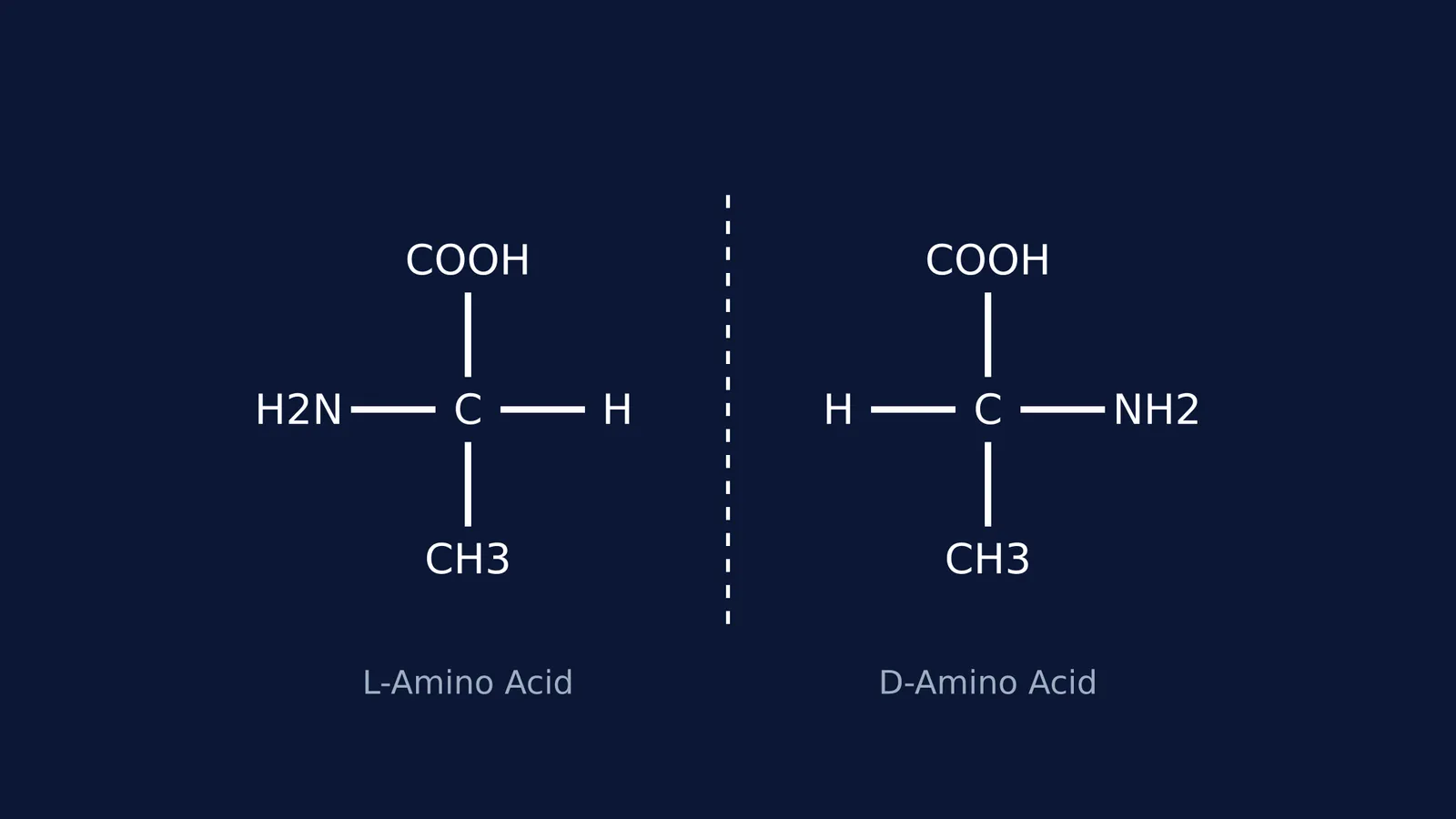
Many amino acids are chiral: they come in two mirror-image forms, known as L (left-handed) and D (right-handed) enantiomers. On Earth, biology is highly selective. Almost all life uses only the L-form of amino acids to build proteins, while sugars are typically found in the D-form. If the meteorite had simply absorbed Earth's microbes or organic matter after it landed, any amino acids found inside would have been almost entirely left-handed.
When the NASA team analysed the Murchison meteorite, they found nearly equal amounts of D and L enantiomers—a 50-50 racemic mixture *Nature*. This split is exactly what happens when molecules form through chemical reactions without the guiding hand of enzymes, which act as highly specific chiral catalysts. The racemic mixture, combined with the presence of unusual amino acids not typically used by Earth life, proved that these compounds formed abiotically in the early solar system.
When you get stuck trying to identify chiral centres or enantiomers, the Fermi Problem Library has worked problems with a step-by-step solver that explains the reasoning rather than printing an answer.
Checklist: Biotic vs abiotic molecules
When researchers analyse organic compounds from space or ancient rocks, they look for specific chemical signatures to rule out modern Earth contamination:
Enantiomer ratio: Biotic sources overwhelmingly prefer one enantiomer (like L-amino acids), while abiotic reactions yield an equal racemic mixture of D and L forms *Nature*.
Molecule variety: Abiotic processes create a wide, chaotic range of molecules, including non-protein amino acids. Biology uses a much narrower set.
Isotope ratios: Extraterrestrial molecules often have different ratios of carbon-13 to carbon-12 or deuterium to hydrogen compared to molecules formed on Earth.
Why do the amino acids in the Murchison meteorite matter?
Before this discovery, the origin of life was largely studied by simulating Earth's early atmosphere. In 1953, the Miller-Urey experiment had shown that sparking a mixture of simple gases like methane, ammonia, and hydrogen could create amino acids in a lab. However, this remained a laboratory simulation, and no one knew for certain if these reactions were common in the wider universe.
The Murchison meteorite provided the first conclusive proof that these same prebiotic reactions actually happened out in the solar system. It showed that the building blocks of life are not unique to Earth, but are widespread throughout the universe. As the solar system was forming, these molecules were already being synthesised in the dust and gas, later to be delivered to the early Earth by falling meteorites and comets.
If you are reviewing organic chemistry or the origins of life and don't know where to start, Fermi's AI tutor works out what you already know and builds a plan for the session.
To read more about the chemistry of life, explore Alexander Oparin and the primordial soup theory of life and Counting stereoisomers from the number of chiral centres.