

On this page
Are all enzymes proteins?
Introductory textbooks often state that all enzymes are proteins folded into complex shapes. Early biochemistry reinforced this view after researchers crystallized digestive enzymes, as seen in our history of James Sumner and the proof that enzymes are proteins. In modern biology, however, that absolute statement is incorrect.
The official NCERT Biology textbook states: "Almost all enzymes are proteins. There are some nucleic acids that behave like enzymes. These are called ribozymes." That qualifier—almost—regularly features in exams like NEET-UG. A ribozyme is an RNA molecule that folds into a defined tertiary shape to catalyze a chemical reaction without being consumed.
What is a ribozyme and what are classic examples?
Catalytic RNA upended molecular biology dogma. In 1982, Thomas Cech and his team reported in *Cell* (Kruger et al., 198290414-7)) that precursor rRNA from *Tetrahymena thermophila* spliced out its own intron without any protein present. In 1983, Sidney Altman and his coworkers showed in *Cell* (Guerrier-Takada et al., 198390117-4)) that the M1 RNA subunit of ribonuclease P cleaved precursor tRNA alone. Cech and Altman shared the 1989 Nobel Prize in Chemistry for discovering RNA catalysis.
Biologists have since documented ribozymes across living organisms:
Peptidyl transferase: 23S rRNA in bacteria and 28S rRNA in eukaryotes that catalyzes peptide bonds.
Spliceosomal snRNAs: U2 and U6 RNAs that remove introns during eukaryotic RNA processing and splicing.
Self-cleaving ribozymes: Small structured RNAs, including hammerhead and hepatitis delta virus ribozymes, that cleave their own backbones.
How does ribosomal RNA catalyze peptide bond synthesis?
For decades, scientists assumed ribosomal proteins catalyzed translation while RNA merely formed a structural scaffold. That assumption crumbled under experimental testing.
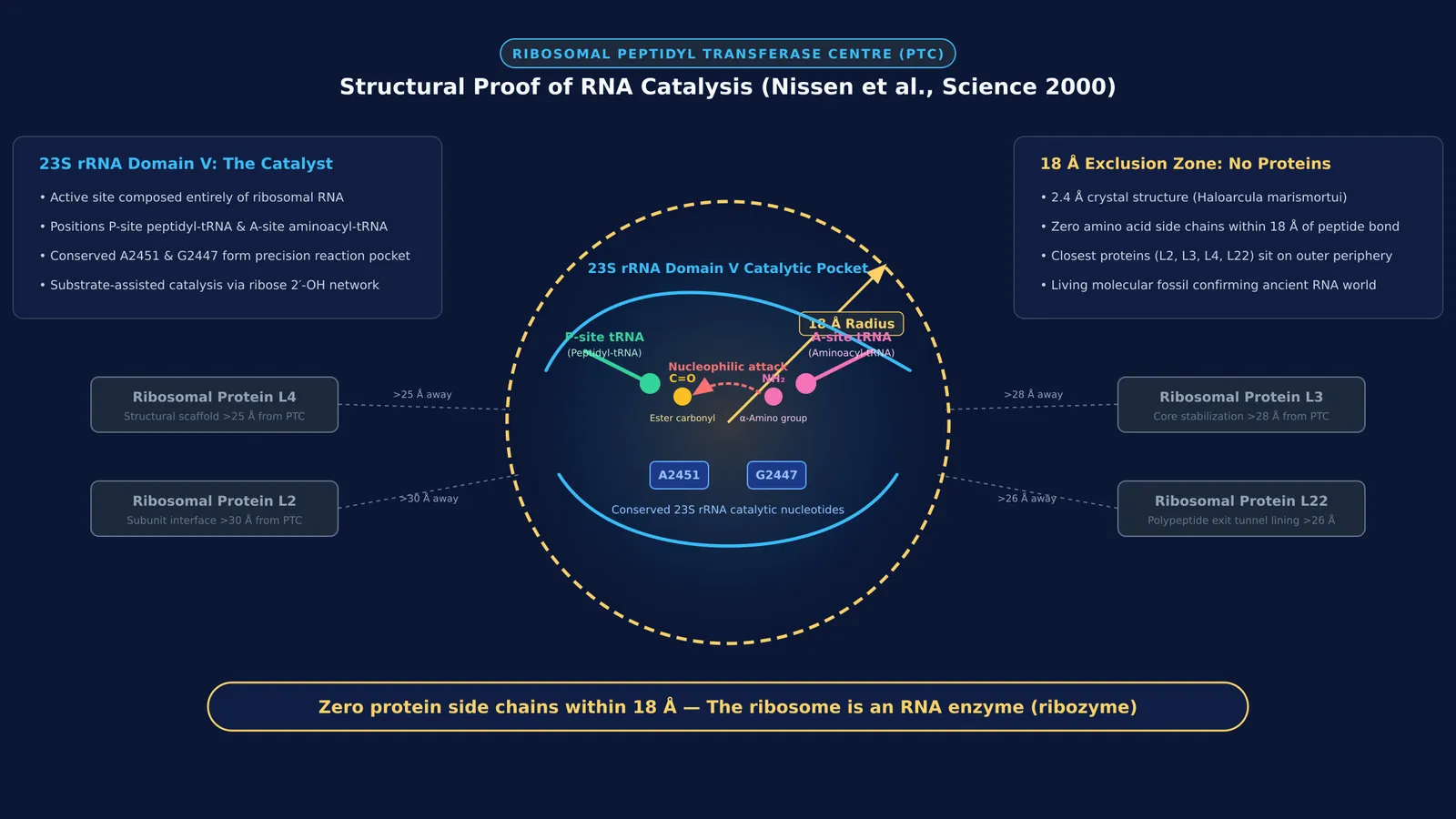
In 1992, Harry Noller and his team reported in *Science* (Noller et al., 1992) that extracting over 95% of ribosomal proteins from *Thermus aquaticus* large subunits left peptide bond synthesis intact, whereas ribonuclease destroyed it. The definitive proof came in 2000, when Thomas Steitz and his colleagues solved the *Haloarcula marismortui* large subunit crystal structure at 2.4 Å resolution, published in *Science* (Nissen et al., 2000).
The crystal structure (Nissen et al., 2000) revealed no amino acid side chains within 18 angstroms of the peptidyl transferase centre. The active site is made entirely of Domain V of 23S rRNA. RNA positions the A-site alpha-amino group to attack the P-site ester carbonyl, as explained in our guide to peptide bonds and dipeptide structures. Steitz, Ada Yonath, and Venkatraman Ramakrishnan shared the 2009 Nobel Prize in Chemistry for this work.
Why does the ribosome point to an ancient RNA world?
Ribozymes resolve early evolution's central riddle: which came first, genetic code or catalytic enzymes? DNA stores instructions but requires protein enzymes to replicate. Proteins catalyze reactions but cannot replicate without nucleic acids.
In 1986, Walter Gilbert proposed in *Nature* (Gilbert, 1986) the RNA world hypothesis, arguing that ancestral RNA carried out both functions before DNA and proteins evolved.
The ribosome is a living molecular fossil of this era. RNA evolved peptide bond synthesis, and proteins were recruited later to stabilize the outer structure. The catalytic core remains an ancient ribozyme.
How should you solve ribozyme questions in exams?
Exam questions on biomolecules in the NCERT Biology syllabus frequently test definitions and exceptions. Use this 4-step checklist:
Check the quantifier: "All enzymes are proteins" is false; "almost all enzymes are proteins" is correct.
Identify the catalytic chemical: Bacterial peptidyl transferase is 23S rRNA, a ribozyme.
Map the subunit: 23S rRNA sits in the prokaryotic 50S subunit; 28S rRNA sits in the eukaryotic 60S subunit.
Link to the RNA world: Ribozymes demonstrate that catalytic activity preceded the evolution of proteins.
Worked exam problem: Assertion and Reason
Assertion (A): Peptide bond synthesis in bacteria is catalyzed by a protein enzyme in the large ribosomal subunit.
Reason (R): 23S rRNA acts as a ribozyme with peptidyl transferase activity.
Step-by-step solution:
Assertion (A) is false: peptidyl transferase is RNA (23S rRNA), not a protein.
Reason (R) is true: 23S rRNA catalyzes peptide bond synthesis.
Conclusion: Assertion is false, but Reason is true.
Connecting these concepts helps you build a solid foundation across molecular biology. The Fermi Concept Library offers every concept in physics, chemistry, biology, mathematics and computing, each with its own lesson and its place in the map. For worked problems, the Fermi Problem Library provides worked problems with a step-by-step solver that explains the reasoning rather than printing an answer.


