On this page
About three hundred years before NCERT put the angle sum of a triangle into a Class 7 textbook, a scholar in Jaipur was proving it in Sanskrit. He was Samrat Jagannatha, and his book was the Rekhaganita, a Sanskrit version of Euclid's Elements. Here is one of his proofs, translated, next to the one you study in school.
Who translated Euclid's Elements into Sanskrit?
The Biographical Encyclopedia of Astronomers entry calls Jagannatha the famous guru of Sawai Jai Singh. It says he translated Euclid's Elements into Sanskrit in 1719, and that the work is called the Rekhaganita. Another account, from MacTutor at the University of St Andrews, notes that a scribe dated his copy to 1727, so the translation was finished by then at the latest. He worked in a group of mathematicians and astronomers Jai Singh gathered around him.
The Wikipedia article on Jagannatha Samrat cites K. V. Sarma's encyclopedia entry for the point that he had to coin more than a hundred Sanskrit mathematical terms for the job.
How did Euclid reach Jaipur in Arabic, not Greek?
Jagannatha did not work from Greek. MacTutor says his source was Nasir al-Din al-Tusi's Arabic translation of the Elements, made nearly 500 years earlier, and Sarma's entry, as cited on Wikipedia, agrees. The BEA entry says his major astronomy work was based on al-Tusi's version of Ptolemy's Almagest. China's version came through a different route, which you can compare in our story on how Xu Guangqi translated Euclid into Chinese.
You can see the Arabic route on the page itself. The 1901 Bombay Sanskrit Series edition, edited by K. P. Trivedi, labels its figures अ, ब, ज, द, ह. That matches the opening of the Arabic abjad order: alif, ba, jim, dal, ha. Each proposition is called a kshetra, a figure.
What does the Rekhaganita's angle-sum proof say?
It is the 32nd kshetra, on pages 50 and 51 of the scanned 1901 edition. Here is our close translation, with ज written as C so it matches the school figure.
The statement: extend one side of any triangle. The angle standing outside equals the sum of the two inside angles facing it. The three inside angles together also equal two right angles.
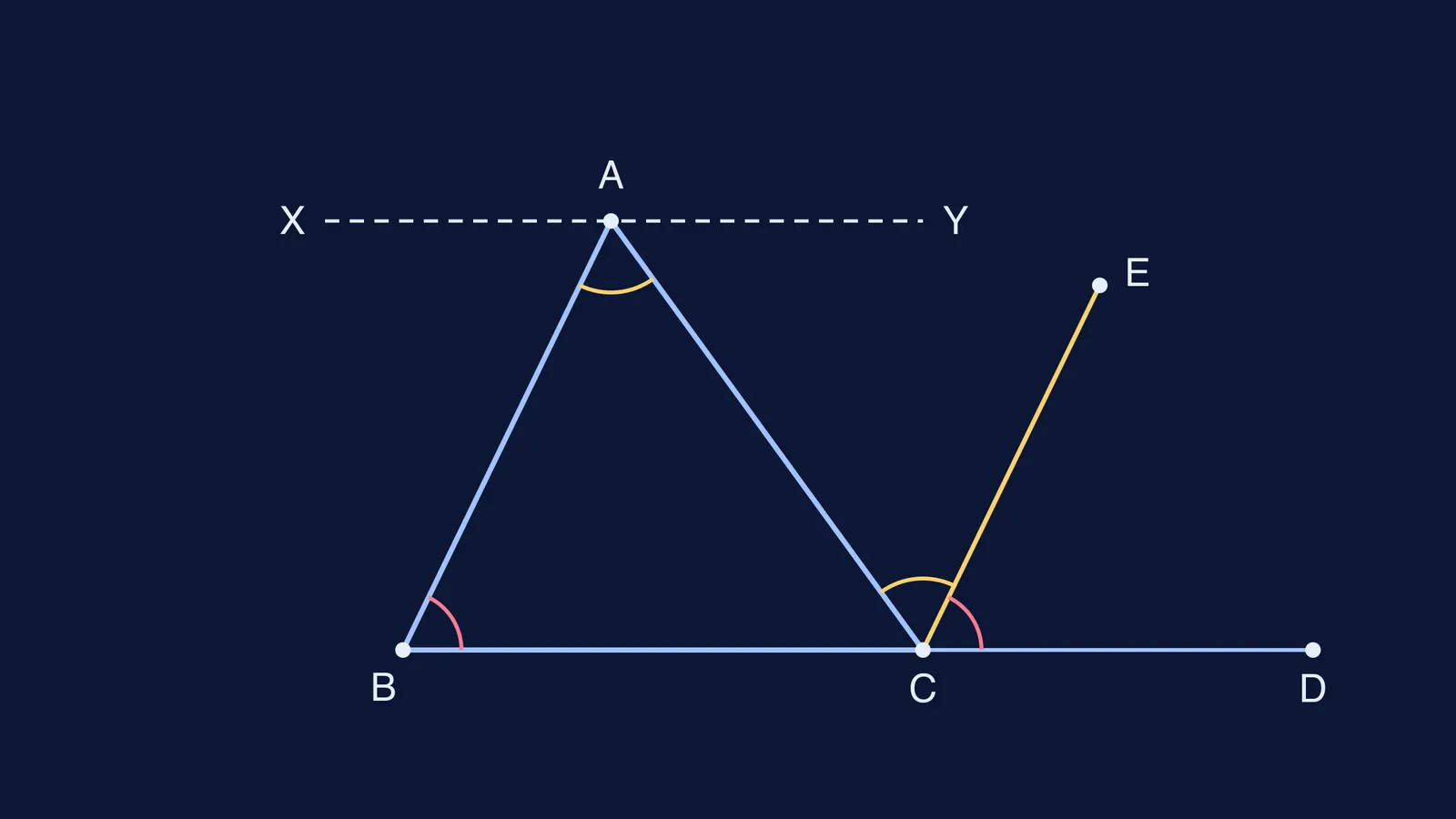
The proof, in triangle ABC with side BC extended to D:
From C, draw line CH parallel to BA.
Angle ACH equals angle BAC.
Angle HCD equals angle B.
So the outside angle ACD equals angle A plus angle B.
Angle ACD together with angle ACB makes two right angles, so the three inside angles make two right angles.
It ends with इदमेवास्माकमभीष्टम्, roughly this is just what we wanted, the Sanskrit equivalent of QED. This matches Proposition 32 of Book I in David Joyce's edition of Euclid, where CE is drawn through C parallel to AB.
Then comes a line marked प्रकारान्तरम्, another method. Draw a line through A parallel to the base BD, and the same angles fall out.
How is it different from the NCERT proof?
In NCERT's Ganita Prakash for Grade 7, Chapter 7 (Reprint 2026-27, pages 165 to 167), you draw line XY through A parallel to BC. Angle B equals angle XAB and angle C equals angle YAC, as alternate angles. The three angles at A sit on a straight line, so they add to 180°. The book says this idea can be found in Euclid's Elements.
Where the parallel goes. Jagannatha's main proof puts it at C, parallel to AB. NCERT puts it at A, parallel to BC, which is Jagannatha's another method.
What comes first. The Rekhaganita proves the exterior angle first and gets the angle sum from it. NCERT proves the angle sum first and asks you to find the exterior angle rule afterwards.
Units. Two right angles, not 180°. Same thing, older language.
Angle facts used. The main proof needs one alternate pair and one corresponding pair. NCERT's needs two alternate pairs.
For a slower walk through the school version, see our explainer on the angle sum proof using a parallel line.
How can you use two versions of one proof to study?
Proving one result two ways tests whether you understand it or only remember it. Try this:
Draw a large triangle ABC and extend BC to D.
Prove the angle sum with the parallel through C, the Rekhaganita way, without looking.
Prove it again with the parallel through A, the NCERT way.
Next to every equals sign, write the reason: alternate angles, corresponding angles, or angles on a straight line.
Say aloud why the extra line has to be parallel, not just any line.
Parents can help with one question: which angle equals which, and why? If the answer is it looks equal, step 4 needs more work. If alternate and corresponding angles keep getting mixed up, the Fermi Concept Library has a lesson on each concept in mathematics. For the ground rules Euclid starts from, read our piece on Euclid's axioms vs postulates.