On this page
Finding the values of k that give a system a unique solution takes one calculation: the determinant. Separating no solution from infinitely many takes a second check, and that check has a trap.
How do you find k for which a system has a unique solution?
Write the system as AX = B, with A the coefficient matrix and B the constants. The NCERT Class 12 Mathematics textbook (Chapter 4, Determinants, section 4.6.1) says that if A is nonsingular, its inverse exists and X = A⁻¹B gives a unique solution (NCERT Class 12 Mathematics, Chapter 4).
So the method is short:
Write det A as an expression in k.
Factorise it and find the values of k that make it zero.
Every other value of k gives a unique solution.
In the same chapter, NCERT defines a system as consistent if it has at least one solution, and inconsistent if it has none.
What happens when det A = 0?
NCERT's rule in section 4.6.1 has two branches. First, compute (adj A)B. If (adj A)B ≠ O, the system is inconsistent and has no solution. If (adj A)B = O, the textbook says the system "may be either consistent or inconsistent", which means it has either infinitely many solutions or none.
Students often misremember this as "(adj A)B = O means infinitely many solutions". You still have to look at the equations.
Worked example: kx + y + z = 1, x + ky + z = 1, x + y + kz = 1
The question: for which values of k does this system have a unique solution, no solution, or infinitely many solutions?
Step 1 is the determinant. Expand along the first row: det A = k(k² − 1) − 1(k − 1) + 1(1 − k) = k³ − 3k + 2.
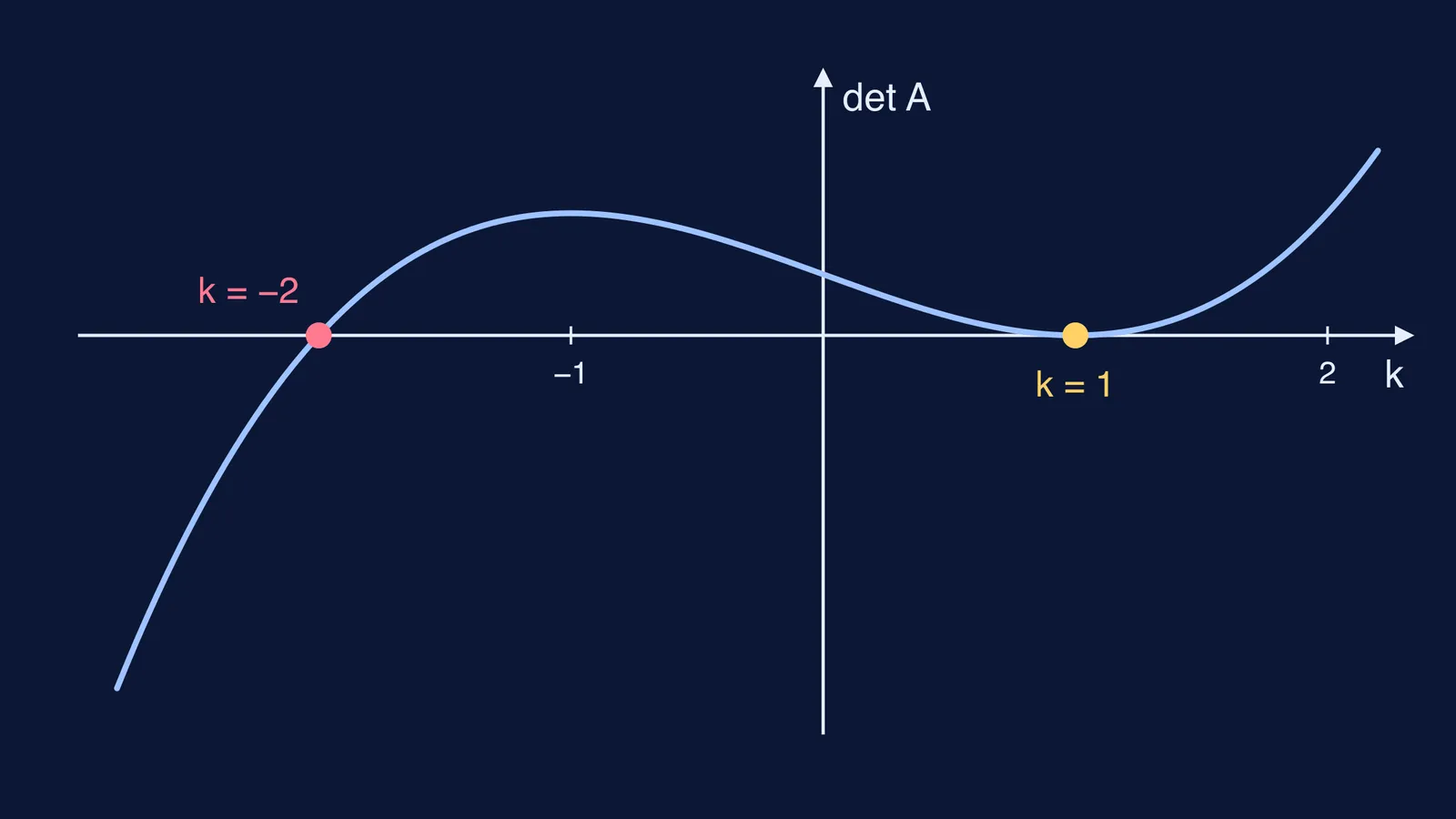
Since k = 1 makes this zero, (k − 1) is a factor, and dividing gives k³ − 3k + 2 = (k − 1)²(k + 2). So det A = 0 only when k = 1 or k = −2.
Step 2 is the unique-solution case. For every k except 1 and −2, there is exactly one solution, so any solution you find is the solution. The equations are symmetric, so try x = y = z = t. Then kt + 2t = 1, which gives t = 1/(k + 2). To check, substitute into any equation: k/(k + 2) + 2/(k + 2) = 1.
Step 3 tests k = −2. The rows of A are (−2, 1, 1), (1, −2, 1) and (1, 1, −2). Each of the nine cofactors works out to 3. For example, A₁₁ = (−2)(−2) − (1)(1) = 3 and A₁₂ = −[(1)(−2) − (1)(1)] = 3. So every entry of adj A is 3, and (adj A)B = (9, 9, 9), which is not O. There is no solution.
To cross-check, add the three equations. The left side becomes 0 and the right side becomes 3, which is impossible.
Step 4 tests k = 1. All three equations become x + y + z = 1. Every 2×2 minor of the all-ones matrix is 0, so adj A = O and (adj A)B = O. On its own, that only tells you "infinitely many or none", so look at the system itself. It is really one equation. You can choose any y and z and set x = 1 − y − z, so there are infinitely many solutions.
Answer: the solution is unique for k ≠ 1 and k ≠ −2, there is no solution for k = −2, and there are infinitely many solutions for k = 1.
On a graph of det A = (k − 1)²(k + 2), the curve crosses the k-axis at −2 and only touches it at 1, the repeated root.
What mistakes cost marks on this question?
Cancelling (k − 1) while simplifying and losing a root. Factorise fully instead of dividing.
Stopping at "(adj A)B = O, so infinitely many". Check the equations, as in the callout above.
Sign errors in cofactors. The checkerboard of + and − signs decides A₁₂, A₂₁ and the rest.
Writing "k ≠ 1 or k ≠ −2". The correct condition is k ≠ 1 and k ≠ −2.
For cofactor practice, see finding the inverse of a 3×3 matrix using the adjoint. For a worked problem with two parameters, λ and μ, read consistency of linear equations by the matrix method, and for the unique case without an inverse, try Cramer's rule for a three-variable system.
For more parameter questions, the Fermi Problem Library has worked problems with a step-by-step solver that explains the reasoning rather than printing an answer, so you can see where a sign or a factor went wrong. If singular matrices or adjoints still feel shaky, the Fermi Concept Library gives each concept its own lesson.